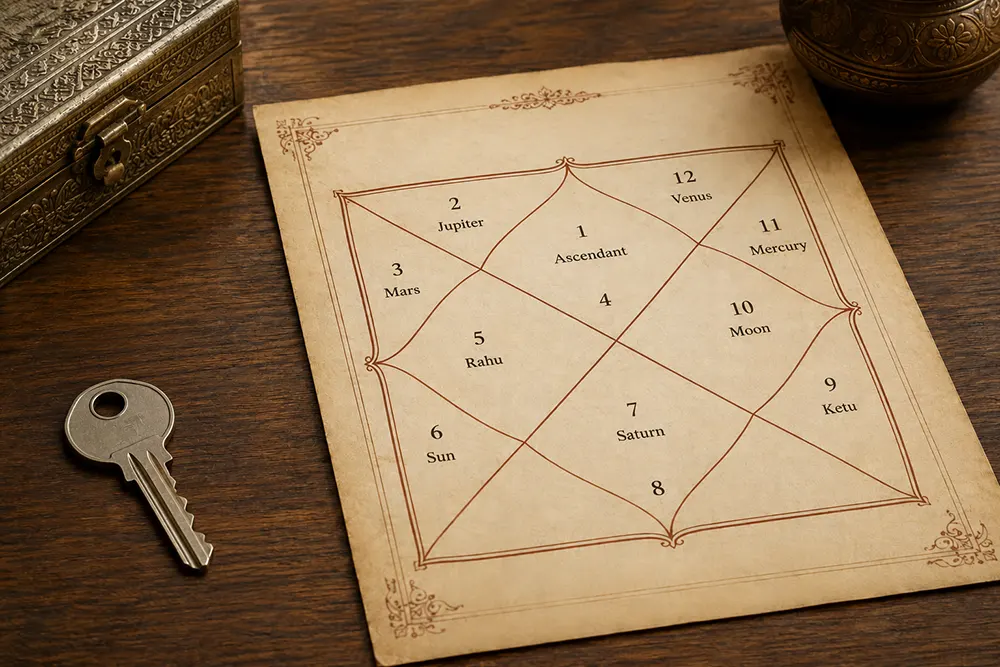

For Leo Ascendant, Ketu represents detachment, past-life mastery, and inner withdrawal working through the fiery, expressive, and authority-driven energy of the Sun. Leo seeks recognition, leadership, identity, and creative self-expression, while Ketu dissolves ego attachment and reduces interest in external validation. This creates a powerful internal contrast. The native may appear confident and authoritative, yet internally feel detached from praise, status, or attention.
Ketu does not remove results completely. Instead, it reduces emotional investment and pushes the native toward inner clarity and spiritual understanding. Its results depend largely on the strength of the Sun, the Ascendant lord. When the Sun is strong, Ketu gives humility, self-awareness, and wise leadership. When the Sun is weak, it can create identity confusion, lack of direction, or ego imbalance. Let us explore how Ketu behaves in each house for Leo Ascendant.
Ketu in 1st House for Leo Ascendant
When Ketu is placed in the 1st house for Leo Ascendant, it occupies Leo, the sign ruled by the Sun, making the condition of the Sun particularly important in determining how Ketu manifests. The 1st house represents the body, personality, appearance, vitality, self-image and sense of individuality, while Ketu signifies detachment, inwardness, spiritualization, past conditioning and disinterest in ordinary forms of worldly validation. This combination can create an interesting contrast because Leo naturally seeks self-expression, recognition and a clearly defined identity, while Ketu tends to withdraw from the very areas it influences. The native may therefore appear confident or self-possessed externally while experiencing periods of uncertainty about personal identity or direction internally. There can be less attachment to praise, status and social approval than might ordinarily be expected from a Leo Ascendant. The person may become uncomfortable with excessive attention and may prefer to work according to personal conviction rather than constantly seeking recognition. Ketu can also give an observant and somewhat detached quality to the personality, with the native watching circumstances carefully before becoming involved. In some cases, this may create a feeling of being different from others or of not fitting comfortably into conventional expectations. The condition of the Sun becomes especially important because the Sun is both the Lagna lord and dispositor of Ketu. A strong Sun can give Ketu a stable foundation for expressing individuality, while an afflicted Sun may make the detachment manifest more strongly as uncertainty about identity or recognition.
Ketu from the 1st house casts its 5th aspect on the 5th house in Sagittarius, its 7th aspect on the 7th house in Aquarius and its 9th aspect on the 9th house in Aries. Its 5th aspect on the 5th house connects Ketu’s detachment with intelligence, education, creativity, romance, children, mantra and Purva Punya. The native may approach knowledge in a highly intuitive or unconventional manner and may become less interested in education pursued solely for status or recognition. There can also be a natural attraction toward spiritual knowledge, mantra, philosophy or subjects that provide insight into deeper realities. Its 7th aspect on the 7th house creates an important 1st-house and 7th-house axis, potentially making the native less dependent upon relationships for defining personal identity. Partnerships can still be significant, but the person may require considerable personal space and may resist relationships that demand complete emotional or psychological dependence. Ketu’s 9th aspect on the 9th house connects the personality with Dharma, higher knowledge, teachers and spirituality. This can encourage independent spiritual inquiry and a tendency to seek direct understanding rather than relying entirely upon external authority. Jupiter, as 5th and 8th lord and natural significator of higher knowledge, can influence how constructively this inclination develops, while Saturn as 7th lord influences the partnership dimension of Ketu’s axis.
The deeper expression of Ketu in the 1st house is the gradual discovery of an identity that does not depend upon applause. The native may initially struggle with questions of self-definition or wonder why conventional achievements do not always provide the satisfaction expected from them. Over time, this can become a significant spiritual strength because the person learns to distinguish genuine self-confidence from the need to be admired. Leadership can therefore become quieter and more principle-driven, with influence arising from competence, insight and personal conviction rather than constant self-promotion. However, detachment should not become indifference toward legitimate responsibilities or relationships. The person benefits from maintaining healthy engagement with worldly duties while allowing inner development to proceed independently of external recognition. The placement can support meditation, spiritual study, introspection, astrology, metaphysics and other disciplines that encourage self-inquiry, particularly when Jupiter, the 5th house and 9th house are supportive. The final results depend upon Ketu’s Nakshatra lord, conjunctions and aspects, the condition of the Sun as dispositor and Lagna lord, Jupiter, the 1st, 5th, 7th and 9th houses, and relevant Dashas. When well supported, Ketu in the Leo Ascendant can gradually transform uncertainty about identity into authentic self-possession, allowing the native to exercise leadership without becoming excessively dependent upon recognition, status or the approval of others.
Ketu in 2nd House for Leo Ascendant
When Ketu is placed in the 2nd house for Leo Ascendant, it occupies Virgo, ruled by Mercury, while the 2nd house represents accumulated wealth, family, speech, food, values and material resources. Ketu tends to create detachment from the matters of the house it occupies, so the native may not develop the same attachment to wealth, possessions or conventional family values that others may exhibit. The person can earn and accumulate resources, but material acquisition may not provide lasting satisfaction, particularly when compared with the importance they place on knowledge, independence or spiritual understanding. There may also be a feeling of being somewhat different from the family’s established traditions or values. This does not necessarily indicate separation from family, but the native may develop a personal value system that differs from what was inherited. Speech can become another important expression of Ketu. The person may speak less, choose words carefully or communicate in a direct, analytical and sometimes detached manner. At its higher expression, this can produce speech that is precise and philosophical, with little interest in unnecessary conversation. Since Mercury rules both the 2nd and 11th houses for Leo Ascendant and is the dispositor of Ketu, its strength becomes particularly important for determining wealth, speech and family matters. A strong Mercury can help convert Ketu’s detachment into discrimination and intelligent resource management, while affliction can produce inconsistency in financial planning or communication.
Ketu from the 2nd house casts its 5th aspect on the 6th house in Capricorn, its 7th aspect on the 8th house in Pisces and its 9th aspect on the 10th house in Taurus. Its 5th aspect on the 6th house connects accumulated resources and speech with service, competition, debts and practical responsibilities. The native may prefer solving financial or professional problems independently and may have little patience for unnecessary disputes. Its 7th aspect on the 8th house creates a strong connection between personal wealth and joint resources, inheritance, taxation and hidden financial matters. This can produce detachment from dependence upon other people’s resources, although joint finances still require careful management and clear agreements. Ketu’s 9th aspect on the 10th house connects speech, family values and accumulated wealth with profession and public reputation. The native may eventually develop a professional identity based more on expertise and meaningful contribution than on financial status alone. Communication can become an important professional strength when the person learns to express Ketu’s concise and analytical nature constructively. Since Venus is the 10th lord and Mars is the Yoga Karaka for Leo Ascendant, their condition can further determine how this detachment from material accumulation affects career and worldly responsibilities. The Sun, as Lagna lord, also remains important because it represents the native’s broader sense of purpose and identity.
The deeper lesson of Ketu in the 2nd house is learning to use material resources without becoming psychologically dependent upon them. The native may gradually realize that wealth is necessary for stability and responsibility even if it does not provide lasting fulfilment. This can produce a relatively simple attitude toward possessions, but excessive detachment can become impractical if the person neglects savings, family responsibilities or long-term financial planning. Developing disciplined financial habits is therefore important. The relationship with family should also be understood carefully. Ketu can create differences in values, communication styles or emotional involvement, but it does not by itself establish family separation or conflict. The person may instead become the one who questions inherited assumptions and introduces a different perspective into the family. Speech can similarly become a source of wisdom when honesty is combined with consideration, because bluntness without sensitivity can create unnecessary distance. The final results depend upon Ketu’s Nakshatra lord, conjunctions and aspects, the condition of Mercury as dispositor and 2nd and 11th lord, the Sun as Lagna lord, Venus as 10th lord, and the 2nd, 6th, 8th, 10th and 11th houses and relevant Dashas. When well supported, Ketu in the 2nd can reduce excessive attachment to wealth and status while giving the native a discerning approach to resources and a distinctive, concise and potentially profound style of speech.
Ketu in 3rd House for Leo Ascendant
When Ketu is placed in the 3rd house for Leo Ascendant, it occupies Libra, ruled by Venus, while the 3rd house represents courage, initiative, self-effort, communication, writing, younger siblings, practical skills and short journeys. Ketu’s nature of detachment can reduce the native’s desire to constantly prove themselves through competition, attention or visible displays of courage. The person may possess considerable skills and ability but feel little need to advertise them or seek recognition for every accomplishment. Rather than acting purely to demonstrate superiority, the native may prefer to work independently and allow results to speak for themselves. This can produce a quiet form of courage in which action comes from inner conviction rather than the desire for applause. Since the 3rd house is an Upachaya, Ketu’s results can become clearer through experience as the native learns which efforts are genuinely meaningful. Communication may be selective, concise or contemplative, and there can be an attraction toward writing, research, documentation, philosophy or subjects requiring independent investigation. Because Venus rules both Libra and the 3rd and 10th houses for Leo Ascendant, its condition becomes especially important. A strong Venus can channel Ketu’s detachment into creative or professional communication, while affliction may make the native withdraw excessively or lose interest in developing practical skills.
Ketu from the 3rd house casts its 5th aspect on the 7th house in Aquarius, its 7th aspect on the 9th house in Aries and its 9th aspect on the 11th house in Gemini. Its 5th aspect on the 7th house connects self-effort and communication with marriage, business partnerships and public dealings. The native may prefer relationships in which both individuals retain independence rather than depending excessively upon one another, although Ketu can also create periods when the person withdraws from partnership communication. Its 7th aspect on the 9th house connects personal effort with Dharma, higher knowledge, teachers and philosophy. This can encourage the native to seek knowledge independently and develop beliefs through personal investigation rather than simply accepting inherited doctrines. Ketu’s 9th aspect on the 11th house connects communication and enterprise with gains, networks and fulfilment of desires. The person may be selective about professional networks and may not feel compelled to maintain social connections purely for material advantage. Mercury, as the 2nd and 11th lord, becomes important for determining how Ketu’s detached communication style affects income and networks. The Sun, as Lagna lord, also helps determine whether the native’s independence becomes constructive self-confidence or unnecessary withdrawal from worldly engagement.
The deeper expression of Ketu in the 3rd house is learning to act without requiring constant external confirmation. The native may become increasingly comfortable pursuing a path simply because it appears meaningful, even when it does not provide immediate recognition. This can be particularly favourable for introspective writing, research, spiritual study, independent creative work and specialized communication, where depth matters more than popularity. Relationships with younger siblings may carry a sense of distance, unusual circumstances or karmic responsibility, but such outcomes require examination of Venus, the 3rd house, its lord and relevant Dashas rather than Ketu alone. The native should also avoid confusing detachment with avoidance. The 3rd house represents effort and skill development, and genuine independence still requires consistent practice. Developing courage to communicate clearly, maintain necessary relationships and complete practical responsibilities allows Ketu’s inward orientation to become productive. The final results depend upon Ketu’s Nakshatra lord, conjunctions and aspects, the condition of Venus as dispositor and 3rd and 10th lord, the Sun as Lagna lord, Mercury, and the 3rd, 7th, 9th, 10th and 11th houses and relevant Dashas. When well supported, Ketu in the 3rd can give quiet courage, independent initiative and a thoughtful communication style, allowing the native to act from purpose rather than the need to prove themselves or obtain constant recognition.
Ketu in 4th House for Leo Ascendant
When Ketu is placed in the 4th house for Leo Ascendant, it occupies Scorpio, ruled by Mars, while the 4th house represents mother, home, property, vehicles, education, emotional security and inner happiness. Ketu tends to create detachment from the matters of the house it occupies, and in the 4th house this can produce a sense that external comforts do not completely satisfy the native’s deeper emotional needs. The person may feel somewhat disconnected from their birthplace, family environment or established roots, even when there is no obvious physical separation. Domestic life may have an unusual quality, or the native may periodically feel the need for privacy and personal space within the home. Since Scorpio is a fixed and intense sign, Ketu’s detachment can operate internally rather than always appearing as visible withdrawal. The native may carry emotions deeply but find it difficult to explain them or derive lasting peace from conventional forms of emotional security. The relationship with the mother can also feel unusual or emotionally complex, although Ketu alone cannot establish separation or difficulty and the Moon, 4th lord Mars and 4th house must be examined. Mars is particularly important because it rules Scorpio and is also the 4th and 9th lord and Yoga Karaka for Leo Ascendant. A strong Mars can give the native greater stability in practical domestic matters while allowing Ketu to produce healthy emotional independence. An afflicted Mars may instead increase restlessness, dissatisfaction or difficulty feeling rooted.
Ketu from the 4th house casts its 5th aspect on the 8th house in Pisces, its 7th aspect on the 10th house in Taurus and its 9th aspect on the 12th house in Cancer. Its 5th aspect on the 8th house connects emotional security with transformation, hidden knowledge, joint resources and psychological depth. This can encourage the native to investigate the deeper causes of emotional experiences and may create an interest in astrology, occult subjects, psychology or spiritual disciplines. Its 7th aspect on the 10th house creates a direct connection between home and career. The native may not define success purely through professional status and may periodically reassess whether career achievements are actually providing inner satisfaction. Career choices can also involve unusual environments or a desire for greater independence when Venus, the 10th lord, supports such indications. Ketu’s 9th aspect on the 12th house strengthens the connection between domestic detachment and solitude, foreign environments, meditation, spiritual retreat and Moksha. Periods of withdrawal may therefore become important for restoring emotional balance. The Moon, as natural significator of the mind and mother, becomes particularly important in assessing how this placement affects emotional life, while Mars as dispositor determines how effectively the native can establish practical security without becoming dependent upon it.
The deeper lesson of Ketu in the 4th house is learning that inner peace cannot always be created through external arrangements. The native may acquire a comfortable home, property or other material forms of security and still experience an unexplained sense of incompleteness. Rather than indicating that material comforts are inherently undesirable, Ketu encourages the person to understand their limitations and develop emotional stability independent of circumstances. Solitude, meditation, spiritual study and introspection can therefore become valuable methods of reconnecting with the inner self. Education may also take an unconventional direction, particularly when Ketu influences Mercury, Jupiter or the 5th house, although the complete educational picture must be examined. The native may eventually develop considerable emotional independence and become less affected by changes in surroundings, but should avoid turning detachment into emotional suppression or refusing legitimate human connection. The final results depend upon Ketu’s Nakshatra lord, conjunctions and aspects, the condition of Mars as dispositor and 4th and 9th lord, the Moon, Venus as 10th lord, and the 4th, 8th, 10th and 12th houses and relevant Dashas. When well supported, Ketu in the 4th can transform dissatisfaction with external security into a profound search for inner peace, allowing the native to develop a stable centre within themselves rather than depending entirely upon home, possessions or circumstances for emotional fulfilment.
Ketu in 5th House for Leo Ascendant
When Ketu is placed in the 5th house for Leo Ascendant, it occupies Sagittarius, ruled by Jupiter, while the 5th house represents intelligence, education, creativity, romance, children, speculation, mantra and Purva Punya. Ketu’s detaching influence can reduce the native’s interest in using these areas primarily for recognition, admiration or personal validation. The person may possess considerable creative or intellectual ability but may not feel compelled to display it constantly or seek applause for their accomplishments. In romance, there can be a reserved or unconventional approach to emotional expression, with the native preferring depth and meaningful connection over superficial displays of affection. Relationships may become important vehicles for self-understanding, although Ketu can create periods of emotional distance or uncertainty when the native withdraws too quickly. Creativity may similarly become more philosophical, contemplative or research-oriented rather than purely performative. Since Ketu occupies Jupiter’s sign, the condition of Jupiter, which rules both Sagittarius and the 5th and 8th houses for Leo Ascendant, is especially important. A strong Jupiter can transform Ketu’s detachment into wisdom, discrimination and spiritual intelligence, while affliction may produce excessive withdrawal from creative or emotional expression. The 5th house is also a Trikona associated with Purva Punya, making Ketu’s placement here significant for the native’s relationship with knowledge, intuition and spiritual subjects.
Ketu from the 5th house casts its 5th aspect on the 9th house in Aries, its 7th aspect on the 11th house in Gemini and its 9th aspect on the 1st house in Leo. Its 5th aspect on the 9th house creates a strong connection between the 5th and 9th houses, both important houses of Dharma, higher knowledge and spiritual development. This can give a natural inclination toward philosophy, mantra, astrology, metaphysics or other subjects concerned with deeper understanding. The native may prefer direct investigation and personal experience over accepting doctrines simply because they are traditional. Its 7th aspect on the 11th house connects intelligence and creativity with gains and social networks. The person may be selective about using creative abilities for commercial recognition and may prefer meaningful projects over activities pursued solely for popularity. Ketu’s 9th aspect on the Lagna connects intelligence, spirituality and introspection directly with personality. This can make the native inwardly thoughtful and less dependent upon external praise. Jupiter becomes particularly significant because it is both the dispositor of Ketu and the 5th lord. Its condition can determine whether Ketu’s detachment manifests as genuine wisdom or as unnecessary disengagement from education, creativity or emotional life. The Sun, as Lagna lord, also influences how confidently the native expresses these qualities.
The 5th house also governs children, and Ketu can make experiences involving children particularly meaningful or unusual. There may be a strong sense of responsibility, emotional distance at certain stages or experiences that encourage the native to reconsider attachment and expectations, but childbirth or the number and nature of children cannot be judged from Ketu alone. Jupiter, the 5th lord and Putra Karaka, the 5th house and relevant Dashas must be examined comprehensively. Similarly, romance should not automatically be described as unsuccessful because Ketu is here. Instead, the native may gradually become less interested in relationships that depend heavily upon admiration or emotional validation and more interested in authentic connection. Speculation should be approached cautiously because Ketu can reduce attachment to material outcomes while simultaneously making judgement less predictable. The higher expression of the placement lies in directing intelligence toward research, spiritual study, mantra, philosophy and deeper forms of knowledge. The final results depend upon Ketu’s Nakshatra lord, conjunctions and aspects, the condition of Jupiter as dispositor and 5th and 8th lord, the Sun as Lagna lord, the 5th, 9th and 11th houses, Venus for romantic relationships and relevant Dashas. When well supported, Ketu in the 5th can produce profound intuitive intelligence and a contemplative creative nature, allowing the native to transform detachment from recognition into genuine wisdom and spiritually meaningful self-expression.
Ketu in 6th House for Leo Ascendant
When Ketu is placed in the 6th house for Leo Ascendant, it occupies Capricorn, ruled by Saturn, while the 6th house represents enemies, debts, disease, disputes, competition, service and daily responsibilities. Ketu’s detaching and separating nature can function constructively in this house because it reduces excessive attachment to conflict and worldly obstacles. The native may possess an ability to confront difficult circumstances without becoming emotionally consumed by them, particularly when competition requires patience and strategic action. Rather than feeling compelled to defeat every rival for personal validation, the person may simply focus on solving the problem and moving forward. This can give a quiet form of resilience and make the native effective in situations where others become overwhelmed by pressure. Since the 6th house is an Upachaya, results can improve through experience, and Ketu may help the native develop an increasingly detached and practical approach toward challenges. Because Ketu occupies Saturn’s sign, the condition of Saturn, which rules the 6th and 7th houses for Leo Ascendant, becomes particularly important. A strong Saturn can provide structure and discipline to Ketu’s instinctive problem-solving ability, while affliction may create avoidance of necessary responsibilities or inconsistent engagement with practical matters. The placement can support service-oriented professions, healing disciplines, research, administration, technical work and other occupations requiring the ability to deal with difficult problems without excessive emotional involvement.
Ketu from the 6th house casts its 5th aspect on the 10th house in Taurus, its 7th aspect on the 12th house in Cancer and its 9th aspect on the 2nd house in Virgo. Its 5th aspect on the 10th house connects service, problem-solving and competition with profession and public reputation. The native may become respected for specialized skills or for handling difficult assignments without seeking excessive recognition. This can be useful in medicine, healing, law, administration, investigation, technical work and other fields where practical competence matters, provided the 10th lord Venus and other career factors support these indications. Its 7th aspect on the 12th house connects the 6th house with foreign environments, institutions, expenditure, isolation and spiritual service. This can support work in hospitals, charitable organizations, research institutions or foreign settings when corroborated by the 9th and 12th houses. Ketu’s 9th aspect on the 2nd house connects service and conflict resolution with wealth, speech and family resources. The native may prefer straightforward communication and may be less interested in using wealth or status to establish superiority over others. Saturn, as dispositor, is central to the interpretation, while Mars, the Yoga Karaka for Leo Ascendant, can provide additional strength in handling competition when favourably placed. The Sun as Lagna lord also helps determine whether Ketu’s detachment becomes calm confidence or excessive withdrawal.
The higher expression of Ketu in the 6th house is learning to serve and solve problems without allowing ego to dominate the process. The native may become particularly effective in difficult environments because they are capable of separating the practical problem from the emotional reaction surrounding it. This can be valuable in professions where service, healing, investigation or crisis management is required. Health should nevertheless be considered carefully. Ketu in the 6th can reduce attachment to bodily concerns, but it does not guarantee freedom from illness, and the condition of the Lagna, Sun, Moon, 6th lord and relevant Dashas must be examined before drawing health conclusions. The native benefits from disciplined routines because Ketu can sometimes produce irregularity or neglect of ordinary maintenance. Similarly, victory over enemies should not be interpreted as a literal guarantee that every dispute will be won. Rather, the placement can provide an ability to disengage from unnecessary conflict and focus on practical resolution. The final results depend upon Ketu’s Nakshatra lord, conjunctions and aspects, the condition of Saturn as dispositor and 6th lord, the Sun as Lagna lord, Venus as 10th lord, the 2nd, 6th, 10th and 12th houses and relevant Dashas. When well supported, Ketu in the 6th can give considerable resilience, strategic detachment and an effective approach to obstacles, allowing the native to overcome challenges through humility, discipline and service rather than through the constant need to prove superiority.
Ketu in 7th House for Leo Ascendant
When Ketu is placed in the 7th house for Leo Ascendant, it occupies Aquarius, ruled by Saturn, while the 7th house represents marriage, spouse, business partnerships, contracts, public dealings and relationships with people outside the immediate family. Ketu tends to create detachment from the matters it influences, and in the 7th house this can reduce the native’s dependence upon relationships for emotional validation or personal identity. The person may value companionship but simultaneously require considerable independence within a relationship. There can be a tendency to feel that ordinary romantic or material expectations do not completely satisfy them, leading them to seek a deeper intellectual, philosophical or spiritual basis for partnership. A spouse may possess reserved, unconventional or spiritually inclined qualities, although such characteristics require support from Saturn, Venus, Jupiter, the Navamsha and other marriage indicators. The native may also experience periods in which relationships feel difficult to define or emotionally distant, particularly if the 7th lord Saturn or Venus is afflicted. Since Saturn rules Aquarius and is both the 6th and 7th lord for Leo Ascendant, its condition becomes especially important. A strong Saturn can give structure and maturity to Ketu’s detachment, allowing the native to maintain a committed relationship without excessive dependence, while affliction can manifest as withdrawal, dissatisfaction or difficulty sustaining emotional involvement.
Ketu from the 7th house casts its 5th aspect on the 11th house in Gemini, its 7th aspect on the 1st house in Leo and its 9th aspect on the 3rd house in Libra. Its 5th aspect on the 11th house connects relationships and partnerships with gains, social networks and fulfilment of desires. The native may become selective about social connections and may not maintain relationships purely for material advantage. Business partnerships can similarly be approached cautiously, with the person preferring clearly defined roles and considerable independence. Its 7th aspect on the Lagna creates a strong 1st-house and 7th-house axis, emphasizing the need to balance individuality with partnership. The native may resist losing personal identity within marriage and may require periods of solitude even while maintaining commitment. Ketu’s 9th aspect on the 3rd house connects relationships with communication, self-effort and enterprise. This makes clear communication especially important because Ketu can sometimes create withdrawal rather than explaining dissatisfaction openly. Venus, as the natural significator of relationships and the 10th lord, is particularly important in determining how Ketu affects marriage and partnerships. The Sun, as Lagna lord, also determines how securely the native maintains personal identity within relationships. A strong Sun can help preserve healthy individuality without making the person excessively self-centred.
The deeper lesson of Ketu in the 7th house is learning that partnership does not have to function as a source of constant validation. The native may gradually discover that relationships become more meaningful when they are based on mutual understanding, shared Dharma and genuine companionship rather than the expectation that another person should complete one’s identity. This does not mean that marriage is denied or that separation is inevitable. Ketu alone cannot establish either outcome, and the 7th lord Saturn, Venus, Jupiter, Navamsha and relevant Dashas must be examined comprehensively. Business partnerships similarly require careful assessment of the 7th and 10th houses, but Ketu can make the native more comfortable with independent work or arrangements where responsibilities are clearly separated. Emotional distance should also not automatically be interpreted as lack of affection. The person may express commitment through loyalty, practical support or respect for personal space rather than conventional demonstrations of affection. The final results depend upon Ketu’s Nakshatra lord, conjunctions and aspects, the condition of Saturn as dispositor and 7th lord, Venus, the Sun as Lagna lord, and the 1st, 7th, 10th and 11th houses and relevant Dashas. When well supported, Ketu in the 7th can encourage mature and non-dependent relationships, teaching the native to participate deeply in partnership while retaining individuality and allowing relationships to become vehicles for understanding, growth and shared purpose rather than mere sources of validation.
Ketu in 8th House for Leo Ascendant
When Ketu is placed in the 8th house for Leo Ascendant, it occupies Pisces, ruled by Jupiter, while the 8th house represents longevity, sudden changes, inheritance, joint assets, secrets, occult knowledge, vulnerability and profound transformation. Ketu’s natural inclination toward detachment and investigation can find a particularly deep expression here, making the native less satisfied with superficial explanations and more interested in understanding hidden causes. There may be a natural attraction toward astrology, occult sciences, psychology, metaphysics, healing traditions, research or subjects concerned with the unseen dimensions of life. The native may possess strong intuitive perception and may notice subtle patterns that others overlook, particularly when Jupiter and the 8th house are well supported. Life can also involve periods of sudden change that compel the person to surrender circumstances they cannot control. Rather than always responding through fear, the native may gradually develop an unusual capacity to accept uncertainty and adapt to transformation. Since Ketu occupies Jupiter’s sign, Jupiter becomes especially important as dispositor and as the 5th and 8th lord for Leo Ascendant. A strong Jupiter can provide philosophical understanding and guide Ketu’s investigative nature toward wisdom, while affliction can produce confusion, excessive withdrawal or an attraction to obscure subjects without adequate discrimination. Financial matters involving inheritance, joint assets, taxation or other people’s resources may also become important, but their actual stability must be judged from the 2nd, 8th and 11th houses and their lords.
Ketu from the 8th house casts its 5th aspect on the 12th house in Cancer, its 7th aspect on the 2nd house in Virgo and its 9th aspect on the 4th house in Scorpio. Its 5th aspect on the 12th house creates a strong connection between transformation and Moksha-related matters, potentially increasing interest in meditation, spiritual retreat, solitude and contemplative practices. The native may be drawn toward periods of withdrawal that allow deeper investigation of the mind and consciousness. Its 7th aspect on the 2nd house connects the 8th house with accumulated wealth, family and speech. This can produce detachment from dependence upon inherited or shared resources, although joint finances may require careful management because Ketu can create uncertainty or lack of interest in matters that require sustained attention. Its 9th aspect on the 4th house connects hidden transformation with home, emotional security and the inner mind. The native may undergo profound changes in their understanding of emotional security and gradually realize that stability cannot always be created by controlling external circumstances. Mars, as ruler of Scorpio and the 4th and 9th lord, can therefore influence how constructively these transformative experiences are integrated. The Sun, as Lagna lord, also remains important because it determines the native’s capacity to retain a coherent sense of purpose while navigating the changes indicated by the 8th house.
The deeper expression of Ketu in the 8th house is freedom from excessive fear of impermanence. The native may gradually become comfortable with the fact that circumstances, relationships, possessions and identities can change, and this acceptance can produce considerable inner resilience. The placement can be particularly meaningful for spiritual study because the 8th house deals with hidden knowledge and Ketu seeks to penetrate beyond surface appearances. Astrology, meditation, tantra, psychology, research and healing disciplines can become avenues through which the native explores deeper truths, provided the relevant houses and planets support these interests. However, intuition should be balanced with discrimination because Ketu can sometimes produce strong subjective impressions without sufficient verification. Longevity should not be judged from Ketu in the 8th alone, as comprehensive longevity assessment requires the relevant houses, lords, significators and Dashas. Likewise, unpredictable inheritance or joint finances should not be assumed without corroboration from the complete Kundali. The final results depend upon Ketu’s Nakshatra lord, conjunctions and aspects, the condition of Jupiter as dispositor and 5th and 8th lord, the Sun as Lagna lord, Mars, and the 2nd, 4th, 8th and 12th houses and relevant Dashas. When well supported, Ketu in the 8th can become a powerful placement for occult inquiry and spiritual transformation, gradually turning experiences of uncertainty and impermanence into profound insight, resilience and detachment from the fear of loss.
Ketu in 9th House for Leo Ascendant
When Ketu is placed in the 9th house for Leo Ascendant, it occupies Aries, ruled by Mars, while the 9th house represents Dharma, higher education, philosophy, religion, teachers, father, fortune, pilgrimage and long-distance travel. Ketu’s natural tendency toward detachment can make the native less inclined to accept religious or philosophical beliefs simply because they are inherited, socially established or taught by authority. The person may have a strong inner need to investigate the truth independently and may prefer personal experience, contemplation and direct understanding over unquestioned adherence to doctrine. This can produce periods of questioning regarding religion, teachers, mentors or established spiritual practices, particularly during the earlier stages of life. Such questioning does not necessarily indicate rejection of spirituality. Rather, Ketu often redirects the native from external forms toward a more personal understanding of Dharma. Since Aries is ruled by Mars, and Mars is the 4th and 9th lord and Yoga Karaka for Leo Ascendant, the condition of Mars becomes especially important. A strong Mars can give courage and direction to this independent search for truth, while affliction may produce excessive impatience with teachers or a tendency to reject guidance before sufficiently understanding it. Higher education can similarly follow an unconventional path, with the native showing greater interest in subjects that allow independent inquiry and practical understanding.
Ketu from the 9th house casts its 5th aspect on the 1st house in Leo, its 7th aspect on the 3rd house in Libra and its 9th aspect on the 5th house in Sagittarius. Its 5th aspect on the Lagna connects Dharma and higher knowledge directly with identity. The native may develop a strong philosophical orientation and may increasingly define themselves through principles rather than through conventional status or social expectations. Its 7th aspect on the 3rd house connects higher knowledge with communication, writing, self-effort and practical skills. This can support independent study, philosophical writing, research and the communication of ideas developed through personal experience. Ketu’s 9th aspect on the 5th house creates a powerful relationship between the 9th and 5th houses, both important houses of Dharma, intelligence and spiritual knowledge. The native may possess an intuitive understanding of philosophical or metaphysical subjects and may be naturally drawn toward mantra, meditation, astrology or contemplative study. Jupiter, as the 5th and 8th lord and natural significator of higher wisdom, becomes especially important in determining whether Ketu’s detachment develops into genuine discrimination. The Sun, as Lagna lord, also helps provide a stable centre from which the native can question beliefs without losing direction or purpose.
The deeper lesson of Ketu in the 9th house is to distinguish independent inquiry from rejection of guidance itself. The native may initially move through periods of confusion because familiar systems no longer provide satisfactory answers, but disciplined study can gradually transform this questioning into a coherent personal philosophy. Ketu can indicate a strong sense of familiarity with philosophical or spiritual subjects, which may be described traditionally as a connection with past-life knowledge, but such interpretations should be understood within the broader framework of the Kundali rather than treated as a literal certainty from one placement. The relationship with the father or mentors may also involve differences in worldview, distance or unconventional circumstances, but Ketu alone does not establish conflict or separation. The native benefits greatly from finding teachers who encourage inquiry while still providing intellectual and spiritual discipline. Long-distance travel and pilgrimage may similarly become meaningful when they contribute to learning rather than merely providing novelty. The final results depend upon Ketu’s Nakshatra lord, conjunctions and aspects, the condition of Mars as dispositor and 9th lord, Jupiter as 5th lord and natural significator of Dharma, the Sun as Lagna lord, and the 1st, 3rd, 5th, 9th and 12th houses and relevant Dashas. When well supported, Ketu in the 9th can transform dissatisfaction with inherited beliefs into a deeply personal and authentic philosophy, allowing the native to pursue truth independently while retaining the humility and discipline necessary to learn from genuine teachers and established wisdom.
Ketu in 10th House for Leo Ascendant
Ketu in the 10th house places the South Node in Taurus, the sign ruled by Venus, for Leo Ascendant. The 10th house represents karma, profession, authority, reputation, recognition, and one’s visible contribution to society. Ketu here can create a distinct sense of detachment from these conventional measures of success. The native may be capable, responsible, and professionally competent, yet feel surprisingly indifferent toward titles, promotions, prestige, or public appreciation. There may be periods of dissatisfaction with one’s profession, changes in career direction, or a tendency to move away from conventional career structures when they no longer provide a sense of meaning. This does not necessarily indicate failure or instability in career. Rather, Ketu often creates an inner disconnect between achievement and satisfaction, causing the native to question why a particular position or status should matter. Since Venus is both the dispositor of Ketu and the 10th lord for Leo Ascendant, the condition of Venus becomes particularly important. A strong Venus can channel this placement into creative, advisory, independent, technical, research-oriented, or specialized professions, while an afflicted Venus may intensify professional dissatisfaction or uncertainty regarding direction.
Ketu’s 5th aspect falls on the 2nd house of wealth, speech, family values, and accumulated resources, linking professional karma with questions of material security and personal values. The native may earn through an unconventional professional path or gradually become less attached to wealth as the primary measure of success. Speech in professional settings can also become concise, detached, technical, or unusually direct. Ketu’s 7th aspect falls on the 4th house, connecting career with home, property, emotional security, and private life. This can produce a life in which professional responsibilities influence residential decisions, or where the native finds it difficult to derive complete inner satisfaction from conventional ideas of domestic and material security. Ketu’s 9th aspect falls on the 6th house, strengthening the ability to deal with problems, service-oriented work, research, competition, and difficult responsibilities without excessive concern for recognition. The native may perform particularly well when working independently or when solving problems that others overlook, but may have little patience for office politics and superficial professional competition.
At a deeper level, Ketu in the 10th house can transform the native’s understanding of karma and authority. Instead of constantly seeking recognition for work, the person may gradually learn to perform their responsibilities for their intrinsic value rather than for applause or status. This can produce an unusual form of professional authority, where expertise becomes more important than position and competence speaks louder than self-promotion. The placement can be particularly meaningful for research, occult subjects, astrology, spirituality, consulting, investigation, specialized technical work, healing traditions, or occupations conducted substantially behind the scenes. It can also support independent work where the native has greater freedom to determine how their skills are used. However, the final expression depends greatly on Venus as the 10th lord, the Sun as Lagna lord, and the overall strength and condition of the 10th house. A well-supported Ketu can therefore produce someone who is professionally capable but inwardly detached from conventional definitions of success, gradually turning career from a pursuit of status into a vehicle for meaningful karma and selfless action.
Ketu in 11th House for Leo Ascendant
Ketu in the 11th house places the South Node in Gemini, a sign ruled by Mercury, for Leo Ascendant. The 11th house represents gains, income, fulfilment of desires, friendships, social networks, elder siblings, recognition, and the larger communities through which opportunities arise. Ketu here can reduce attachment to these matters, particularly when they become associated with comparison, status, or the constant pursuit of more. The native may receive gains and opportunities yet experience a sense that they do not provide lasting satisfaction. There can be an unusual pattern in income, with gains coming through unconventional sources or arriving in ways that do not follow a predictable pattern. Socially, the native may prefer a relatively small circle of meaningful or intellectually stimulating connections rather than maintaining a large network merely for popularity. Since Mercury rules both the 2nd and 11th houses for Leo Ascendant and disposits Ketu in Gemini, the condition of Mercury becomes important in determining how this detachment manifests. A strong Mercury can channel Ketu into specialized knowledge, intellectual communities, independent ventures, or unusual sources of income, while a weak or afflicted Mercury can produce greater dissatisfaction with financial accumulation and social belonging.
Ketu’s 5th aspect from the 11th house falls on the 3rd house of courage, communication, initiative, skills, younger siblings, and self-effort. This can make the native less concerned with proving their abilities to others and more inclined to develop skills privately or pursue interests without requiring external encouragement. Communication may become selective, and the person may not feel compelled to constantly promote themselves or maintain visibility. Ketu’s 7th aspect falls on the 5th house, linking gains and social associations with intelligence, creativity, romance, children, education, and personal expression. This can reduce attachment to admiration for one’s creative abilities or intellectual accomplishments, while also producing unconventional interests and friendships based on knowledge or shared pursuits. Ketu’s 9th aspect falls on the 7th house of marriage, partnerships, and public dealings, potentially making the native selective or detached regarding the social dimension of relationships. The person may value meaningful partnerships over relationships formed for networking or social advantage. Elder siblings and friends can also become areas where the native experiences periods of closeness and distance, depending on the condition of Mercury and other relevant factors in the Kundali.
At a deeper level, Ketu in the 11th house addresses the endless cycle of desire and fulfilment. The 11th house is an important house of material gains and the fulfilment of desires, yet Ketu can make the native realize through experience that obtaining something does not necessarily produce lasting contentment. This can create a philosophical shift from constantly asking what more can be acquired toward asking what is genuinely worth pursuing. The placement can therefore be valuable for spiritual development when the native consciously redirects the energy of the 11th house toward knowledge, service, meaningful associations, and higher aspirations. At the same time, Ketu does not automatically deny gains, and a strong 11th lord Mercury can still produce substantial income, networks, and opportunities while leaving the native relatively detached from them. The highest expression of this placement is not poverty or isolation, but freedom from excessive dependence on gains, popularity, and social approval. The native may continue to achieve and accumulate, yet gradually understand that happiness cannot be permanently secured through the fulfilment of every desire.
Ketu in 12th House for Leo Ascendant
Ketu in the 12th house places the South Node in Cancer, ruled by the Moon, and is traditionally considered a significant placement for detachment, introspection, solitude, spiritual practice, and moksha-oriented tendencies. The 12th house governs expenditure, isolation, foreign lands, sleep, retreats, hospitals and institutions, private activities, meditation, and ultimately liberation from worldly attachments. Ketu naturally signifies separation and spiritualization, so its placement in the 12th house can strengthen the desire to withdraw periodically from external life and turn attention inward. The native may feel comfortable spending time alone and may develop an interest in meditation, contemplation, occult subjects, or spiritual disciplines, sometimes from a relatively early stage of life. There can also be periods when ordinary material pursuits appear less meaningful than inner exploration. Foreign lands or environments away from familiar surroundings may become important, particularly when other factors support foreign residence or travel. However, Ketu does not necessarily deny material life. Rather, it can reduce emotional attachment to possessions and external circumstances, making the native seek something beyond conventional worldly fulfilment.
Ketu’s 5th aspect from the 12th house falls on the 4th house of emotional security, home, mother, property, and inner contentment. This can create detachment from conventional ideas of domestic comfort and may make solitude more valuable than an elaborate material environment. The native may periodically withdraw from family or familiar surroundings to regain inner balance, and property or domestic matters may be approached with less emotional attachment. Ketu’s 7th aspect falls on the 6th house of service, obstacles, debts, competition, and daily responsibilities. This can give an unusual ability to remain inwardly detached while dealing with difficult circumstances, and may support service-oriented, healing, spiritual, or institutional work. Ketu’s 9th aspect falls on the 8th house, further connecting the placement with occult knowledge, hidden subjects, transformation, research, and the mysteries of existence. The Moon, as dispositor of Ketu and 12th lord, becomes particularly important. A strong Moon can provide emotional receptivity and allow Ketu’s spiritual tendencies to develop constructively, while an afflicted Moon can instead produce emotional withdrawal, excessive isolation, disturbed sleep, or difficulty maintaining connection with ordinary responsibilities.
At its higher expression, Ketu in the 12th house can become a powerful placement for understanding the temporary nature of worldly experience. The native may gradually lose interest in accumulating experiences merely for pleasure or recognition and instead become attracted to meditation, pilgrimage, retreats, spiritual study, contemplation, or practices aimed at self-realization. There can be an instinctive understanding that solitude is not necessarily loneliness and that periods of withdrawal can serve a deeper purpose. The placement is therefore traditionally associated with moksha, particularly when supported by the 5th and 9th houses, their lords, Jupiter, and other spiritual combinations in the Kundali. At the same time, Ketu alone cannot guarantee enlightenment or liberation, and its results depend on the complete horoscope and the condition of the Moon. When well supported, however, this placement can help the native cultivate profound inner awareness, reduce unnecessary attachment to worldly circumstances, and discover a sense of peace that does not depend entirely upon external possessions, relationships, recognition, or achievement.
Conclusion
For Leo Ascendant, Ketu creates a journey of ego detachment within a sign that seeks recognition and identity. It challenges the native to move beyond external validation and discover inner confidence. While Leo shines outwardly, Ketu turns the focus inward.
When understood consciously, Ketu becomes a guide that transforms ego into awareness and leadership into service. It teaches the Leo native to lead without attachment, create without seeking validation, and find true power in inner stability rather than external recognition.
Curious to know how Ketu is influencing your life?
Ask Astrologer | Book Astrology Consultation | Get Kundali Report
Planets in All Houses for Leo Ascendant

Sun in All Houses for Leo Ascendant
Moon in All Houses for Leo Ascendant
Mars in All Houses for Leo Ascendant
Mercury in All Houses for Leo Ascendant
Jupiter in All Houses for Leo Ascendant
Venus in All Houses for Leo Ascendant
Saturn in All Houses for Leo Ascendant
Rahu in All Houses for Leo Ascendant
Ketu in All Houses for Leo Ascendant