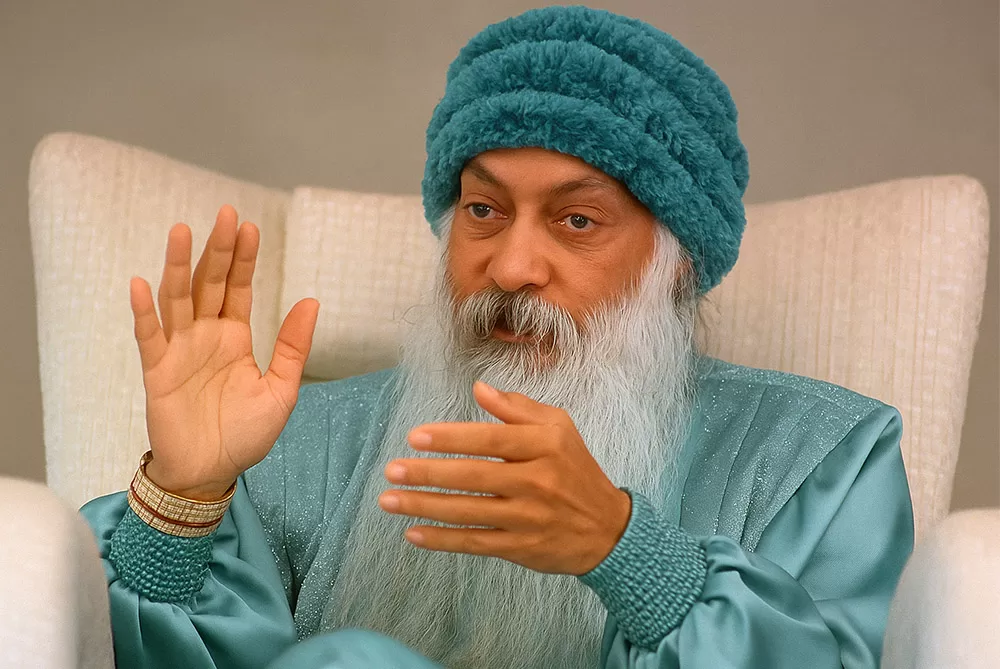

Osho Rajneesh remains one of the most enigmatic spiritual figures of the twentieth century. His radical approach to meditation, celebration, and inner freedom continues to inspire seekers around the world. A deep dive into his Kundali reveals the astrological blueprint behind his transformative presence and offers clues as to why his message resonates so powerfully even today.
Osho Rajneesh Kundali
Birth Details
- Date: 11 December 1931
- Time: 5:45 PM
- Place: Raisen, Madhya Pradesh, India
- Ascendant: Taurus
- Rashi: Sagittarius
- Nakshatra: Purva Ashadha (Venus)
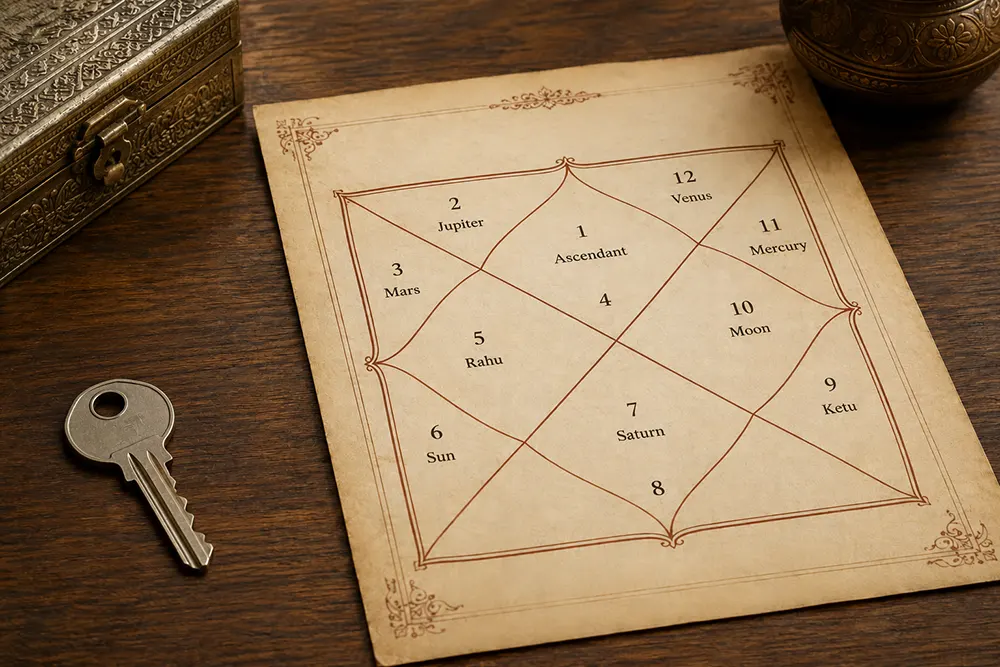
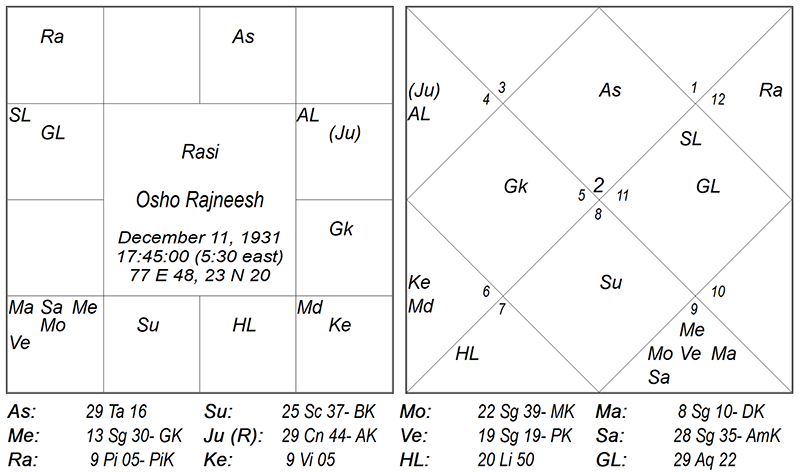
Rashi Chart (D1)
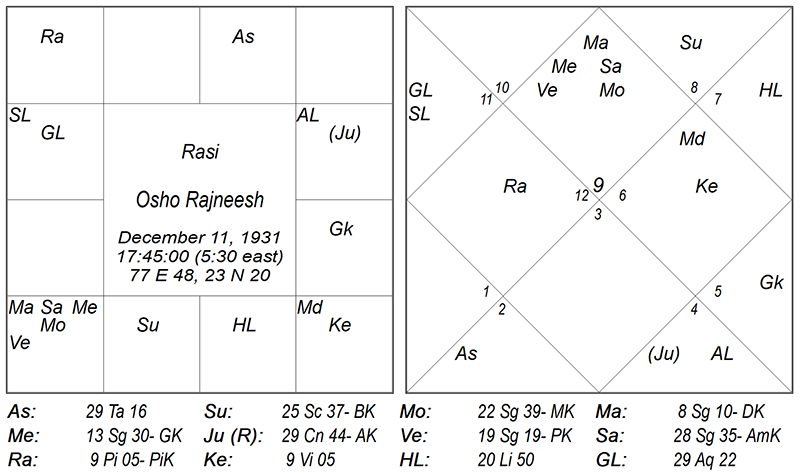
Moon Chart
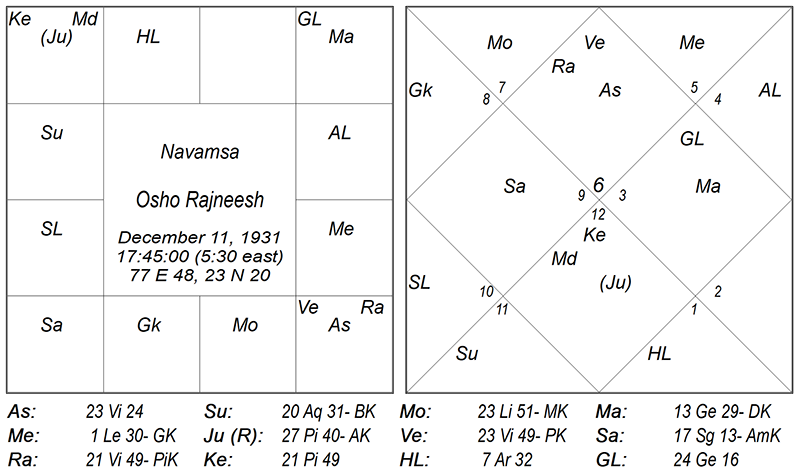
Navamsa Chart (D9)
Kundali Analysis
Osho was born with Taurus rising, granting him a magnetic yet grounded persona. Taurus Ascendants exude a steady calm and an appreciation for beauty and comfort. This earth sign on the horizon endowed him with an unshakeable poise that drew people in. His voice, soothing yet urgent, mirrored the dependable solidity of Taurus, while the fixed quality of this sign underpinned his unwavering commitment to personal freedom. Even as he challenged societal norms, his demeanor remained remarkably composed, lending credibility to his more provocative ideas.
At the heart of his Kundali sits an exalted Jupiter in the third house, serving as his Atmakaraka (soul significator). Jupiter rules wisdom, teaching, and expansion, and its exaltation magnifies these qualities. Placed in the domain of communication and learning, this Jupiter gifted Osho with an inspired mind and an uncanny ability to articulate complex spiritual truths in simple, accessible language. As lord of the eighth and eleventh houses, Jupiter bridged the unseen realms of transformation with the fulfillment of collective aspirations. His discourses often felt like a direct transmission from a higher plane, inviting audiences to let go of fear and embrace the mystery within.
Much of Osho’s life theme unfolded through a powerful stellium in the eighth house in Sagittarius. Here, Mercury, Moon, Mars, Saturn, and Venus converge, coloring his inner world with intensity and insight. The eighth house governs transformation, taboo, and deep psychological processes; its emphasis explains why his teachings frequently broke through conventional moral codes. Mercury’s presence sharpened his intellect and provided the wit that often punctuated his lectures. The Moon infused emotional depth, allowing him to connect with the hidden longings of his followers. Mars, as lord of the twelfth and seventh, ignited his willingness to sacrifice personal egos and to forge intimate bonds through shared spiritual practices. Saturn, ruling the ninth and tenth, lent him the discipline to systematize meditation techniques and build an international ashram network. Venus, as the ascendant lord and sixth lord, wove in a celebration of the sensual aspects of existence, which his meditative dances and dynamic therapies continue to influence in contemporary mindfulness practices.
Ketu in the fifth house, situated in Virgo, reflects his detachment from traditional creative forms and childlike fantasies. The fifth house relates to self‑expression, drama, and progeny, and Ketu’s placement here indicates a karmic release from rigid structures of creativity. Osho famously discarded all preconceived notions of spiritual “performance,” instead inviting people to experience meditation as a living art. This placement encouraged him to dissolve the ego-driven search for recognition and to point others toward an inner source of spontaneous joy rather than external validation.
Opposing this, Rahu in the eleventh house symbolizes his unorthodox approach to community and social change. Rahu here drives innovation in how groups gather and support one another. Under his guidance, thousands came together in communes that defied conventional hierarchy, seeking collective enlightenment rather than individual gain. This Rahu placement also fueled his critique of consumerist culture and beckoned people toward a new vision of shared consciousness.
The Sun occupies Scorpio in the seventh house, highlighting his role as a catalyst in one‑on‑one and public relationships. Scorpio’s intensity lends a probing, almost surgical quality to his presence, enabling deep interpersonal transformations. As lord of the fourth house, the Sun connected him to the root of human conditioning = family, childhood, and homeland; and he often spoke about transcending inherited limitations. In the arena of partnership and public dialogue, this placement gave him the charisma to mirror back the hidden shadows of his listeners, propelling them toward self‑awareness.
When viewed holistically, Osho’s Kundali sketches a life devoted to breaking down barriers between mind and body, sacred and profane, self and other. His exalted Jupiter insisted on unveiling higher truths; the eighth‑house stellium demanded immersion in the depths of human experience; Rahu and Ketu polarized his innovative urgency and karmic letting go; and Taurus Ascendant anchored it all in an approachable, sensorial presence. These combined energies produced a guide who was at once scholarly and irreverent, ascetic and celebratory.
Why does this Kundali blueprint continue to matter? First, the world is hungrier than ever for authenticity. In an age of social media facades, Osho’s insistence on raw honesty and radical self‑acceptance resonates deeply. His teachings remind us that true freedom emerges when we acknowledge our shadows, exactly the invitation of Scorpio and the eighth house in his chart. Second, his methods – dynamic meditation, silent retreats, and expressive therapies – anticipate modern psychological approaches such as somatic experiencing and mindfulness-based stress reduction. Jupiter in the third house foresaw a global exchange of spiritual technologies, and today his techniques thrive in wellness centers across continents.
Third, the tension between Rahu’s visionary leaps and Ketu’s call to release expectations speaks directly to contemporary challenges. We juggle the rapid pace of innovation with the need for soulful rest; Osho’s Kundali shows us that both are essential. His ordained dissolution of rigid tradition (Ketu in the fifth) and embrace of new communal paradigms (Rahu in the eleventh) foreshadow modern movements in conscious community building and decentralized spirituality.
Finally, the Taurus Ascendant reminds us of the body’s sacred role in spiritual awakening, a lesson often lost in purely intellectual or ascetic paths. Osho’s charismatic embodiment of pleasure and contemplation challenges the dualism that afflicts many seekers. In honoring the senses and earth’s beauty, he pointed back to the simple wonder of being alive.
As seekers today navigate mental health crises, social fragmentation, and the loneliness epidemic, Osho’s Kundali‑inspired message provides a holistic roadmap. His chart compels us to integrate wisdom (Jupiter), dive into transformation (eighth house), innovate community (Rahu), release egoic dramas (Ketu), and ground ourselves in the body’s intelligence (Taurus Ascendant). Through dynamic balance, we can rediscover joy, connection, and the silent field of consciousness that underlies all experience.
Osho Rajneesh passed from this life in 1990, yet the astrological forces that shaped his mission continue to ripple outward. His Kundali remains a potent reminder that true spirituality transcends time and culture. By studying his chart, we gain not only historical insight but also a living template for personal and collective evolution. Whether you approach his teachings with curiosity or conviction, the celestial logic of his Kundali invites you to explore your own path with open eyes, an open heart, and an unwavering commitment to truth.
Want to unlock secrets of your Kundali?