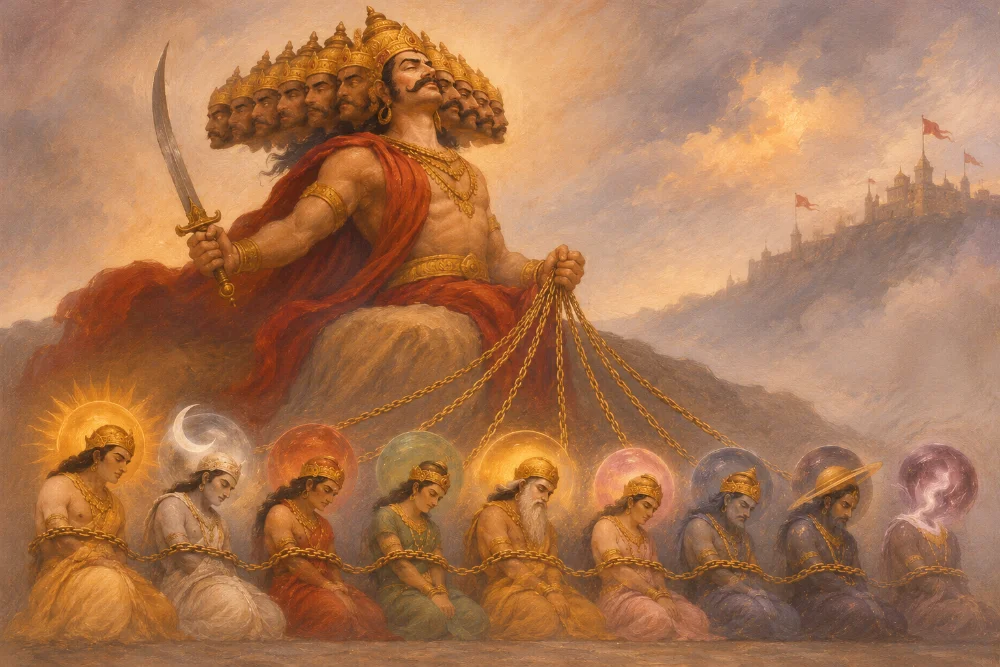

Jupiter Mahadasha, also known as Guru or Brihaspati Mahadasha, lasts sixteen years in the Vimshottari system. Governed by Brihaspati, the preceptor of the Devas, this period brings prominence to matters involving wisdom, knowledge, Dharma, children, teachers, wealth, prosperity and religious activities.
Jupiter occupies a distinctive position among the nine Grahas. It is traditionally regarded as the great benefic and represents the principles of expansion, knowledge, righteousness and higher understanding. Its influence is associated with education, counsel, religious observances, charitable activities, family growth and the pursuit of knowledge.
However, Jupiter Mahadasha should not be reduced to a period of good fortune, wealth or spiritual advancement. The classical texts describe a wider range of results, including professional recognition, property, authority, family happiness and material prosperity when Jupiter is strong. They also describe financial loss, anxiety, difficulties involving children and loss of position when Jupiter is weak or afflicted.
Brihat Parashara Hora Shastra gives particular importance to Jupiter’s dignity, divisional strength, placement and benefic associations. Its functional role, determined by house ownership, further modifies the results of its sixteen-year period.
1. The Nature and Significations of Jupiter
In Vedic astrology, Jupiter is known as Guru, Brihaspati or Jeeva. It is regarded as the preceptor of the Devas and represents wisdom, knowledge, righteousness and the principles of Dharma.
Parashara describes Jupiter as a naturally benefic planet, associated with learning, religious knowledge, wealth, children and auspicious activities.
Its traditional significations extend across several dimensions.
Wisdom and knowledge: Jupiter represents higher knowledge, understanding, judgement, counsel and the ability to distinguish between right and wrong. It signifies teachers, preceptors, scholars and those who transmit knowledge.
Dharma and religion: Religious observances, Vedic learning, sacred knowledge, rituals, charity and adherence to righteous conduct fall within Jupiter’s domain.
Children and progeny: Jupiter is the natural significator of children, particularly in the assessment of progeny and the blessings associated with family growth.
Wealth and prosperity: Jupiter represents accumulated prosperity, valuable resources, generosity, financial growth and the ability to acquire material abundance.
Teachers and guidance: Gurus, spiritual preceptors, mentors, advisers and learned individuals are represented by Jupiter. Its condition is relevant when examining the relationship with teachers and the pursuit of guidance.
Marriage and family: Jupiter has an important role in traditional marriage assessment, particularly as a significator of husband in a woman’s horoscope under classical conventions. It also signifies family happiness and auspicious domestic circumstances.
Expansion and growth: Jupiter represents increase, abundance, generosity and the expansion of existing circumstances. Its influence may become prominent in matters involving education, family, wealth and professional advancement.
These significations explain why Jupiter Mahadasha can coincide with developments involving education, children, marriage, prosperity, religious activities and professional recognition.
2. General Results of Jupiter Mahadasha According to Parashara
Brihat Parashara Hora Shastra, Chapter 47, verses 44 to 51, provides the principal description of Jupiter Mahadasha.
Parashara introduces Jupiter as the most auspicious among the Grahas and describes its favourable results according to dignity and strength.
When Jupiter occupies its exaltation sign, own sign, Moolatrikona, Kendra or Trikona, or possesses strength in its own or exalted Navamsa, the text describes considerable prosperity.
These favourable results include:
- Acquisition of wealth and valuable possessions.
- Recognition and honour from rulers.
- Attainment of authority and important positions.
- Happiness through spouse, children and friends.
- Acquisition of conveyances and fine garments.
- Success in religious observances and auspicious activities.
- Participation in Vedic learning and the study of Vedanta.
- Generosity and charitable activities, particularly feeding others.
Parashara also describes fulfilment of desires, prosperity through influential relationships and considerable happiness during a well-supported Jupiter Mahadasha.
The adverse results are described when Jupiter is debilitated, combust, associated with malefics or placed in the 8th or 12th house under the stated conditions.
These may include loss of position, mental distress, difficulties involving children, loss of cattle and other resources, and financial setbacks.
An interesting qualification appears in BPHS 47.51. Parashara describes difficulties at the beginning of the period under adverse conditions, followed by happiness, recognition and prosperity during the middle and latter portions.
This is a traditional timing indication, not a compulsory sequence for every individual. The actual progression depends on Jupiter’s strength, placement, divisional dignity, associations and Antardasha relationships.
3. Jupiter’s Functional Role Across the Twelve Ascendants
Jupiter owns Sagittarius and Pisces. Its functional role therefore changes according to the ascendant and the houses represented by these two signs.
Unlock this Pro Content
Access Advanced Astrology with Astro Assured Pro
5. The Nine Antardashas of Jupiter Mahadasha
Jupiter Mahadasha lasts sixteen years and contains nine Antardashas. The sequence begins with Jupiter itself, followed by Saturn, Mercury, Ketu, Venus, Sun, Moon, Mars and Rahu.
| Antardasha | Approximate Duration |
|---|---|
| Jupiter | 2 years, 1 month, 18 days |
| Saturn | 2 years, 6 months, 12 days |
| Mercury | 2 years, 3 months, 6 days |
| Ketu | 11 months, 6 days |
| Venus | 2 years, 8 months |
| Sun | 9 months, 18 days |
| Moon | 1 year, 4 months |
| Mars | 11 months, 6 days |
| Rahu | 2 years, 4 months, 24 days |
| Total | 16 years |
The durations follow the traditional 360-day Dasha year. Actual calendar dates may vary according to the calculation convention used.
The following are the principal considerations for each sub-period, drawing on BPHS Chapter 56.
Jupiter Antardasha
The opening sub-period activates Jupiter’s own significations. When Jupiter is exalted, in its own sign, Moolatrikona, Kendra or Trikona, Parashara describes prosperity, recognition, wealth, religious activities and happiness involving spouse and children.
A weak or afflicted Jupiter may instead bring mental distress, financial difficulties, loss of position and concerns involving children. Its functional lordship and associations are particularly important.
Saturn Antardasha
Saturn introduces work, discipline, responsibilities, service and long-term obligations.
A well-supported Saturn may contribute to property, vehicles, material gains, professional responsibilities and recognition. Its placement in favourable houses relative to Jupiter and the ascendant is important.
An afflicted Saturn may bring disputes, financial difficulties, separation from family members and increased responsibilities. The relationship between Jupiter and Saturn must be examined through their functional lordships and mutual placements.
Mercury Antardasha
Mercury activates education, communication, commerce, business, intellect and analytical pursuits.
A strong Mercury may support wealth, professional development, favourable relationships with parents and influential people, and success in intellectual activities.
A weak or afflicted Mercury may bring disputes, financial setbacks, anxiety and difficulties involving relatives. Its functional role and relationship with Jupiter determine the quality of results.
Ketu Antardasha
Ketu introduces separation, discontinuity and unusual circumstances.
A well-supported Ketu may contribute to limited but constructive gains and favourable developments through its dispositor or benefic associations. Under adverse conditions, Parashara describes financial difficulties, dependence on others and complications involving resources.
Its dispositor and planetary associations are particularly important.
Venus Antardasha
Venus brings marriage, relationships, comforts, property, vehicles, ornaments and material enjoyment into prominence.
A strong Venus may support prosperity, recognition, acquisition of valuable possessions, family happiness and auspicious activities. Affliction may bring disputes involving spouse, relatives and financial resources.
Its functional lordship and relationship with Jupiter must be considered before drawing conclusions about marriage and wealth.
Sun Antardasha
The Sun activates authority, father, reputation, government and leadership.
A well-supported Sun may contribute to recognition, professional advancement, wealth and favourable relationships with influential people. Its relationship with Jupiter can be particularly important when both planets influence the 9th or 10th houses.
A weak or afflicted Sun may bring financial difficulties, loss of position and conflict with authorities.
Moon Antardasha
The Moon introduces the mind, mother, family, residence, nourishment and domestic circumstances.
A strong Moon may support property, family happiness, celebrations, material comforts and favourable professional developments. A weak or afflicted Moon may bring mental distress, financial difficulties and concerns involving the mother.
Its phase, Paksha Bala and relationship with Jupiter must be examined.
Mars Antardasha
Mars activates courage, land, property, competition, energy and initiative.
A strong Mars may support acquisition of land, professional advancement, authority, property-related developments and victory over opponents. An afflicted Mars may bring disputes, physical difficulties and financial setbacks.
Its functional lordship and relationship with Jupiter are essential to the interpretation.
Rahu Antardasha
Rahu introduces unusual circumstances, unfamiliar associations and developments that may not follow conventional expectations.
A well-supported Rahu may contribute to material gains, recognition and favourable developments through influential or foreign associations. Under adverse conditions, it may bring anxiety, disputes, financial loss and difficulties involving authority.
Its dispositor, associations and position relative to Jupiter must be examined.
These descriptions are conditional. Each Antardasha lord must be judged through its own house ownership, dignity, placement and relationship with Jupiter.
6. Jupiter Mahadasha and Education, Knowledge and Spiritual Development
Jupiter has a particularly important relationship with higher learning, religious knowledge and the pursuit of wisdom.
Its Mahadasha may bring opportunities for education, advanced study, teaching, research, philosophical inquiry and association with learned individuals.
A strong Jupiter connected with the 4th, 5th or 9th houses can support academic achievements, intellectual development and the acquisition of specialised knowledge.
The 5th house represents intelligence, learning and mantra, while the 9th house represents Dharma, higher knowledge and teachers. Jupiter’s relationship with these houses can therefore become particularly significant.
Its influence also extends to religious observances, Vedic learning, scriptural study, charity and the pursuit of righteous conduct.
Parashara explicitly includes the performance of Yajnas and other religious activities, along with listening to Vedanta, among the favourable indications of a strong Jupiter Mahadasha.
However, Jupiter Mahadasha does not automatically make an individual religious or spiritually inclined. The 5th, 9th and 12th houses, their lords, Ketu and the relevant divisional combinations must be considered together.
Spiritual development should be understood through the complete configuration rather than Jupiter’s natural significations alone.
7. Jupiter Mahadasha and Children and Family
Jupiter is the principal natural significator of children in classical Jyotisha. Its Mahadasha can therefore bring significant developments involving progeny, family growth and responsibilities towards children.
A strong Jupiter connected with the 5th house or its lord may support favourable developments involving children, education and family happiness.
Parashara specifically includes happiness through spouse and children among the favourable results of Jupiter Mahadasha.
However, Jupiter alone cannot determine childbirth or the number of children. The 5th house, its lord, Jupiter, relevant divisional charts and the operating Antardasha must be examined together.
Jupiter also represents teachers, mentors and advisers. Its Mahadasha may coincide with important developments involving guidance, mentorship and the transmission of knowledge.
A well-supported Jupiter may strengthen relationships with teachers and learned individuals, while affliction may bring disagreements, disappointment or difficulties involving guidance and family responsibilities.
8. Jupiter Mahadasha and Wealth and Prosperity
Jupiter is traditionally associated with abundance, wealth, generosity and the expansion of resources.
Parashara’s description of a strong Jupiter includes acquisition of wealth, conveyances, garments, property and recognition from rulers.
Its period may become significant for financial growth through education, advisory work, teaching, professional advancement, business and other Jupiter-related activities when the relevant planetary combinations support such developments.
The 2nd and 11th houses, their lords, Dhana Yogas and the 10th house must be examined when assessing financial results.
Jupiter’s natural significations can also influence generosity and charitable activities. Parashara specifically mentions feeding others and religious charity among the favourable indications of its period.
However, wealth accumulation and expenditure should be judged separately. Jupiter’s association with generosity does not automatically guarantee financial stability, particularly when it owns or occupies houses associated with expenditure and financial obligations.
9. Jupiter Mahadasha and Marriage and Relationships
Jupiter is an important natural significator in traditional marriage assessment. Its Mahadasha can bring developments involving marriage, spouse, family happiness and social relationships.
A strong Jupiter connected with the 7th house, its lord or favourable marriage combinations may support marriage and constructive partnerships.
For women, classical Jyotisha traditionally gives Jupiter particular importance as a natural significator of the husband. Its condition is therefore an important component of marriage assessment, alongside the 7th house and Navamsa.
However, Jupiter Mahadasha does not automatically guarantee marriage. The 7th house, its lord, Venus, relevant Upapada indications, Navamsa and the operating Antardasha must support the event.
Existing marriages may also experience developments during this period. Whether these are favourable depends on the condition of the relevant houses, their lords and the relationship between Jupiter and the operating sub-period lord.
10. Classical Remedies During Jupiter Mahadasha
Brihat Parashara Hora Shastra Chapter 56 prescribes specific remedial measures for difficult Antardashas within Jupiter Mahadasha.
The text gives different recommendations according to the sub-period lord and the nature of the affliction. These include forms of recitation, worship, charity and Shanti measures.
They should not be combined into a universal prescription for everyone undergoing Jupiter Mahadasha.
The condition of Jupiter, the nature of its affliction and the operating Antardasha must first be established. A gemstone or ritual should not be recommended merely because Jupiter is debilitated or placed in a particular house.
Classical remedies are best understood as responses to specific planetary conditions rather than generic prescriptions for an entire sixteen-year period.
Conclusion
Jupiter Mahadasha is a sixteen-year period in which knowledge, Dharma, children, teachers, wealth, prosperity and religious activities may become particularly significant.
Classical Jyotisha describes the potential for recognition, material abundance, family happiness, professional advancement and spiritual learning when Jupiter is strong and favourably placed. It also recognises financial loss, mental distress, difficulties involving children and loss of position when Jupiter is weak or afflicted.
Its functional lordship changes across the twelve ascendants, making house ownership an essential part of interpretation. Its placement, dignity, divisional strength, aspects and associations further determine the quality of its results.
The nine Antardashas introduce additional planetary influences, creating different phases within the sixteen-year period. Their results depend on the relationship between each sub-period lord and Jupiter, as well as the promises contained in the birth chart.
Ultimately, Jupiter Mahadasha is not simply a period of good fortune or expansion. It is a period in which the principles represented by Jupiter become active, bringing opportunities, responsibilities and experiences in accordance with its condition in the Kundali.
Frequently Asked Questions About Jupiter Mahadasha
What is Jupiter Mahadasha in Vedic astrology and how long does it last?
Jupiter Mahadasha (Guru Mahadasha) is a 16-year major planetary period in the Vimshottari Dasha system ruled by Jupiter (Brihaspati). As the primary natural benefic and karaka of wisdom, Dharma (righteousness), higher knowledge, children, and abundance, this period shifts focus from Rahu’s intense worldly drive toward expansion through knowledge, mentorship, ethics, and meaningful growth.
What are the positive effects of a well-placed Jupiter Mahadasha?
When Jupiter is exalted in Cancer, in its own signs Sagittarius or Pisces, or placed in Kendra or Trikona houses, these 16 years often bring financial prosperity, wise counsel, spiritual depth, harmonious marriage, and blessings related to children. Natives frequently gain respect as teachers, advisors, or principled leaders.
How does Jupiter Mahadasha influence career, education, and wealth?
Because Jupiter governs higher learning, law, philosophy, banking, and counsel, this Mahadasha favors growth in teaching, advisory roles, finance, judiciary, spiritual studies, and ethical enterprise. Wealth tends to grow steadily when guided by integrity, long-term vision, and generosity rather than reckless shortcuts.
Can Jupiter Mahadasha cause over-expansion or health issues if afflicted?
Yes, if Jupiter is debilitated in Capricorn, placed in Dusthana houses (6th, 8th, or 12th), or afflicted by malefics or functional malefic lordship (such as Badhaka or Maraka roles), it can lead to over-optimism, dogmatism, weight gain, or liver and metabolic imbalances associated with excess Kapha.
How can one make the most of Jupiter Mahadasha?
Aligning with Brihaspati’s energy involves continuous study, respecting teachers and elders, practicing truthfulness, and sharing knowledge generously. Maintaining moderation in diet and commitments, along with supporting education or charitable causes, helps turn Jupiter Mahadasha into a deeply fulfilling phase.
Classical References
- Brihat Parashara Hora Shastra: Chapter 46, Vimshottari Dasha; Chapter 47, verses 44-51, results of Jupiter Mahadasha; Chapter 56, results of the nine Antardashas within Jupiter Mahadasha; Chapter 34, functional lordship; Chapter 3, natural planetary characteristics.
- Phaladeepika by Mantreswara: Chapter 2, natural significations of Jupiter; Chapter 19, verse 11, results of Jupiter Mahadasha; Chapter 21, Jupiter-related Antardasha results.
- Jataka Parijata by Vaidyanatha Dikshita: Chapter 18, verses 109-119, results of Jupiter Mahadasha and its subordinate periods.
- Saravali by Kalyana Varma: Planetary characteristics, Jupiter’s significations, house placements, strength and Dasha-related considerations.
Note: Chapter and verse numbering may vary between editions and recensions. References above follow the editions consulted for this article.