
There is a peculiar contradiction in human existence. We spend our lives trying to conquer circumstances, overcome obstacles and defeat those we perceive as our adversaries. Yet, some of the greatest forces working against us are not outside us, but within us.
Ancient Indian philosophy identified six such adversaries and called them Shadripu. Desire, anger, greed, delusion, pride and envy. They do not always appear as enemies. They disguise themselves as ambitions, attachments, justifications and even virtues. Before we recognise their influence, they have already begun shaping our thoughts, decisions and actions.
Perhaps the most difficult battle in life is not the one we fight against the world, but the one we must recognise within ourselves.
The Six Enemies Within
The Sanskrit word Shadripu (षड्रिपु) combines Shad, meaning six, and Ripu, meaning enemy. Together, they describe six destructive tendencies of the human mind that obstruct discernment, disturb inner harmony and bind an individual to suffering.
These six tendencies are Kama, Krodha, Lobha, Moha, Mada and Matsarya. While each has a distinct expression, they are deeply interconnected, often strengthening one another.
1. Kama (काम) – Desire
Kama represents desire, craving and the longing for gratification. It is the constant pursuit of something we believe will make us happier, more complete or more fulfilled. The problem, however, is not the presence of desire itself, but our dependence on its fulfilment.
One desire gives birth to another, and satisfaction becomes increasingly temporary. What we once longed for eventually becomes ordinary, making room for another pursuit. Thus, a mind governed by unrestrained desire is perpetually occupied with what it does not have, rarely appreciating what it already possesses.
2. Krodha (क्रोध) – Anger
Krodha is anger, often arising when our desires remain unfulfilled or our expectations are challenged. It emerges when reality refuses to conform to our wishes, when someone questions our ego or when circumstances fall outside our control.
Its greatest danger lies in its ability to temporarily overpower reason. Anger distorts perception, clouds judgement and makes us act in ways we may later struggle to understand. A moment of uncontrolled anger can damage relationships, destroy years of trust and leave behind consequences that no apology can entirely undo.
3. Lobha (लोभ) – Greed
Lobha is the insatiable desire to acquire more, whether wealth, possessions, recognition, power or influence. Unlike ordinary ambition, greed is not driven by a meaningful aspiration but by an inability to recognise sufficiency.
It turns abundance into scarcity, because no amount ever seems enough. Even after acquiring what was once considered sufficient, the mind begins measuring itself against something greater. Greed therefore has little to do with how much one possesses and everything to do with the inability to feel content with what one has.
4. Moha (मोह) – Delusion
Moha represents delusion, infatuation and the loss of clear perception. It makes us mistake the temporary for the permanent, attachment for love and possession for belonging.
Perhaps its most dangerous expression is the inability to see something as it truly is because we are too emotionally invested in seeing it differently. We become attached not merely to people or possessions, but also to our beliefs, expectations and imagined versions of reality. Moha prevents us from accepting impermanence and clouds the very discernment necessary for liberation.
5. Mada (मद) – Pride
Mada is arrogance, conceit and the intoxication of one’s own accomplishments, knowledge, beauty, wealth or position. It makes an individual believe they are superior to others, gradually diminishing their capacity for humility and self-reflection.
The intoxication of pride is particularly deceptive because it often grows alongside genuine achievements. A person may acquire knowledge but lose the willingness to learn, attain authority but lose the ability to listen, or achieve success but become incapable of acknowledging their shortcomings. Mada turns self-worth into self-importance.
6. Matsarya (मत्सर्य) – Envy
Matsarya is envy, the inability to tolerate another person’s happiness, prosperity or accomplishments. It is perhaps the most revealing of the six because it exposes how deeply our happiness can become dependent on comparison.
Greed makes us want more for ourselves, but envy makes us uncomfortable when someone else has more. Another person’s success becomes our dissatisfaction, their happiness our insecurity. Instead of finding inspiration in another’s achievements, an envious mind perceives them as a threat to its own worth.
How the Six Enemies Reinforce One Another
The Shadripu are not isolated tendencies. They form an interconnected cycle in which one can become the cause of another.
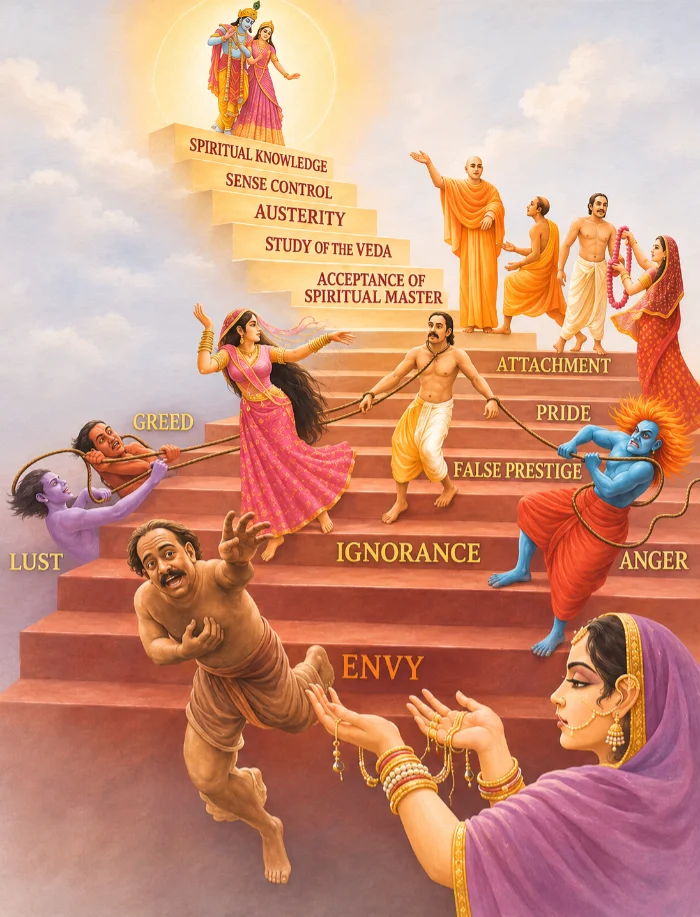
The Bhagavad Gita offers a remarkable explanation of this psychological progression in Chapter 2, Verses 62–63. Krishna describes how contemplation of sensory objects gives rise to attachment, attachment produces desire, and unfulfilled desire leads to anger. Anger then gives rise to delusion, which clouds memory and ultimately destroys discernment.
This progression reveals something profound: the downfall of an individual rarely begins with a dramatic act. It often begins with an unchecked thought that gradually acquires control over the mind.
The other tendencies further strengthen this cycle. Greed perpetuates desire, pride prevents self-correction, and envy makes contentment increasingly difficult. Together, they create a state in which the individual becomes increasingly governed by impulses rather than understanding.
Interestingly, in Chapter 16, Verse 21, Krishna identifies Kama, Krodha and Lobha as the three gates leading to self-destruction. While this verse specifically names three tendencies, it reinforces the broader philosophical understanding of the inner enemies.
The Path Beyond Shadripu
The objective of understanding the Shadripu is not to become emotionless or renounce every worldly desire. Indian philosophy recognises Kama as one of the four Purusharthas, the legitimate aims of human existence, alongside Dharma, Artha and Moksha.
The distinction lies between experiencing a desire and becoming enslaved by it, between feeling anger and allowing it to govern our actions, between possessing something and deriving our entire identity from it.
The path towards overcoming these tendencies involves cultivating their counterbalancing qualities: contentment against desire, patience against anger, generosity against greed, discernment against delusion, humility against pride and goodwill against envy.
Different spiritual paths offer different approaches to this transformation. Jnana Yoga cultivates discernment and self-knowledge. Bhakti Yoga redirects attachment towards the Divine. Karma Yoga teaches action without bondage to its fruits, while Raja Yoga emphasises discipline and mastery of the mind.
Ultimately, the battle against Shadripu is not fought through suppression but through awareness, understanding and sustained inner discipline.
The Greatest Conquest
Perhaps the greatest irony of human existence is that we seek freedom while remaining prisoners of our own tendencies. We aspire for peace but nurture anger, seek fulfilment but feed greed, desire happiness but allow envy to consume us.
The six inner enemies do not necessarily take away everything we possess. They take away our ability to experience what we possess without being disturbed by what we lack.
And perhaps that is where the wisdom of Shadripu becomes most relevant. The greatest victory is not conquering another person, acquiring the world or commanding circumstances to obey us. It is developing the awareness to recognise what governs us and the discipline to no longer be governed by it.
For the world outside may present us with countless adversaries, but the most consequential ones are often the six we carry within.