
An exploration of ancient Vedic mythology, the guardians of Yama, the final journey of Yudhishthira and the timeless relationship between Dharma and compassion.
This content is a preview of the quality and depth available inside Astro Assured Pro. Become a Pro Member to unlock advanced astrology, exclusive tools, and premium research.
There are few festivals in the world that place an animal at the centre of religious reverence quite like Kukur Tihar. Celebrated in Nepal as part of the five-day Tihar festival, the occasion is dedicated to dogs. They are adorned with marigold garlands, marked with vermilion tika, offered delicious food and honoured with prayers.
For a day, dogs are not merely companions, guardians or familiar inhabitants of our streets and homes. They become the recipients of affection, gratitude and worship.
But this tradition has a much deeper cultural and mythological significance than its beautiful rituals might initially suggest. In the ancient Indian imagination, dogs occupy a rather unusual position. They appear in the Vedic descriptions of the afterlife as guardians of Yama, the god of death. They accompany Kala Bhairava, a fierce manifestation of Lord Shiva, and they feature in one of the most moving episodes of the Mahabharata, where a seemingly ordinary dog becomes the instrument of a divine test.
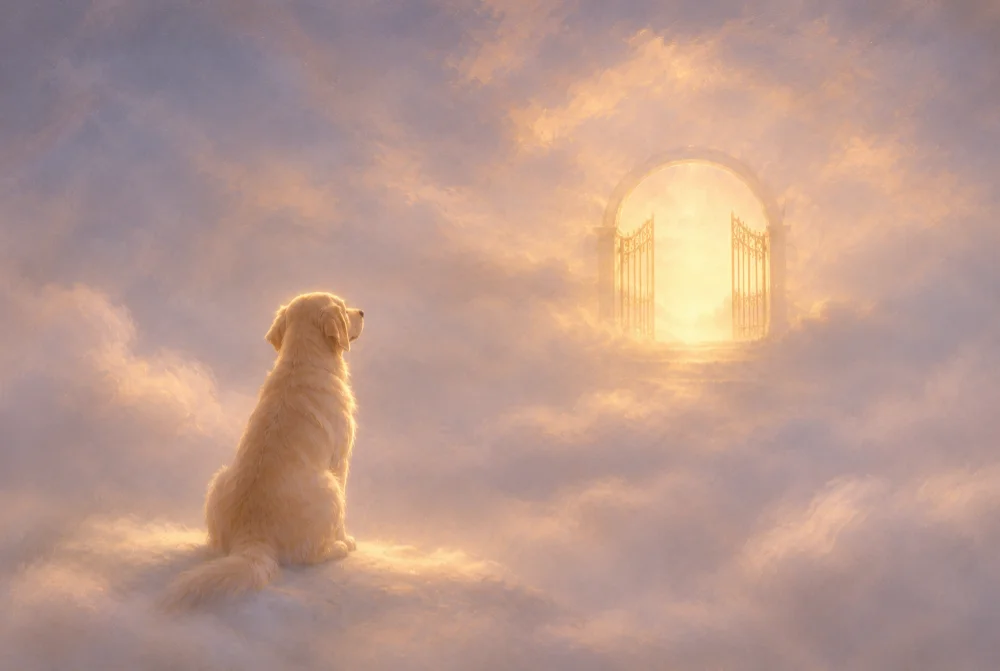
Perhaps the most remarkable of these stories is that of Yudhishthira, who refuses to enter heaven if doing so requires him to abandon a dog that has faithfully accompanied him.
It is a story about loyalty, but its message reaches much further. It raises a fundamental question about the nature of Dharma: can righteousness truly exist without compassion?
To understand the deeper meaning of Kukur Tihar, we must first travel into the ancient mythology surrounding these extraordinary companions of humankind.
1. Kukur Tihar: A Day Dedicated to Dogs
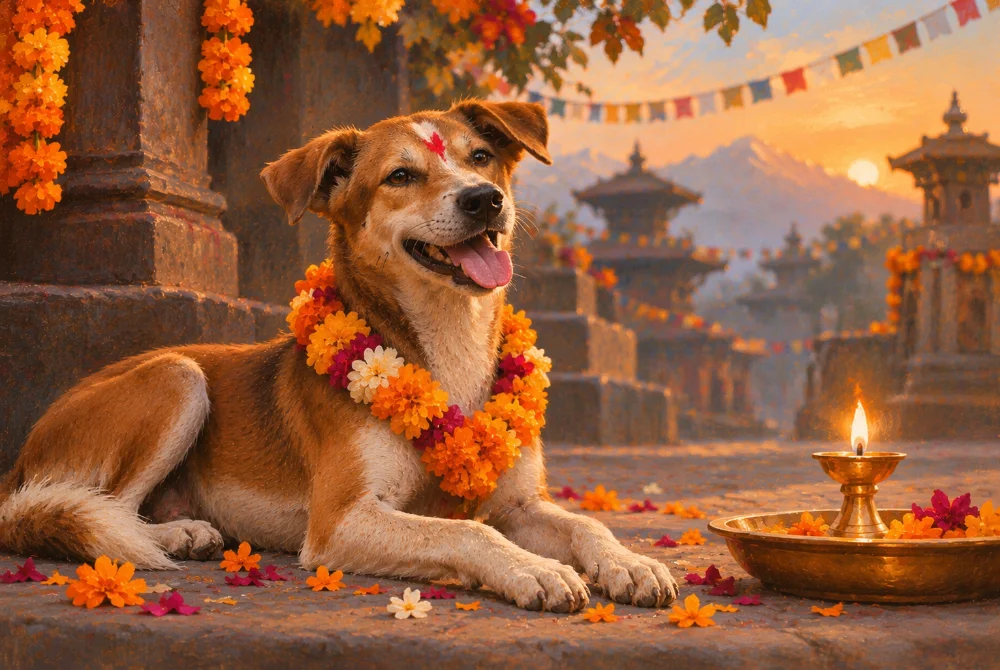
Kukur Tihar is observed on the second day of Nepal’s five-day Tihar festival, also known as Yamapanchak. The word Kukur means dog in Nepali, and the day is dedicated to honouring dogs, which are traditionally associated with Yama, the god of death.
The celebrations are simple yet deeply affectionate. Dogs are decorated with marigold garlands, a red tika is applied to their foreheads, and they are offered food and treats. Household pets and street dogs alike are included in the festivities.
The significance of this inclusion is worth noticing. The celebration is not meant exclusively for animals that belong to wealthy households or have the privilege of living as pets. Even the dogs that wander through streets, often without anyone to care for them, are recognised and honoured.
Kukur Tihar forms part of a larger tradition in which different living beings are given a place in the festival.
The first day, Kaag Tihar, is dedicated to crows, which are associated with messages from Yama. The second honours dogs. The third is associated with cows and Goddess Lakshmi, while the fourth includes the worship of oxen and, among the Newar community, Mha Puja, the worship of one’s own existence. The fifth day is Bhai Tika, celebrating the bond between brothers and sisters.
The sequence reflects a cultural world in which human existence is understood through its relationships with nature, animals, family and the divine.
But why are dogs associated with the god of death in the first place? The answer takes us much further back than the festival itself.
2. The Two Dogs of Yama: Guardians of the Afterlife
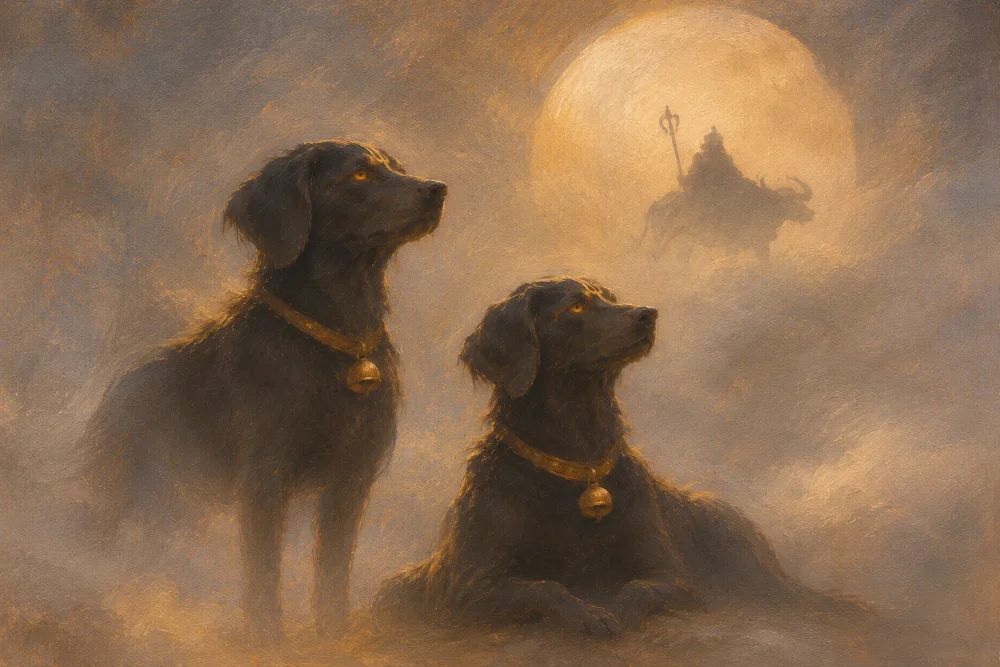
One of the oldest and most fascinating references to dogs in Indian religious literature appears in the Rigveda, particularly in its 10th Mandala, Sukta 14, which is dedicated to Yama and the departed ancestors.
The hymn describes two dogs associated with Yama. They are the offspring of Sarama and are known as the Sarameyas, meaning the descendants of Sarama.
They are described as four-eyed and brindled or spotted. Their unusual appearance is accompanied by an equally unusual responsibility: they watch over the paths associated with the departed and are connected with the passage towards Yama’s realm.
The two dogs are commonly identified as:
- Shyama: The dark-coloured dog.
- Shabala: The brindled or spotted dog.
Their names and descriptions are rooted in the Vedic tradition, although different translations and later accounts do not always present their identities in exactly the same way.
Rigveda 10.14.10 asks the departed to pass beyond these two four-eyed dogs and proceed towards the ancestors who rejoice in the company of Yama.
The following verse, Rigveda 10.14.11, addresses Yama directly and describes his two dogs as guardians of the path, possessing four eyes and watching over human beings. The hymn asks Yama to entrust the departed to their protection and grant them well-being.
This is a particularly interesting detail. The dogs are not portrayed merely as frightening creatures standing at the entrance to the underworld. They are also associated with protection and the safe passage of the departed.
Another verse, Rigveda 10.14.12, describes Yama’s two messengers roaming among human beings and expresses the wish that they may return people to a healthy existence, allowing them to see the sunlight once again.
The symbolism is remarkable. Dogs occupy a position between the world of the living and the realm of the departed. They are associated with mortality, but also with guardianship and protection.
It is important not to read these hymns as a fully developed later mythology of heaven and hell. The Rigvedic verses belong to an older conception of Yama, the ancestors and the journey after death. Nevertheless, they establish an ancient and enduring association between dogs and the passage beyond earthly existence.
The image of the dog as a guardian of the threshold between two worlds would continue to hold a fascinating place in Indian religious imagination.
3. Sarama: The Mysterious Mother of Yama’s Dogs
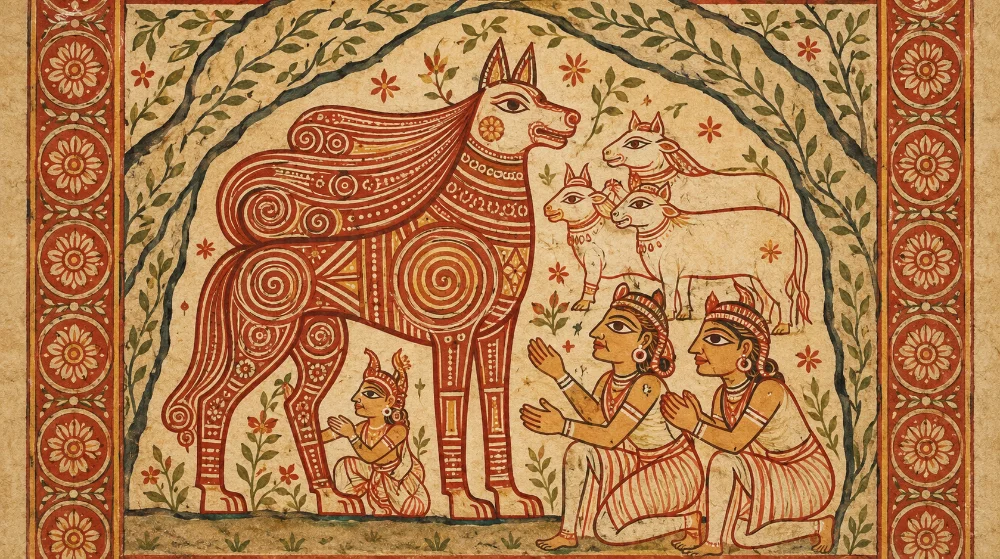
The story of Yama’s dogs introduces another fascinating figure from Vedic mythology: Sarama.
Sarama appears in Rigveda 10.108 in a dialogue hymn involving the Panis, a group associated with the concealment of valuable cattle.
According to the narrative, the Panis have hidden the cattle, and Indra sends Sarama to discover their whereabouts. She crosses the river Rasā, encounters the Panis and confronts them about the stolen cattle.
The Panis attempt to persuade her to abandon her mission, but Sarama remains faithful to the purpose for which she was sent.
Eventually, the conflict leads towards the recovery of the hidden cattle through Indra and the Vedic seers.
It is a story associated with loyalty, determination and the recovery of something that has been concealed.
What makes Sarama especially interesting is the relationship between her Vedic identity and her later association with dogs.
In Rigveda 10.14, the two dogs of Yama are explicitly described as Sarama’s offspring. This establishes a connection between her and the canine guardians of the afterlife.
However, there is an important textual distinction worth preserving. The Rigvedic hymn describing Sarama’s encounter with the Panis does not straightforwardly identify her as a dog in the familiar later sense. Her canine identity becomes clearer through her association with the two dogs of Yama and subsequent mythological traditions.
A 2024 academic study by Alessia Manca, Saramā as a Psychopomp Dog in Ancient India, examines this development and explores the relationship between Sarama, her progeny and the ancient symbolism of dogs in connection with death and the afterlife.
The distinction is important because it shows how mythological identities evolve across different layers of religious literature.
Sarama is therefore not simply another character in the story of Yama’s dogs. She represents a fascinating intersection of Vedic mythology, divine messengership and the symbolism of animals in the ancient Indian world.
4. The Dog of Kala Bhairava: A Companion of the Divine
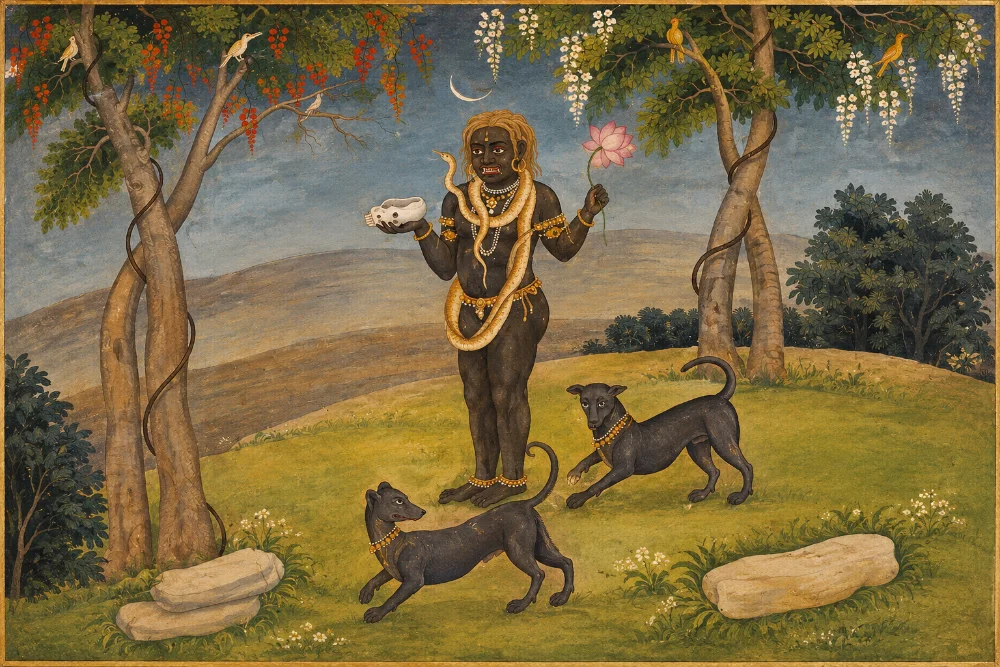
The association between dogs and the divine is not restricted to Yama.
In several Hindu traditions, dogs are also closely associated with Kala Bhairava, a fierce manifestation of Lord Shiva.
Bhairava represents a formidable aspect of divinity associated with time, protection, the destruction of evil and the guardianship of sacred spaces.
In traditional representations, a dog accompanies Bhairava as his vahana, or divine vehicle. The association is particularly prominent in the worship of Kala Bhairava.
This relationship adds another dimension to the symbolism of dogs.
In the Vedic association with Yama, dogs are connected with the passage of the departed and the threshold between life and death. In Bhairava traditions, the dog becomes a companion of a deity associated with protection and the power to confront destructive forces.
The animal is thus placed within two distinct but complementary symbolic worlds: the guardianship of the afterlife and the guardianship of the living.
In certain devotional traditions, feeding dogs is also regarded as an act of reverence towards Bhairava.
It is worth remembering, however, that the association with Bhairava is a broader Hindu religious tradition, not necessarily the historical origin of Kukur Tihar.
Together, these traditions reveal something fascinating about the place of dogs in Hindu religious imagination. An animal that might ordinarily be overlooked in everyday human life can occupy a position of profound spiritual significance.
And yet, the most moving illustration of this idea is not found in an elaborate temple or a description of a celestial guardian. It appears in the final journey of a king.
5. Yudhishthira and the Dog: The Final Test of Dharma
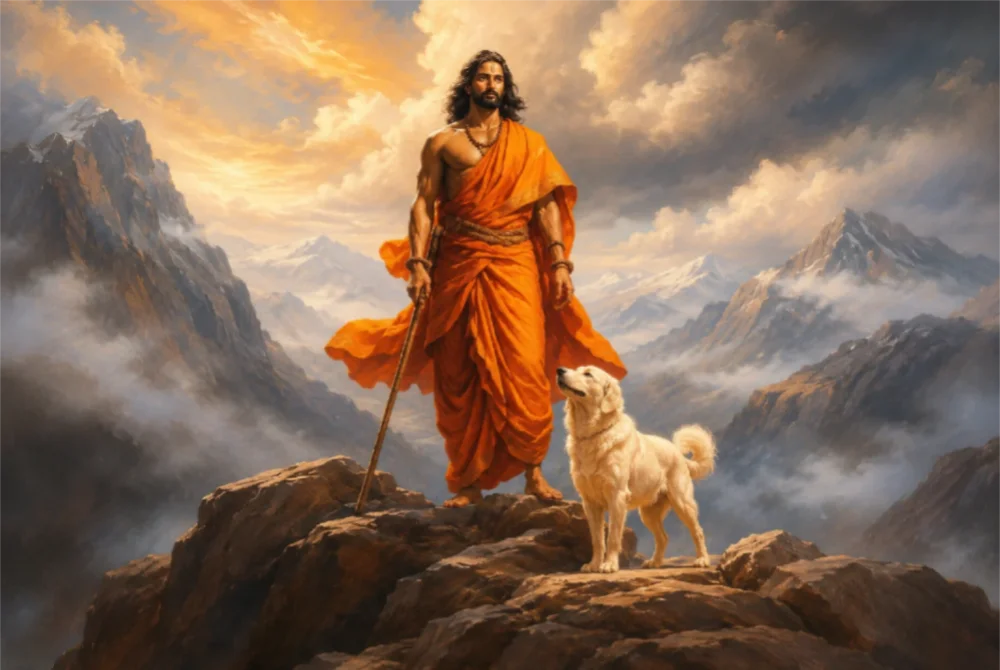
Among all the stories associated with dogs in Indian mythology, perhaps none carries a message as profound as the final journey of Yudhishthira in the Mahabharata.
The great war of Kurukshetra has ended. The Pandavas have fulfilled their earthly responsibilities, and Lord Krishna has departed from the world. Having witnessed the impermanence of power, kingdoms and human relationships, the brothers decide to renounce their kingdom and undertake their final journey.
This journey is known as Mahaprasthana, the great departure.
Yudhishthira, accompanied by his brothers and Draupadi, sets out towards the Himalayas. They leave behind their kingdom, possessions and worldly attachments, turning their attention towards the final destination of their lives.
But they are not entirely alone.
A dog begins following them.
The journey is difficult, and one by one, Draupadi and the Pandava brothers fall along the way. Yudhishthira continues walking, without turning back, while the dog remains beside him.
Eventually, he is the only one left, accompanied by the animal that has faithfully followed him throughout the journey.
Then something extraordinary happens.
Indra, the king of the Devas, appears before Yudhishthira in a celestial chariot. He invites the righteous king to ascend to heaven in his mortal body, an extraordinary privilege granted to very few.
Yudhishthira, however, does not immediately accept.
He asks that the dog accompanying him be allowed to enter heaven as well.
Indra is surprised by this request. He explains that heaven is not a place for dogs and urges Yudhishthira to abandon the animal.
But Yudhishthira refuses.
He explains that the dog has remained devoted to him throughout the difficult journey. To abandon such a companion merely to secure his own heavenly happiness would be an act of unrighteousness.
Indra continues to persuade him. He reminds Yudhishthira of the extraordinary rewards awaiting him in heaven and insists that the dog should not become an obstacle to his final destination.
Yet the king remains unmoved.
In the Mahabharata’s Mahaprasthanika Parva, Yudhishthira expresses his position with remarkable clarity:
“I do not desire that union with prosperity for which I shall have to cast off one that is devoted to me!”
He further explains that abandoning someone who has sought his protection and remained devoted to him is a grave moral failing.
This is not an ordinary disagreement about the admission of an animal into heaven. It is a confrontation between the promise of personal reward and the responsibility towards a living being.
Yudhishthira is being offered immortality, celestial happiness and a place in heaven. Yet he refuses to accept these rewards if they require him to betray the trust of a companion.
He does not consider the dog’s life insignificant simply because it belongs to an animal.
And then comes the revelation.
The dog transforms into Dharma, the divine embodiment of righteousness, who is also identified with Yama and is regarded as Yudhishthira’s divine father.
Dharma reveals that the entire episode was a test of Yudhishthira’s character.
He praises the king for his compassion towards all creatures and declares that Yudhishthira has demonstrated the qualities of a truly righteous person.
The dog that appeared to be an ordinary companion was, in fact, Dharma himself.
But the greatest beauty of this story lies not in the revelation.
It lies in what happened before it.
Yudhishthira did not protect the dog because he knew it was divine. He protected it because he believed abandoning a faithful creature would be wrong.
His compassion was not dependent on the animal’s identity, status or ability to reward him.
That is what made his actions worthy of Dharma.
The episode appears in Book 17 of the Mahabharata, the Mahaprasthanika Parva, particularly Section III.
6. When Dharma Appears in an Unexpected Form
Throughout the Mahabharata, Dharma is an enduring concern. The epic repeatedly examines the difficulty of distinguishing righteousness from unrighteousness, especially when circumstances make moral decisions complicated.
Dharma is not always easy to identify. It cannot always be reduced to a rule, a ritual or an instruction. Sometimes, it demands that a person recognise the moral responsibility inherent in a particular situation.
Yudhishthira’s final test illustrates precisely this.
He is not asked to perform a sacrifice, recite a scripture or demonstrate his knowledge of religious philosophy. He is simply placed in a situation where he must decide whether his own happiness is more important than the well-being of a creature that depends upon him.
And he chooses compassion.
There is another subtle detail worth noticing. Yudhishthira has already lost his brothers and Draupadi during the journey. He could not bring them back to life, and he continued towards his destination. But the dog is still alive, still following him, and still seeking his companionship.
He refuses to abandon the one living creature that has placed its trust in him.
His decision demonstrates that Dharma is not merely about personal spiritual attainment. It also concerns how we conduct ourselves towards those who are vulnerable and dependent upon us.
The revelation that the dog was Dharma makes the episode even more meaningful, but it should not overshadow the moral significance of Yudhishthira’s decision.
He passed the test without knowing its divine nature.
Compassion does not need the promise of divinity or reward to become righteous.
7. Beyond the Garland: What Kukur Tihar Truly Teaches Us
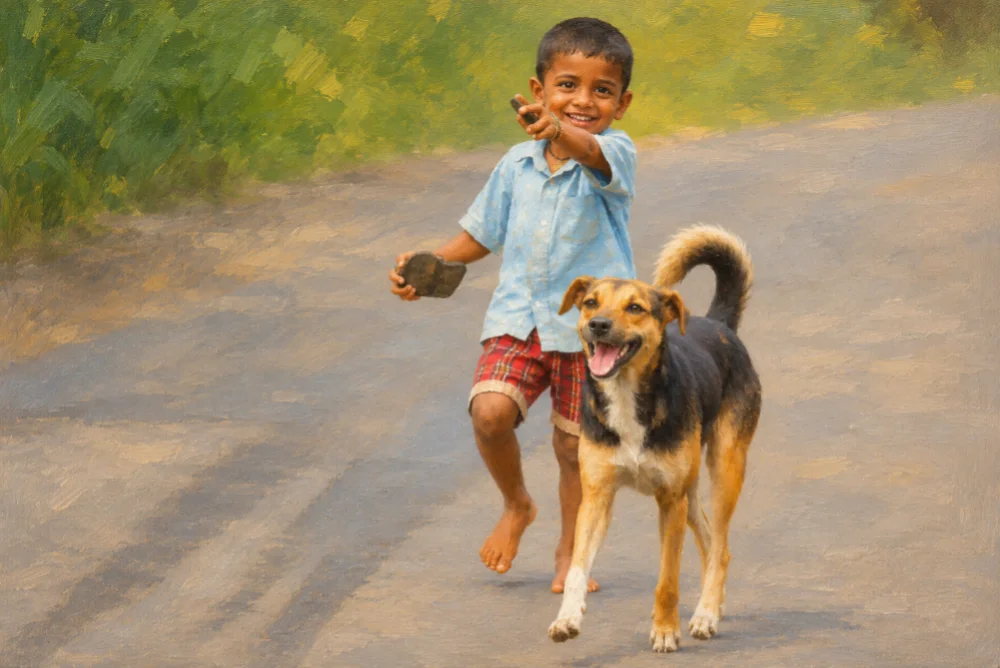
After exploring these mythological connections, we return to the festival itself.
A dog receives a marigold garland. Vermilion is placed on its forehead. Food is offered, prayers are performed and affection is expressed.
There is something deeply moving about this tradition, particularly when we remember that the celebration includes street dogs that might otherwise be ignored.
But perhaps the most important question is what happens after the celebrations end.
Do we continue to care for the animals that share our surroundings? Do we offer food and water to those that are hungry and thirsty? Do we treat abandoned animals with dignity? Do we recognise their suffering, even when they cannot express it in words?
A garland can symbolise reverence, but it cannot replace responsibility.
A tika can express devotion, but it cannot substitute for kindness.
And a day of worship cannot compensate for a year of neglect.
The deeper message of Kukur Tihar is not restricted to dogs. It invites us to reconsider our relationship with every living being.
Dogs may be the focus of this particular celebration, but compassion should not be selective. It should extend to birds, cattle, animals living in the wild and every creature whose existence intersects with ours.
We often measure the importance of another being through its usefulness to us. We value animals when they protect our homes, offer companionship, provide material resources or serve a purpose in our lives.
But what about those that offer us nothing?
What about the hungry animal on the roadside, the injured bird, the creature that frightens us, or the abandoned dog that has never known the comfort of a home?
Do they become less deserving of compassion because they cannot serve us?
The story of Yudhishthira suggests otherwise. He did not ask what the dog could do for him or measure its worth by its usefulness. He simply recognised the responsibility that came with the animal’s trust.
To honour a living being is not merely to place it on a pedestal for a day. It is to acknowledge that its existence has value, even when that existence offers us no personal advantage.
8. The Meaning of Compassion Beyond Religious Boundaries
Compassion towards living beings is not the exclusive concern of one religion, one festival or one spiritual tradition. It is an ethical responsibility that transcends religious boundaries.
Within Hindu philosophical thought, the idea of Ahimsa, or non-injury, occupies an important place. It encourages restraint from causing unnecessary harm and invites us to recognise the value of life beyond our immediate interests.
The Bhagavad Gita, too, presents compassion and equanimity as qualities of spiritual maturity.
In Bhagavad Gita 12.13, Lord Krishna describes the qualities of a devotee:
Adveshta sarva-bhutanam maitrah karuna eva cha.
One who bears no hatred towards any living being, who is friendly and compassionate, is dear to the Lord.
The expression sarva-bhutanam is particularly significant. It does not restrict compassion to human beings. It encompasses all living creatures.
Similarly, Bhagavad Gita 6.32 describes the highest yogic understanding as recognising the joys and sorrows of others through one’s own experience.
These teachings offer a philosophical foundation for extending our understanding of Dharma beyond ritual observances.
A person may perform elaborate worship, visit sacred places and recite scriptures, but the deeper question remains: how does that spiritual understanding manifest in everyday conduct?
Can we claim to recognise divinity in the world while remaining indifferent to suffering around us? Can devotion exist without kindness? Can the pursuit of spiritual liberation be separated from the responsibility of living compassionately?
Kukur Tihar offers a beautiful opportunity to reflect upon these questions.
The animal that seeks food at our doorstep, the bird that rests on our balcony, the cow that wanders through our streets and the dog that quietly follows us may never become the subject of our prayers. But they are all part of the same living world.
Perhaps recognising their existence with kindness is itself a form of spiritual practice.
9. When the Festival Ends, Let Compassion Remain
Every festival eventually comes to an end. The marigold garlands are removed, the tika fades, the offerings are consumed and everyday life resumes.
But the values that a festival represents should not disappear with its rituals.
Kukur Tihar is celebrated once a year, yet the responsibility towards animals exists every day.
It does not require us to build temples for every creature, perform elaborate ceremonies or adopt every animal we encounter. Sometimes, compassion begins with much smaller gestures: offering water to a thirsty animal, feeding a hungry dog, helping an injured bird or simply choosing not to cause unnecessary harm.
It also means recognising that animals have their own instincts, boundaries and needs. True kindness does not demand that every creature behave according to human expectations. It allows them to exist without unnecessary interference, fear or cruelty.
When offered the highest reward imaginable, Yudhishthira refused to abandon a creature that had trusted him. He did not calculate its worth, question its usefulness or demand that it prove its divinity.
He simply chose not to be cruel.
That decision reveals something essential about the nature of Dharma. Righteousness is not measured only by what we do in the presence of the divine, but also by how we behave towards those who cannot offer us anything in return.
Perhaps the greatest lesson of Kukur Tihar is not that dogs deserve to be worshipped on a particular day. It is that no living being should have to become divine before it deserves our kindness.
We often search for the divine in temples, scriptures, rituals and distant heavens, while overlooking the lives unfolding quietly around us.
Sometimes, Dharma walks beside us on four legs. Sometimes, it looks into our eyes from the roadside, waits for a little food or seeks shelter from the rain.
The question is not whether we can recognise God in every living being. The question is whether we can extend compassion even when we see nothing extraordinary in them.
Let the garland be a symbol of gratitude, the tika an expression of reverence, and compassion the offering that remains long after the festival is over.