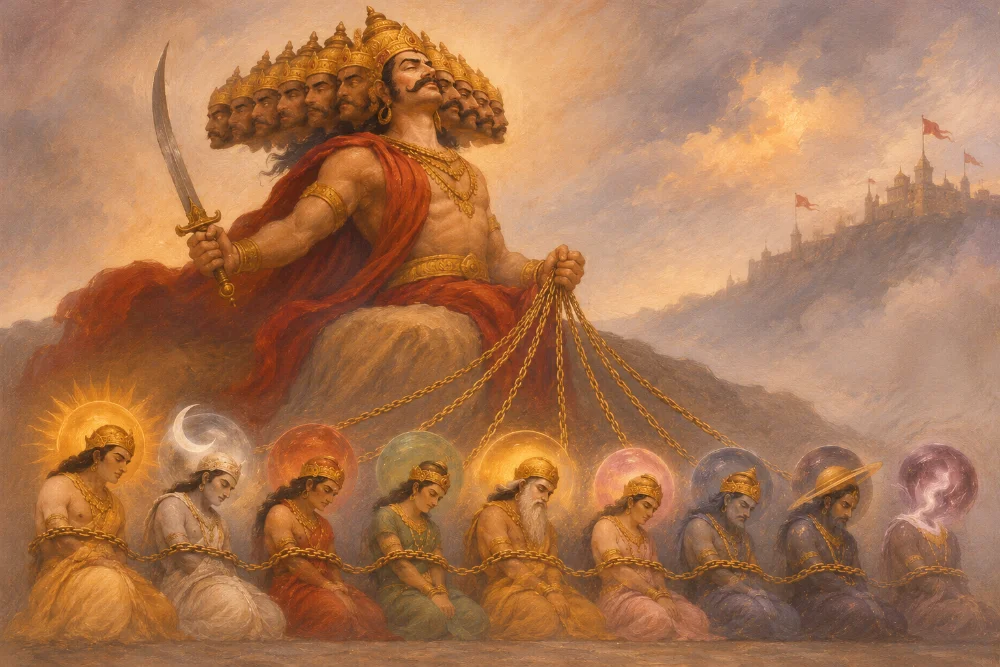

Rahu Mahadasha lasts eighteen years in the Vimshottari system. It is the fourth planetary period in the sequence and is governed by Rahu, one of the two lunar nodes.
Rahu occupies a distinctive position in Jyotisha. It is classified as a Chhaya Graha, or shadow planet, and does not possess an independent physical body like the seven visible planets. Its astrological results are therefore understood through its placement, sign dispositor, planetary associations and the houses it influences.
Rahu is frequently associated with ambition, worldly desires, unconventional pursuits, foreign connections, sudden developments and the breaking of established boundaries. Modern interpretations often describe its Mahadasha as a period of obsession, materialism, illusion and extraordinary worldly success.
However, classical Jyotisha presents a considerably wider picture. Brihat Parashara Hora Shastra describes the possibility of wealth, property, vehicles, children, religious inclination, recognition from foreign rulers and high positions during a well-supported Rahu Mahadasha. It also describes loss of position, mental distress, destruction of property and difficulties involving family when Rahu is weak or afflicted.
The eighteen-year period must therefore be judged through Rahu’s actual condition in the birth chart. Its sign, house, dispositor, associations, aspects and overall strength determine how its indications manifest.
1. The Nature and Significations of Rahu
Rahu is the ascending lunar node, the point at which the Moon’s orbit intersects the ecliptic while moving northward. Together with Ketu, the descending node, it forms the axis of the lunar nodes.
In traditional mythology, Rahu is identified with the head of Swarbhanu, who consumed Amrita during the churning of the cosmic ocean before Vishnu severed his head. The head became Rahu, while the remaining body became Ketu.
This mythology provides an important symbolic distinction between the two nodes, although their astrological interpretation must ultimately follow classical principles.
Parashara classifies Rahu among the naturally malefic Grahas. Its traditional characteristics and results must be examined through its placement and associations.
Several important dimensions are associated with Rahu.
Worldly ambition and desire: Rahu is associated with the pursuit of material objectives, acquisition and circumstances involving strong worldly aspirations. Its influence can make certain ambitions particularly prominent.
Foreign connections: Parashara specifically describes recognition from foreign rulers and gains through foreign governments under favourable Rahu conditions. Foreign associations and distant environments are therefore important considerations.
Unconventional circumstances: Rahu can signify situations that depart from established conventions, unfamiliar associations and circumstances that are difficult to anticipate through ordinary patterns.
Authority and political influence: The classical descriptions include royal recognition, administrative authority, influence over powerful people and acquisition of high positions under favourable conditions.
Sudden developments: Rahu’s results can involve unexpected gains or losses, changes in circumstances and developments that require careful judgement.
Material acquisition: Wealth, property, vehicles, agricultural resources, garments and ornaments appear among the favourable results described by Parashara.
These significations explain why Rahu Mahadasha can coincide with substantial changes in material circumstances, professional ambitions, social associations and one’s relationship with established institutions.
2. General Results of Rahu Mahadasha According to Parashara
Brihat Parashara Hora Shastra, Chapter 47, verses 34 to 43, provides the principal description of Rahu and Ketu and their Mahadasha results.
Parashara first establishes the dignity scheme of the two nodes. He then describes Rahu’s favourable and adverse results according to its placement, sign and associations.
When Rahu occupies a favourable sign, receives benefic aspects or association, and is placed in the 1st, 3rd, 4th, 7th, 10th or 11th house, the text describes favourable results.
These include:
- Acquisition of wealth and agricultural resources.
- Construction of a new house.
- Acquisition of vehicles with assistance from influential people or government.
- Birth of children and happiness through family.
- Religious inclination and participation in auspicious activities.
- Recognition from foreign governments and rulers.
- Acquisition of garments, ornaments and valuable possessions.
- Financial prosperity and comforts at home.
Parashara also identifies the 3rd, 6th, 10th and 11th houses as particularly favourable placements in his discussion of Rahu’s Antardasha within its own Mahadasha.
The adverse results are described when Rahu occupies the 8th or 12th house, is associated with malefics or Maraka planets, or occupies its prescribed debilitation sign.
These conditions may bring loss of position, destruction of residential property, mental distress, difficulties involving spouse and children, loss of wealth and other forms of adversity.
Parashara also describes a temporal progression during Rahu Mahadasha. The beginning may bring financial loss, followed by some relief and gains in one’s own country, while the concluding phase may bring distress and anxiety.
This is a traditional timing indication and should not be treated as an inevitable sequence for every individual. The actual progression depends on Rahu’s strength, placement, associations and the results of its Antardashas.
3. Rahu’s Dignity, Dispositor and Functional Considerations
Rahu requires a different method of assessment from the seven classical planets because its sign ownership is not universally established across Jyotisha traditions.
Unlock this Pro Content
Access Advanced Astrology with Astro Assured Pro
5. The Nine Antardashas of Rahu Mahadasha
Rahu Mahadasha lasts eighteen years and contains nine Antardashas. The sequence begins with Rahu itself, followed by Jupiter, Saturn, Mercury, Ketu, Venus, Sun, Moon and Mars.
| Antardasha | Approximate Duration |
|---|---|
| Rahu | 2 years, 8 months, 12 days |
| Jupiter | 2 years, 4 months, 24 days |
| Saturn | 2 years, 10 months, 6 days |
| Mercury | 2 years, 6 months, 18 days |
| Ketu | 1 year, 18 days |
| Venus | 3 years |
| Sun | 10 months, 24 days |
| Moon | 1 year, 6 months |
| Mars | 1 year, 18 days |
| Total | 18 years |
The durations follow the traditional 360-day Dasha year. Actual calendar dates may vary according to the calculation convention used.
The following are the principal considerations for each sub-period, drawing on BPHS Chapter 55.
Rahu Antardasha
The opening sub-period activates Rahu’s own significations. When Rahu occupies supportive houses, particularly the 3rd, 6th, 10th or 11th, or is associated with a strong Yogakaraka, Parashara describes gains involving property, authority, family happiness and recognition.
When Rahu occupies the 8th or 12th, or is associated with malefics, the period may bring disputes, financial loss, physical difficulties and anxiety.
Its dispositor and planetary associations are particularly important during this phase.
Jupiter Antardasha
Jupiter activates knowledge, teachers, children, wealth, Dharma and auspicious activities.
When strong and favourably placed, Parashara describes gains involving authority, property, vehicles, family happiness, children, charitable activities and religious observances.
A weak or afflicted Jupiter may bring financial loss, obstacles in professional activities, reputational difficulties and distress involving family members.
Saturn Antardasha
Saturn introduces work, discipline, service, responsibilities and long-term obligations.
A strong Saturn in a Kendra, Trikona, exaltation, own sign or Moolatrikona can support professional responsibilities, material gains, family celebrations and property-related developments.
A weak or afflicted Saturn may bring disputes, difficulties involving relatives, professional obstacles and distress involving spouse and children.
Mercury Antardasha
Mercury activates education, communication, commerce, business, intellect and analytical pursuits.
A strong Mercury may support Raja Yoga results, financial gains through business, marriage, conveyances, family happiness and professional recognition.
An afflicted Mercury may bring disputes, financial loss, difficulties involving government and unwise decisions. Its relationship with Saturn and Rahu must be examined carefully.
Ketu Antardasha
Ketu introduces separation, discontinuity and unusual circumstances.
Parashara describes possible foreign journeys, difficulties involving authorities, physical distress and loss of resources under adverse conditions.
However, a Ketu associated with benefics or the Lagna lord may produce gains, recognition, material acquisition and fulfilment of ambitions.
Its dispositor and associations are particularly important.
Venus Antardasha
Venus brings marriage, relationships, comforts, property, vehicles and material enjoyment into prominence.
A strong Venus in a Kendra, Trikona or 11th house can support wealth, recognition, high positions, family happiness, property and business profits.
A weak or afflicted Venus may bring disputes, diseases, financial loss and difficulties involving spouse and children.
Sun Antardasha
The Sun activates authority, father, government, reputation and leadership.
A strong Sun in exaltation, own sign, Kendra, Trikona or 11th house can support recognition from authorities, financial gains, professional advancement and fulfilment of ambitions.
A weak or afflicted Sun may bring disputes with government officials, health difficulties, financial loss and opposition from enemies.
Moon Antardasha
The Moon introduces the mind, mother, family, residence, nourishment and domestic circumstances.
A strong Moon in exaltation, own sign, Kendra, Trikona or 11th house can support wealth, family happiness, property, recognition and favourable developments involving children.
A weak or afflicted Moon may bring domestic disturbances, financial difficulties and mental distress.
Mars Antardasha
Mars activates courage, land, property, competition, physical energy and action.
A strong Mars may support recovery of lost property, financial gains, professional authority, recognition and success in undertakings.
An afflicted Mars may bring disputes, injuries, loss of position, physical difficulties and distress involving spouse, children and siblings.
These descriptions are conditional. Each Antardasha lord must be judged through its own house ownership, dignity, placement and relationship with Rahu.
6. Rahu Mahadasha and Profession and Worldly Ambitions
Rahu has a particularly important relationship with ambition, material acquisition and positions of influence.
Its Mahadasha may bring opportunities to pursue objectives that were previously inaccessible or to enter professional environments that differ from one’s established circumstances.
Parashara specifically describes recognition from foreign rulers, acquisition of wealth through influential associations, government support and attainment of high positions under favourable Rahu conditions.
In contemporary circumstances, such indications may manifest through international business, foreign employment, multinational institutions, unconventional professional fields or opportunities involving unfamiliar markets and networks.
A well-supported Rahu connected with the 10th or 11th house can become particularly significant for professional advancement and material gains.
However, Rahu does not independently determine one’s profession. The 10th house, its lord, Saturn, the dispositor and Dashamsa must be examined together.
A weak or afflicted Rahu may instead bring instability, conflicts with authorities, damage to reputation and difficulties arising from questionable associations or decisions.
The important distinction is between the ability to pursue ambitious objectives and the capacity to sustain the results obtained through them.
7. Rahu Mahadasha and Foreign Connections
Foreign connections occupy a prominent position in Parashara’s description of Rahu Mahadasha.
The text explicitly mentions recognition from foreign governments and rulers, acquisition of wealth through foreign authorities, and favourable circumstances arising through influential associations.
Rahu’s connection with distant environments can become particularly significant when it occupies or influences the 9th, 10th or 12th houses, or is connected with their lords.
Its dispositor and relationship with the relevant houses must be examined before judging foreign travel, employment or settlement.
A well-supported Rahu may coincide with opportunities involving foreign countries, international business, distant institutions and unfamiliar professional environments.
However, foreign settlement cannot be predicted from Rahu alone. The 4th, 9th and 12th houses, their lords, the relevant divisional charts and the operating Antardasha must also support such developments.
Similarly, foreign connections do not necessarily indicate permanent relocation. They may manifest through professional relationships, travel, business or institutional associations.
8. Rahu Mahadasha and Material Prosperity
Rahu is frequently associated with intense worldly ambition, but Parashara’s descriptions provide a more specific framework.
A well-placed Rahu can bring wealth, agricultural resources, property, vehicles, garments, ornaments and recognition from influential people.
Its relationship with the 2nd and 11th houses can be particularly relevant when examining financial acquisition.
A strong dispositor and favourable associations can support material progress, while affliction may bring unstable gains, financial loss and difficulties involving property.
Rahu’s influence may also increase the importance of ambition and acquisition during its Mahadasha. However, the desire for wealth and the actual capacity to accumulate it are different matters.
Financial results must therefore be judged through the 2nd and 11th houses, their lords, Dhana Yogas, the 10th house and the overall strength of the Kundali.
9. Rahu Mahadasha and Spiritual and Religious Inclination
Although Rahu is frequently associated with material ambition, Parashara explicitly includes religious inclination and Dharma-related activities among the favourable results of a well-supported Rahu Mahadasha.
The text describes religious thought, auspicious activities and favourable circumstances involving influential people alongside material prosperity.
This is important because it prevents Rahu from being reduced to a purely materialistic or worldly planet.
Its Mahadasha may bring developments involving religious institutions, unfamiliar traditions, philosophical inquiry or a change in one’s established approach to Dharma.
However, spiritual development cannot be inferred from Rahu alone.
The 5th, 9th and 12th houses, their lords, Jupiter and relevant spiritual combinations must be examined. Ketu may also become important depending on the broader configuration.
Rahu’s association with unconventional circumstances may coincide with exposure to unfamiliar ideas, but whether these developments become constructive depends on the condition of the relevant planets and houses.
10. Classical Remedies During Rahu Mahadasha
Brihat Parashara Hora Shastra Chapter 55 prescribes specific remedial measures for difficult Antardashas within Rahu Mahadasha.
For Rahu’s own Antardasha, the text recommends worship of Rahu through appropriate Mantra recitation and charity involving objects associated with the planet.
Other Antardashas have their own prescriptions, including worship, recitation and charitable measures according to the planetary period and the specific affliction described.
These prescriptions should not be combined into a universal remedy for everyone undergoing Rahu Mahadasha.
The condition of Rahu, its dispositor, the nature of its affliction and the operating Antardasha must first be established.
A gemstone or ritual should not be recommended merely because Rahu is placed in a particular house or because someone is entering its eighteen-year period.
Classical remedies are best understood as responses to specific planetary conditions rather than generic prescriptions for an entire Mahadasha.
Conclusion
Rahu Mahadasha is an eighteen-year period in which ambition, material acquisition, foreign connections, unconventional circumstances and positions of influence may become particularly significant.
Classical Jyotisha describes the potential for wealth, property, recognition, professional advancement and religious inclination when Rahu is favourably placed and supported by benefic influences. It also recognises loss of position, mental distress, family difficulties and financial instability when Rahu is weak or afflicted.
Its interpretation requires particular attention to the sign dispositor, planetary associations, aspects and the houses it occupies or influences. Its dignity must also be understood within the particular classical tradition being followed.
The nine Antardashas introduce additional planetary influences, creating different phases within the eighteen-year period. Their results depend on the relationship between each sub-period lord and Rahu, as well as the promises contained in the birth chart.
Ultimately, Rahu Mahadasha is not simply a period of ambition, illusion or materialism. It is a period in which Rahu’s role within the individual Kundali becomes active, bringing its opportunities, uncertainties and limitations into greater prominence.
Frequently Asked Questions About Rahu Mahadasha
What is Rahu Mahadasha in Vedic astrology and how long does it last?
Rahu Mahadasha is an 18-year major planetary period in the Vimshottari Dasha system ruled by Rahu, the North Node of the Moon. Representing worldly ambition, innovation, unconventional paths, and intense material desire, this period shifts focus from the direct physical action of Mars Mahadasha toward rapid expansion, foreign connections, and breaking traditional boundaries.
What are the positive effects of a well-placed Rahu Mahadasha?
When Rahu is well-placed in Upachaya houses (3rd, 6th, 10th, or 11th) or supported by strong benefic dispositors, these 18 years can deliver sudden rise in status, extraordinary financial gains, technological breakthroughs, and success in foreign lands. Natives often gain mass influence, political power, or recognition in pioneering fields.
How does Rahu Mahadasha influence career, foreign travel, and ambition?
Because Rahu thrives on novelty, global networks, and disruptive thinking, this Mahadasha strongly favors careers in technology, media, aviation, international trade, research, politics, and digital entrepreneurship. Relocation abroad or working across diverse cultures frequently becomes a defining theme.
Can Rahu Mahadasha cause illusion, anxiety, or sudden setbacks?
Yes, because Rahu is a shadow planet (Chhaya Graha) without a physical form, an afflicted Rahu or weak dispositor can create mental restlessness, obsessive desires, overambitious miscalculations, or sudden reversals. It can also bring misunderstandings in relationships or elusive health issues linked to stress and nervous exhaustion.
How can one stay grounded during Rahu Mahadasha?
Navigating Rahu’s amplifying energy requires ethical integrity, clear discernment between genuine opportunity and illusion, and avoiding shortcuts. Practicing daily meditation, maintaining transparent communication, and seeking wise mentorship help channel Rahu Mahadasha into sustainable innovation and growth.
Classical References
- Brihat Parashara Hora Shastra: Chapter 46, Vimshottari Dasha; Chapter 47, verses 34-43, dignity and results of Rahu and Ketu Mahadashas; Chapter 55, results of the nine Antardashas within Rahu Mahadasha; Chapter 34, functional lordship and planetary associations.
- Phaladeepika by Mantreswara: Chapter 2, natural planetary characteristics; Chapter 19, Rahu Mahadasha results; Chapter 21, Antardasha results.
- Jataka Parijata by Vaidyanatha Dikshita: Chapter 18, results of Rahu Mahadasha and its subordinate periods.
- Sarvartha Chintamani: Rahu’s planetary results, placement-based interpretations and Dasha considerations.
- Saravali by Kalyana Varma: Planetary characteristics, associations and house-related indications.
Note: Chapter and verse numbering may vary between editions and recensions. References above follow the editions consulted for this article.