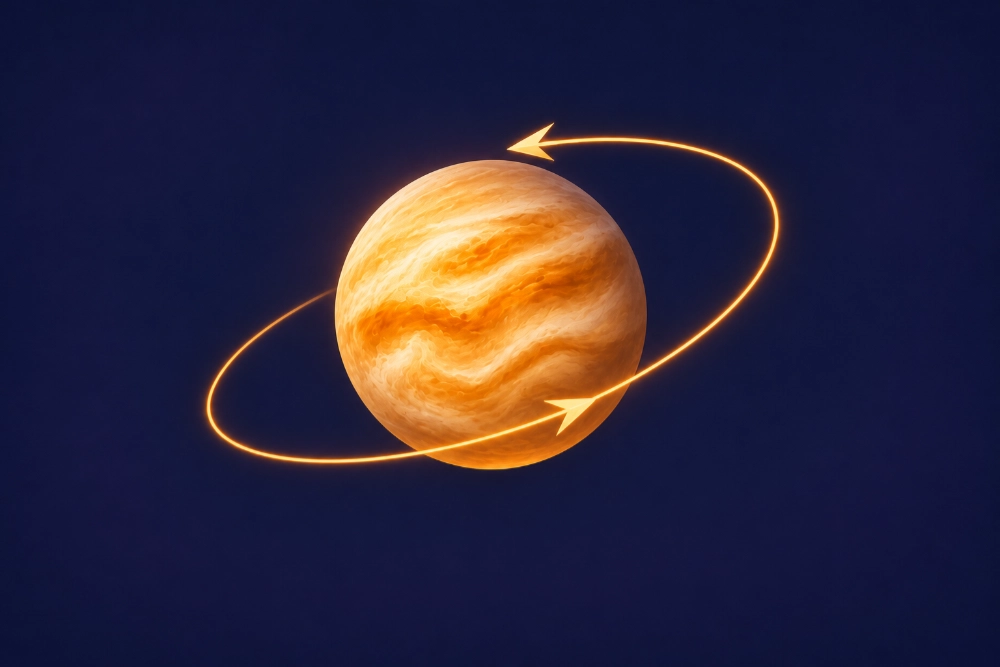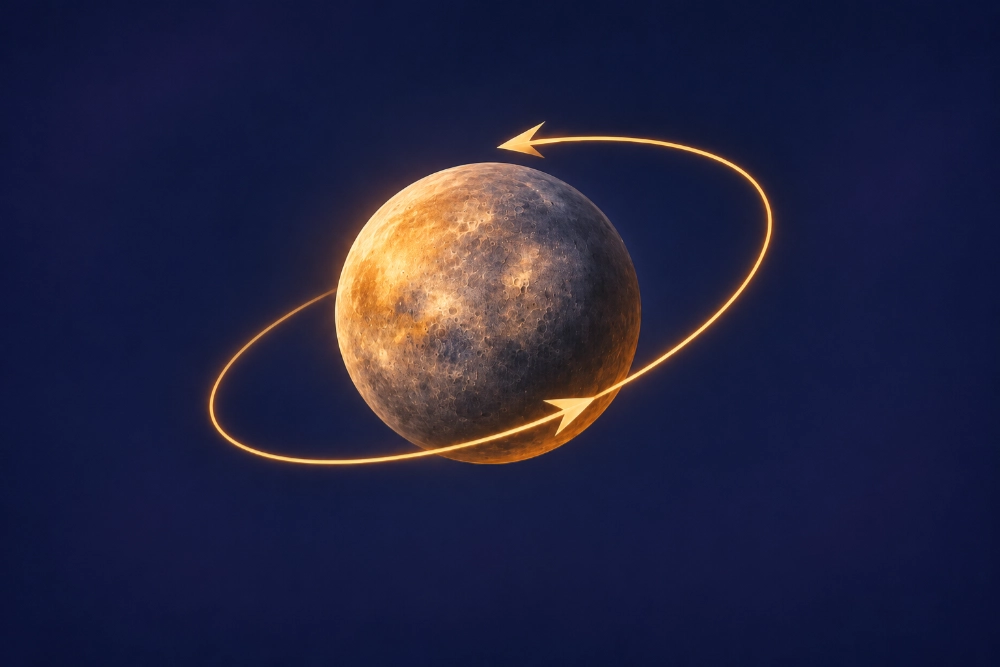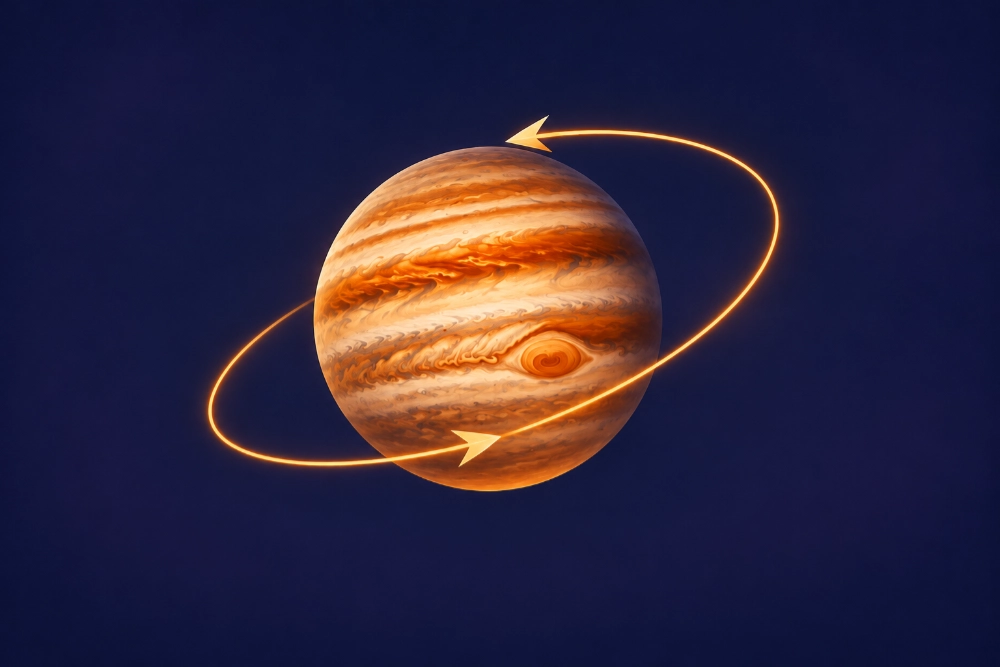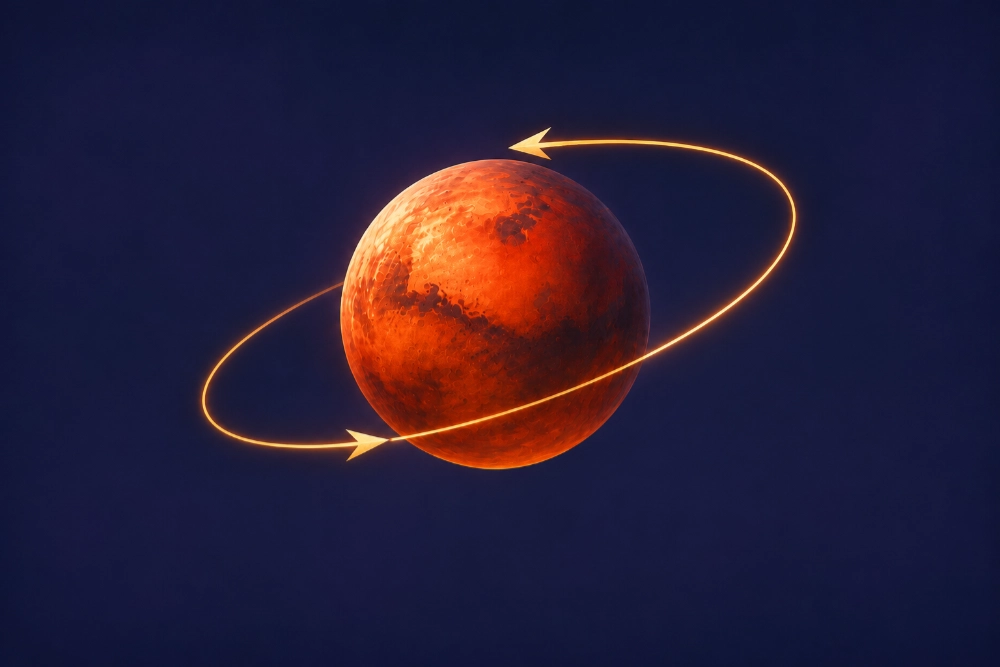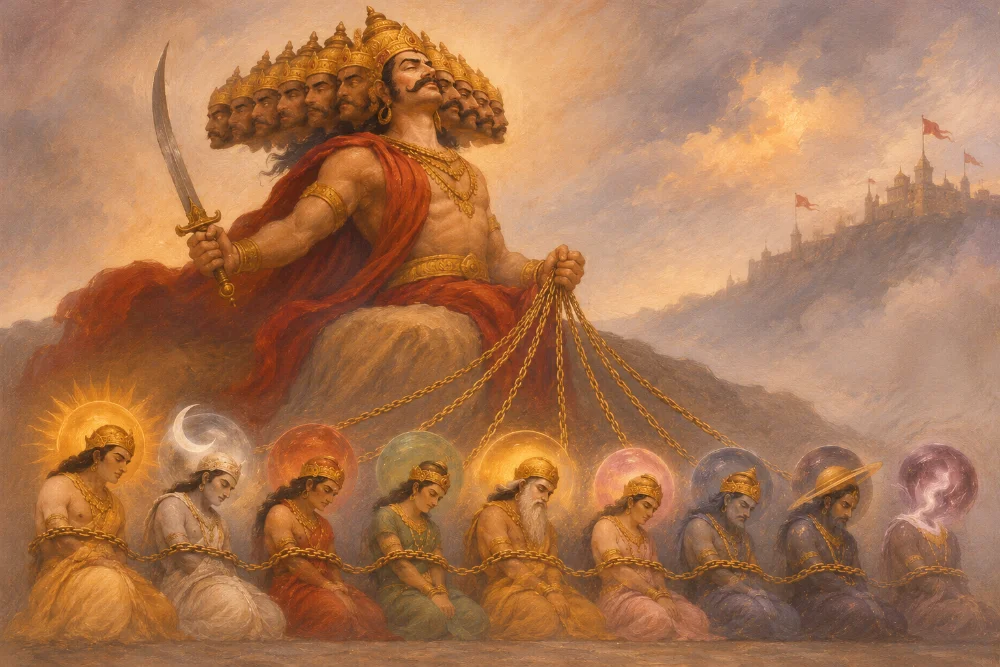

In Vedic astrology, planetary motion is an important consideration in determining the strength and results of a Graha. Among the various planetary conditions, retrogression, known as Vakra Gati, holds particular significance because classical Jyotisha associates it with increased motional strength.
A retrograde planet appears to move backwards through the zodiac when observed from Earth. Although this is an apparent astronomical phenomenon rather than an actual reversal of its orbital direction, traditional astrology assigns specific significance to this condition.
Classical authorities such as Maharishi Parashara and Mantreshwara discuss retrograde motion in connection with planetary strength, particularly Cheshta Bala, one of the six components of Shadbala. Their teachings establish that retrogression is not inherently a condition of weakness. In fact, a retrograde planet is traditionally considered to possess considerable motional strength.
However, planetary strength and the auspiciousness of its results are two different considerations. A planet may be powerful while simultaneously producing challenging results, depending on its natural characteristics, functional lordship, sign dignity, house placement and associations.
Understanding this distinction is essential to interpreting retrograde planets correctly.
This article examines the classical principles governing Vakri Grahas, their contribution to planetary strength, their influence on Dasha results and the method of interpreting retrograde planets in a birth chart.
1. What Is a Retrograde Planet in Vedic Astrology?
The Sanskrit term Vakra (वक्र) means crooked, bent or deviating from a straight course. In Jyotisha, Vakra Gati refers to the apparent backward movement of a planet against the background of the zodiac.
Ordinarily, planets appear to progress through the zodiac in the forward direction, from one sign to the next. During retrogression, however, their apparent movement reverses, causing them to traverse the preceding degrees of the zodiac.
This phenomenon is known as retrograde motion.
From an astronomical perspective, planetary retrogression occurs because of the relative orbital movements of Earth and the other planets. When observed from Earth, the changing relative positions of these celestial bodies create the appearance that a planet has temporarily reversed its direction.
The planet does not physically reverse its orbital movement around the Sun.
In Vedic astrology, however, the apparent motion observed from Earth forms part of the traditional system of planetary evaluation. Consequently, retrogression is treated as a distinct planetary condition rather than dismissed merely because it is an apparent phenomenon.
Which Planets Can Become Retrograde?
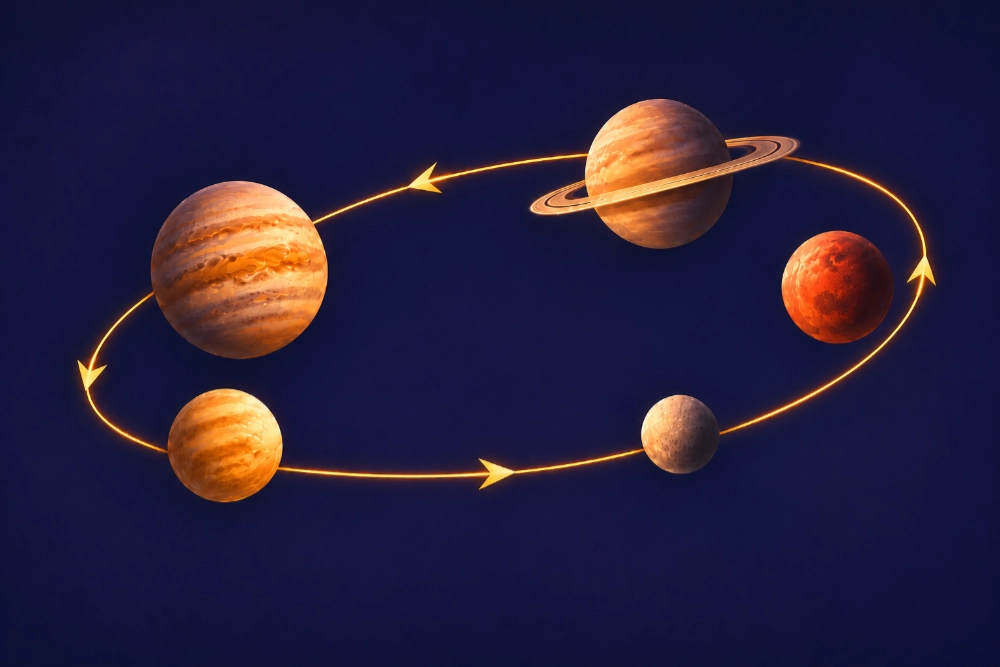
Among the nine Grahas traditionally considered in Vedic astrology, five planets periodically undergo retrogression:
- Mars (Mangala)
- Mercury (Budha)
- Jupiter (Guru)
- Venus (Shukra)
- Saturn (Shani)
The Sun and Moon do not undergo apparent retrograde motion in the conventional geocentric system.
Rahu and Ketu are different. These lunar nodes are conventionally treated as retrograde because of their characteristic apparent movement through the zodiac. Their motion and interpretation must be distinguished from the periodic retrogression of the five visible planets.
This distinction is important because the classical calculations of Shadbala do not treat the lunar nodes in the same manner as the seven planets from the Sun to Saturn.
2. Vakra Gati in Classical Jyotisha
One of the most important references concerning planetary motion appears in the Brihat Parashara Hora Shastra, in the chapter dealing with the evaluation of planetary strengths.
In Chapter 27, Maharishi Parashara describes eight different types of planetary motion.
The relevant Sanskrit verse reads:
चक्रानुवक्रा विकला मन्दा मन्दतरा समा ।
चरा चाऽतिचरा चेति ग्रहाणामष्टधा गतिः ॥
Cakrānuvakrā vikalā mandā mandatarā samā,
carā cāticarā ceti grahāṇām aṣṭadhā gatiḥ.
The verse establishes that planetary motion is eightfold.
The eight classifications are:
- Chakra: Direct or ordinary forward motion.
- Anuvakra: Retrograde movement involving entry into the preceding sign.
- Vikala: A stationary or nearly motionless condition.
- Manda: Slow motion.
- Mandatara: A still slower condition.
- Sama: Mean or normal motion.
- Chara: Accelerated motion.
- Atichara: Very rapid motion.
These classifications describe different conditions of planetary movement as observed through traditional astronomical calculations.
The distinction between Vakra and Anuvakra is particularly interesting. Vakra refers to retrograde motion, whereas Anuvakra describes a specific stage involving movement into the preceding zodiacal sign.
Similarly, Vikala represents the stationary or nearly stationary phase associated with the turning points of planetary motion.
The eightfold classification demonstrates that classical Jyotisha does not consider planetary motion to be a simple distinction between direct and retrograde. It recognises several gradations of movement and assigns different strengths to them.
This is important when studying retrogression because a planet’s motion is considered within a broader framework of astronomical and mathematical evaluation.
3. Cheshta Bala: Why Retrograde Planets Are Considered Strong
Cheshta Bala (चेष्टाबल) is one of the six components of Shadbala, the classical sixfold system of planetary strength.
Unlock this Pro Content
Access Advanced Astrology with Astro Assured Pro
9. How to Interpret a Retrograde Planet in a Birth Chart
The presence of a retrograde planet should prompt a detailed examination of its condition rather than an immediate judgement about its results.
A systematic interpretation should consider the following factors.
1. Natural significations
Begin with the natural significations of the planet.
For example, a retrograde Venus must still be examined through its significations of marriage, relationships, comforts, artistic abilities and material pleasures.
Retrogression does not erase the planet’s natural significations.
2. Functional lordship
Examine which houses the planet owns from the Ascendant.
Determine whether it functions as a benefic, malefic or mixed influence for the particular horoscope.
This is essential because the same planet can have substantially different functional roles for different Ascendants.
3. House placement
The house occupied by the retrograde planet identifies the area of life through which its results become prominent.
A retrograde Jupiter in the 5th house and a retrograde Jupiter in the 8th house should not be interpreted identically.
The planet’s lordship must also be considered alongside its placement.
4. Sign dignity
Determine whether the planet occupies an exalted, debilitated, own, Moolatrikona, friendly, neutral or inimical sign.
This helps establish its positional condition independently of its motional strength.
5. Dispositor
Examine the condition of the sign lord.
A planet’s dispositor can significantly influence how its results manifest.
The dispositor’s dignity, house placement, strength and associations should therefore be evaluated.
6. Conjunctions and aspects
Examine the planets associated with or aspecting the retrograde Graha.
The influence of benefics and malefics, particularly when considered through functional lordship, may substantially modify its results.
Planetary war and combustion should also be examined wherever applicable.
7. Divisional charts
The Navamsha (D9) should be considered when evaluating the underlying dignity and strength of a planet, alongside its Rashi placement.
Other divisional charts should be selected according to the subject being examined.
For example, the Dashamsha (D10) becomes relevant for professional matters, while the Saptamsha (D7) is considered for matters relating to children.
A divisional chart should supplement the interpretation of the birth chart rather than replace it.
8. Shadbala and other strength considerations
Where accurate planetary-strength calculations are available, examine the complete Shadbala rather than relying exclusively on retrogression.
A planet’s Cheshta Bala is important, but it is only one component of its total strength.
9. Dasha and Antardasha
Finally, examine the operating planetary periods.
The results of a retrograde planet become particularly relevant during its Mahadasha and Antardasha, subject to the overall condition of the horoscope.
The specific classical rule concerning the reversed Drekkana sequence should also be considered where applicable.
10. Common Misconceptions About Retrograde Planets
Retrogression is frequently associated with a number of interpretations that are presented as universal rules despite lacking sufficient classical support.
Some of the most common misconceptions deserve clarification.
Misconception 1: Every retrograde planet is weak.
This contradicts the classical principles of Cheshta Bala. Parashara and Mantreshwara explicitly recognise retrogression as a source of planetary strength.
Misconception 2: Every retrograde planet is stronger than every direct planet.
Retrogression contributes motional strength, but the overall strength of a planet must be determined through Shadbala and other relevant considerations.
Misconception 3: Retrograde planets always delay results.
The classical principle concerning retrograde Dasha results in BPHS describes a reversal in the sequence of Drekkana-related effects. It does not establish that all retrograde planets invariably delay their results.
Misconception 4: A retrograde planet behaves like a debilitated planet.
This should not be adopted as a universal classical rule. Phaladeepika explicitly recognises the strength of a retrograde planet even when it occupies a debilitated or inimical sign.
Misconception 5: Retrogression cancels debilitation.
Increased motional strength is not equivalent to cancellation of debilitation. Neechabhanga must be examined through its own applicable conditions.
Misconception 6: Retrograde planets give the results of the previous sign.
The fact that a planet appears to move backwards does not, by itself, establish that it should be interpreted as occupying the preceding sign. Its actual zodiacal position remains the foundation of chart interpretation.
Misconception 7: Retrograde benefics always produce favourable results.
A natural benefic may be a functional malefic for a particular Ascendant. Its lordship, dignity and placement must be considered before judging its results.
Misconception 8: Retrograde malefics always produce destructive results.
A natural malefic may function as a Yogakaraka or otherwise become favourable through its house ownership. Retrogression alone cannot determine the final outcome.
Misconception 9: Retrogression reverses the natural significations of a planet.
There is insufficient basis to treat this as a universal classical doctrine. The natural significations of the Graha remain relevant.
11. Conclusion: Understanding the True Significance of Vakri Grahas
Retrograde planets occupy a distinctive position in classical Vedic astrology because their apparent movement contributes to the assessment of planetary strength.
The teachings of Brihat Parashara Hora Shastra and Phaladeepika establish that retrogression is an important source of Cheshta Bala. A retrograde planet should therefore not be dismissed as weak merely because of its unusual motion.
At the same time, increased motional strength does not automatically make a planet auspicious. Its natural significations, functional lordship, sign dignity, house placement, dispositor, associations and overall strength must all be considered.
The classical discussion of retrograde planets also extends into the interpretation of planetary periods. Parashara’s teaching concerning the reversed sequence of Drekkana-related Dasha results is a particularly important example.
Ultimately, Vakra Gati is one condition within the broader science of planetary evaluation. It modifies the assessment of a Graha but does not independently determine the destiny of the native.
The correct understanding of a retrograde planet, therefore, lies not in assigning it a fixed positive or negative meaning, but in examining how its motion, strength and position interact with the complete horoscope.
Classical References
- Brihat Parashara Hora Shastra
- Chapter 27, verses 21–25: Eight types of planetary motion and Cheshta Bala.
- Chapter 27, verses 32–40: Shadbala requirements and the use of planetary strength in prediction.
- Chapter 28: Ishta and Kashta Bala.
- Chapter 47, verses 1–6: Dasha results according to planetary strength, placement and the reversed Drekkana sequence for retrograde planets.
- Phaladeepika by Mantreshwara
- Chapter 4, verses 1–5: Sixfold planetary strength and the strength associated with retrogression.
- Saravali by Kalyana Varma
- Chapter 40, verse 68: Results of the Dasha of a retrograde planet.
Editorial note: Sanskrit readings and verse numbering should be checked against the chosen printed edition before publication, as variations occur between published recensions and translations of classical Jyotisha texts.