
Pro Summary
Kabir’s mystical poem Naiharwa Humka Na Bhave beautifully captures the profound moment a spiritual seeker realizes the material world can never be the soul’s true home. Using the poignant metaphor of a bride who has outgrown her parental residence, the poem explores the deep ache of viraha, the intense longing for the Divine. The seeker finds themselves caught in a deeply human struggle, torn between the distracting dance of worldly pleasures and an unshakeable spiritual yearning. Unable to find the path to the Beloved’s city alone, the seeker must rely on the Satguru to bridge the gap between the temporary world and ultimate truth.
Ultimately, the poem reveals that this spiritual journey is not about escaping the world, but transforming how we relate to it. The desperate outward search gracefully resolves into a quiet inner revelation when the Beloved finally comes to the seeker to extinguish the fire of separation. Kabir reminds us that true awakening rarely begins with having all the answers. Instead, it starts with the honest, aching recognition that our familiar life is merely a temporary residence, and the soul has finally begun to remember where it truly belongs.

There comes a point in the life of a spiritual seeker when nothing may appear to be terribly wrong, yet something within no longer feels satisfied. The same world that once seemed familiar begins to feel strangely distant. One continues to work, love, eat, speak, pursue ambitions and live an ordinary life, but somewhere underneath it all arises a quiet question: Is this really home?
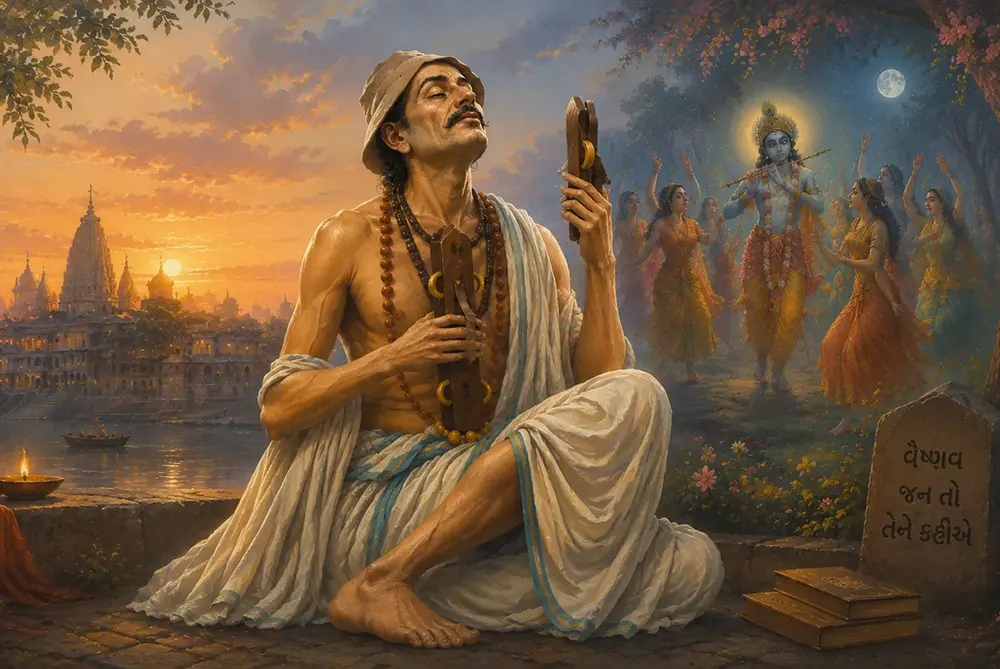
Kabir captures this experience with extraordinary simplicity in Naiharwa Humka Na Bhave. The word naihar means the parental home of a married woman, the place where she was born and raised, before she belongs to her husband’s home. Kabir turns this familiar image into a mystical metaphor. The seeker is like a bride who has remembered her Beloved and can no longer feel completely at home where she was born.
This is not simply a poem about rejecting the world. It is about awakening to the sense that the world, however beautiful or compelling, cannot be the final home of the soul.
Naiharwa Humka Na Bhave
The poem is found in different textual and musical versions, and some of the lines vary between popular renditions. The following presents the familiar core of the composition and its meaning.
Naiharwa humka na bhave
Sai ki nagari param ati sundar, jahan koi jaye na aaveChand suraj jahan, pavan na pani, kaun sandesh pahunchave?
Dard yah Sai ko sunaveBiraha zor jarave, vishay ras naach nachave
Bin Satguru apno nahi koiKahat Kabira, suno bhai sadho, sapne preetam aave
Tan man ki agan bujhave
A translation in spirit
My parental home no longer pleases me.
The city of my Beloved is supremely beautiful,
yet no one goes there and no one returns.
There is neither sun nor moon there,
neither wind nor water.
Who will carry my message there?
Who will tell my Beloved of the pain I suffer here?
The fire of separation burns intensely,
while the pleasures of the senses make me dance.
Without the true Guru, I have no one who is truly mine.
Kabir says, listen, seekers:
the Beloved comes to me in a dream
and extinguishes the fire burning within.
The exact wording varies across versions, particularly in the middle and final portions, but the spiritual movement remains remarkably consistent.
What is Kabir saying?
The first line contains the key to the entire poem.
Naihar literally means the parental home. But Kabir is not merely talking about a physical house. In the mystical reading, it becomes the world in which we currently find ourselves: the body, our identities, our relationships, our sensory experiences and the attachments through which we ordinarily define our lives.
The Beloved’s city, Sai ki nagari, represents something altogether different. It is not another geographical place that one can reach by travelling far enough. Kabir describes it as a realm beyond the ordinary sensory world: there is no familiar sun or moon, no wind or water, and no ordinary coming and going. It is the realm of the Divine, beyond the conditions through which we normally experience existence.
And this creates the seeker’s predicament.
He remembers the Beloved, but does not know the road.
The old home no longer satisfies him, yet he does not know how to reach the new one.
That is perhaps one of the most honest descriptions of the spiritual path.
The Fire of Separation
Kabir calls this longing viraha, the pain of separation from the Beloved.
Viraha is not merely sadness. In mystical traditions, separation itself can become a form of remembrance. When the Beloved is absent, the mind continually turns towards the Beloved. The very pain of absence keeps the object of longing alive within consciousness.
This is why Kabir’s poem is not simply about dissatisfaction with worldly life.
The seeker is pulled in two directions.
On one side is the longing for Sai. On the other is vishaya-rasa, the taste and pleasure of the senses.
Kabir says that the pleasures of the senses make him dance.
That line is remarkably important. The seeker does not suffer simply because God seems distant. He also suffers because everything around him continually pulls his attention outward. The senses offer their pleasures, the world offers its attractions, and ordinary life keeps demanding participation.
The heart longs for the Beloved, while the senses keep dancing to the world.
This is the tension that makes the poem so human.
Kabir does not present the spiritual seeker as someone who has already conquered everything. He presents someone who has awakened enough to know that the old life is not enough, while still being deeply entangled in it.
And then comes the Satguru.
The Road the Seeker Cannot Find
There is a point in the poem where longing alone is not sufficient.
The seeker knows that the Beloved exists. He knows that the world cannot provide what he is seeking. But knowing this does not automatically reveal the path.
This is why Kabir’s invocation of the Satguru is so significant.
Without the true Guru, he says, there is no one who is truly his.
The Guru is not merely someone who provides information or teaches a philosophy. In Kabir’s mystical framework, the Satguru is the one who knows the road because the ordinary mind cannot discover it simply through worldly knowledge.
The progression is almost like a conversation:
I no longer feel at home here.
I know there is another home.
I cannot find the way there.
Who will show me the way?
The Satguru.
This is also why Kabir’s spirituality should not be reduced to escapism. He is not simply saying, “The world is unpleasant, so leave it.” His problem is deeper. He has begun to recognize that mistaking the temporary for the ultimate cannot resolve the deepest longing within him.
The world may remain exactly where it is.
What changes is the seeker’s relationship with it.
When the Soul Remembers Its Home
Perhaps the most beautiful movement in Naiharwa comes at the end.
The seeker initially imagines that he must somehow reach the Beloved’s city. Yet he cannot find the road. The destination is beyond ordinary movement, and the senses continue to pull him back.
Then the direction changes.
The Beloved comes to him.
Kabir speaks of the Beloved appearing in a dream and extinguishing the fire within. This can be understood literally as a dream, but it can also be heard as the language of an inner revelation: a moment in which the distance between seeker and Beloved temporarily disappears.
There are, in a sense, three homes in the poem.
There is Naihar, the home where we were born and where our worldly identity has been formed.
There is Sai ki nagari, the incomprehensible home of the Beloved that lies beyond ordinary sensory existence.
And then there is the inner space in which the Beloved finally reveals Himself.
The seeker begins by thinking, I must go there.
Then comes, I do not know the way.
Then, I need the Guru.
And finally, the Beloved comes to me.
That movement from external seeking to inner revelation is one of the deepest reasons this poem continues to resonate.
Kabir himself was relentlessly concerned with the question of what is real beneath the identities and religious forms through which human beings ordinarily understand themselves. His poetry repeatedly turns the seeker away from merely looking outward and towards direct recognition of the Divine.
This is also why his use of the bride and Beloved is so powerful. Kabir belongs to the Nirgun stream, speaking of the Divine as ultimately beyond form and attributes, yet he uses the language of intimate love to approach what cannot easily be described. The formless becomes the Beloved. The soul becomes the bride. Philosophy becomes longing.
And perhaps that is the point.
Some truths cannot be adequately communicated as doctrines. They have to be experienced as a longing so deep that ordinary answers cease to satisfy.
For a spiritual seeker, Naiharwa Humka Na Bhave therefore carries a timeless message.
There may come a time when you do not hate the world, yet you no longer mistake it for your final destination. You continue to live in it, but something within you has begun looking beyond it. You may not yet know where you are going. You may even feel lost between the life you have outgrown and the truth you have not yet realized.
Kabir does not tell us to solve that tension intellectually.
He gives it a name.
Viraha.
The ache of remembering something you cannot yet fully reach.
And perhaps the spiritual path begins precisely there: not when we have found the answer, but when we have become honest enough to admit that the old answers are no longer enough.
Naiharwa humka na bhave.
My old home no longer satisfies me.
Maybe this does not mean that the world has become meaningless.
Maybe it means that the soul has begun to remember where it belongs.
And once that memory awakens, everything else begins to feel like a temporary residence.