
Few political figures in modern India have inspired as much fascination, admiration, criticism, and debate as Narendra Modi. To some, he represents decisive leadership, nationalism, and India’s rise on the global stage. To others, he symbolizes political centralization, ideological rigidity, and deep polarization. Yet beyond politics lies a more intriguing question: what kind of human being becomes Narendra Modi?
His life story does not resemble the journey of a conventional ruler born into privilege or political legacy. It resembles the story of a man who slowly detached himself from ordinary life and rebuilt his identity around mission, discipline, power, and destiny.
Born into a financially modest family in Vadnagar, Gujarat, Narendra Modi’s early life carried none of the signs of future authority. He helped his father sell tea at a railway station, lived a simple life, and grew up far away from India’s elite political circles. Yet over the decades, he transformed himself from an RSS worker into the Chief Minister of Gujarat and eventually the Prime Minister of India.
Astrologically, his Kundali is equally unusual. It is not the chart of effortless comfort. It is the chart of struggle, reinvention, emotional isolation, ideological intensity, and karmic destiny. The rise does not happen through inheritance or luck alone. It happens through endurance, timing, discipline, psychological control, and an extraordinary ability to survive controversy.
Narendra Modi Kundali
Birth Details
- Date: 17 September 1950
- Time: 9:34 AM
- Place: Vadnagar, Gujarat, India
- Ascendant: Libra
- Rashi: Scorpio
- Nakshatra (Moon): Anuradha (Pada 2)
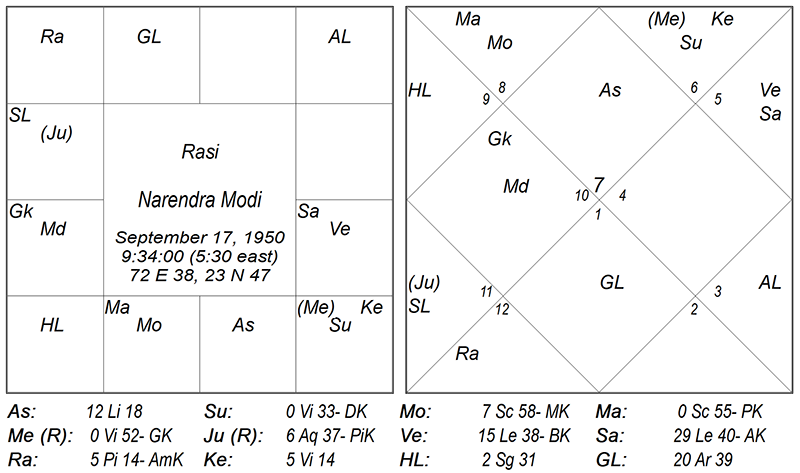
Rasi Chart (D1)
Moon Chart
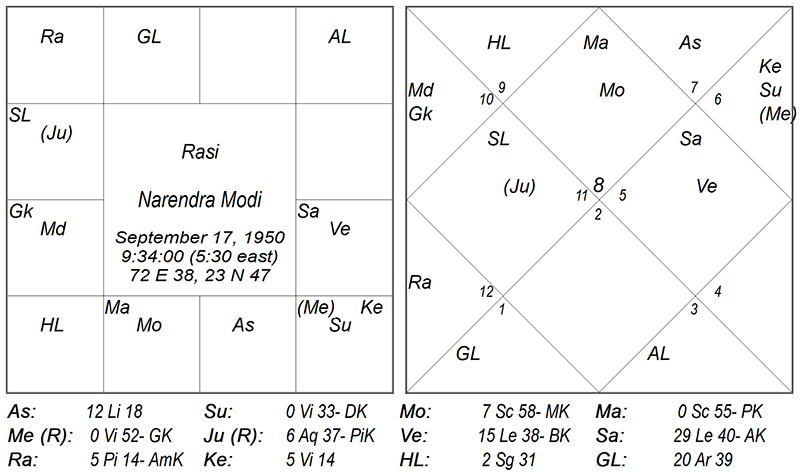
Navamsa Chart (D9)
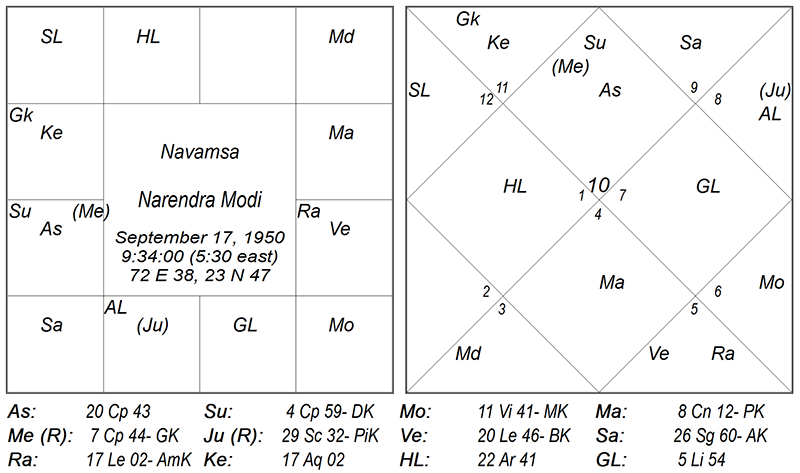
Birth Chart Overview
Narendra Modi’s Kundali rises with Libra Ascendant, a sign associated with diplomacy, presentation, image consciousness, and public engagement. But unlike a soft or socially accommodating Libra personality, this chart carries immense Saturnian and Scorpionic intensity beneath the surface.
The most important placements include:
- Libra Ascendant
- Moon and Mars in Scorpio in the 2nd house
- Jupiter in Aquarius in the 5th house
- Rahu in Pisces in the 6th house
- Venus and Saturn in Leo in the 11th house
- Sun, Mercury, and Ketu in the 12th house
The chart immediately reveals three dominant themes:
- detachment from ordinary personal life,
- relentless long-term ambition,
- and a destiny tied to mass influence.
This is not a chart built for anonymity.
The Emotional Core of the Chart
One of the most revealing placements in Modi’s Kundali is the Moon in Scorpio.
Debilitated Moon + Mars Conjunction = Neech Bhang Raja Yoga
The Moon represents emotional nature, psychological comfort, public connection, and inner security. In Scorpio, the Moon becomes emotionally intense, guarded, strategic, and deeply transformative. It creates a personality that rarely reveals vulnerability openly.
But this placement becomes even more significant because the Moon is debilitated. A debilitated Moon often indicates emotional turbulence, loneliness, distrust, or a feeling of psychological displacement. However, the conjunction with Mars creates Neech Bhang Raja Yoga, transforming emotional weakness into power through struggle.
This is one of the defining signatures of Narendra Modi’s life.
Instead of breaking under pressure, he appears to gain strength through crisis. Opposition sharpens his identity rather than dissolving it. Controversy intensifies his public image instead of diminishing it. The chart repeatedly suggests a person who psychologically adapts to conflict and converts emotional intensity into ambition and action.
This placement also explains his highly controlled emotional expression. Despite being one of the most visible political figures in the world, he often appears psychologically solitary. Publicly expressive, yet privately inaccessible.
This content is a preview of the quality and depth available inside Astro Assured Pro. Become a Pro Member to unlock advanced astrology, exclusive tools, and premium research.
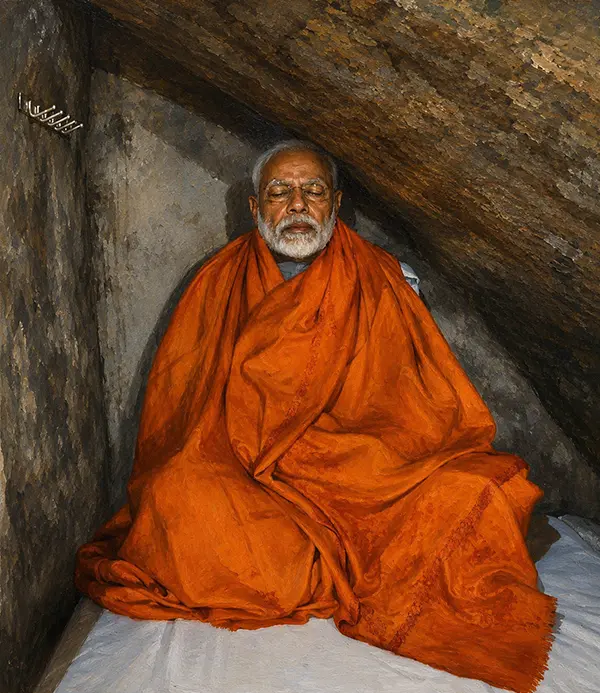
The Sanyasi Who Returned to the Material World
One of the most fascinating chapters of Modi’s life occurred during Mercury Mahadasha.
Around 1967, he left home and moved toward a spiritual path, spending time in the Himalayas and reportedly associating with the Ramakrishna Math. According to accounts surrounding this phase, he had embraced a renunciate mindset and was eventually advised that his destiny was not meant for complete withdrawal from society, but for important work in the material world.
Astrologically, this phase reflects his chart almost perfectly.
Exalted Mercury + Sun + Ketu in the 12th House
Mercury rules both the 9th house and 12th house in his chart. It sits powerfully placed in the 12th house alongside Sun and Ketu. This is a deeply spiritual and introspective combination. It creates:
- intellectual restlessness,
- attraction toward spiritual philosophy,
- detachment from ordinary domestic life,
- and a strong urge to search for meaning beyond worldly structures.
Ketu in the 12th house further intensifies renunciate tendencies. This combination is often found in charts where the individual experiences phases of withdrawal, wandering, or inner spiritual searching.
But Narendra Modi’s chart does not fully support permanent renunciation. The powerful Saturn-Venus combination in the 11th house repeatedly pulls him back toward society, organization, networks, and large-scale influence.
In many ways, his life became a compromise between sanyas and worldly power. He did not become a monk. Instead, he carried aspects of renunciation into politics itself.
Marriage, Detachment and Sacrifice
Narendra Modi married Jashodaben in 1968, but the marriage never evolved into a conventional partnership. Within a few years, he had distanced himself from domestic life and moved fully toward organizational and ideological work through the RSS.
Astrologically, the chart strongly supports emotional and domestic detachment.
Mars, the 7th lord, sits in Scorpio alongside the debilitated Moon. This alone can create emotional turbulence and intensity within partnerships. But the deeper story lies in the heavy 12th house influence involving Sun, Mercury, and Ketu.
This is not the chart of a person psychologically designed for ordinary marital life. The personality repeatedly prioritizes:
- mission over intimacy,
- ideology over domestic comfort,
- and collective purpose over personal attachment.
It is important to understand this astrologically without turning it into moral judgment. His life trajectory consistently moved away from private emotional life and toward public destiny.
The emotional isolation visible in the chart becomes one of the recurring themes throughout his life.
RSS, Discipline and Organizational Power
Narendra Modi joined the RSS as a Pracharak in 1972, and this phase became foundational to his personality.
The influence of Saturn in his chart becomes extremely important here. Saturn, as Yogakaraka for Libra Ascendant, is conjunct Venus in the 11th house.
Venus + Saturn Conjunction in Leo (11th House)
This combination creates:
- strategic social intelligence,
- patience,
- organizational capability,
- image discipline,
- calculated networking,
- and long-term political thinking.
Unlike naturally flamboyant leaders, Narendra Modi appears to have constructed his persona carefully over decades. RSS culture amplified the Saturnian side of his chart:
- strict routine,
- ideological discipline,
- personal sacrifice,
- controlled communication,
- and organizational loyalty.
This is why his political rise was gradual but deeply rooted. He was not merely building popularity. He was building systems, networks, and influence structures.
The 11th house placement also explains why large organizations and collective movements became central to his destiny.
The Master of Narrative and Public Image
One of the strongest combinations in Modi’s Kundali is the repeated Budhaditya Yoga appearing across important divisional charts.
Sun + Mercury Conjunction = Budha Aditya Yoga
This yoga is often associated with:
- intellectual sharpness,
- strategic communication,
- persuasive ability,
- messaging control,
- and political intelligence.
But in Modi’s chart, this conjunction occurs in the 12th house alongside Ketu. This changes the expression significantly.
His communication style rarely feels casual or spontaneous. It feels symbolic, intentional, and highly controlled. Whether through speeches, slogans, pauses, visual imagery, or public appearances, the chart shows someone deeply aware of perception management.
This also explains his extraordinary understanding of media and technology.
Unlike many Indian politicians of his generation, Narendra Modi adapted quickly to:
- social media,
- digital branding,
- visual storytelling,
- hologram rallies,
- centralized communication,
- and technology-driven governance.
His carefully tailored kurtas, shawls, jackets, and visual presentation are not superficial details. They reflect the Libra-Venus influence combined with strong Saturnian control. He understands visual politics instinctively.
In modern politics, image itself becomes power. Modi understood this earlier than most.
Venus Mahadasha and the Rise of Political Destiny
Narendra Modi joined the BJP in 1987 during Venus Mahadasha.
This period became one of the most important turning points in his life because Venus, the Ascendant lord, sits in the 11th house with Yogakaraka Saturn. This is an extremely powerful placement for long-term gains through networks, organizations, alliances, and mass influence.
During this Mahadasha:
- he strengthened BJP’s presence in Gujarat,
- organized major political movements,
- managed large-scale campaigns,
- and slowly became indispensable within the party structure.
Unlike leaders who rise through charisma alone, Modi’s chart shows someone who first mastered organizational mechanics before becoming the face of power itself.
The Venus-Saturn combination rewards patience. It builds slowly, but once authority is established, it becomes difficult to remove.
Becoming Chief Minister of Gujarat
In October 2001, Narendra Modi became the Chief Minister of Gujarat during Venus Mahadasha, Saturn Antar Dasha, and Moon Pratyantar Dasha.
Astrologically, this timing is remarkable.
Venus activated political alliances and visibility.
Saturn activated institutional authority and long-term karma.
Moon activated public identity and mass connection.
The chart shows a clear transition here:
from strategist to ruler.
But the rise also came with enormous karmic intensity.
The 2002 Gujarat Riots and Karmic Polarization
No serious analysis of Narendra Modi’s life can avoid the 2002 Gujarat riots. The events became the defining controversy of his career and permanently shaped both his supporters’ admiration and his critics’ opposition.
Astrologically, the Kundali repeatedly shows patterns of polarization, mass emotional upheaval, and transformation through crisis.
The Scorpio Moon-Mars conjunction is especially significant here. Scorpio governs secrecy, survival, destruction, and rebirth. Combined with Rahu in the 6th house, the chart gains extraordinary capacity to survive hostile circumstances and emerge politically stronger after conflict.
Rahu in the 6th House
Rahu in the 6th house often gives:
- strategic resilience,
- victory over opponents,
- survival through controversy,
- and the ability to navigate adversarial environments.
This does not morally justify events or remove human tragedy from the discussion. But astrologically, it helps explain a strange phenomenon visible throughout Modi’s life: crisis often intensifies his political consolidation rather than weakening it.
After 2002, instead of disappearing politically, he reinvented himself.
Reinvention Through Development and Governance
One of Narendra Modi’s greatest political strengths has been his ability to reshape his own narrative.
Following years of global criticism and controversy, he gradually shifted focus toward:
- infrastructure,
- governance,
- investment,
- development,
- digital expansion,
- and economic branding.
The “Gujarat Model” became central to his image.
This transformation reflects the intelligence of the Sun-Mercury combination combined with Saturn’s long-term planning ability. Modi’s chart repeatedly shows someone capable of strategic reinvention without abandoning core ideological identity.
He understands timing. He understands symbolism. And most importantly, he understands how to redirect public perception.
Prime Minister and the Transformation of India
In May 2014, Narendra Modi became the Prime Minister of India during Moon Mahadasha, Mars Antar Dasha, and Venus Pratyantar Dasha.
The symbolism is powerful.
The Moon, being the 10th lord, activated national destiny and public authority.
Mars activated aggression, decisive action, and ideological force.
Venus activated mass support and visibility.
Moon Mahadasha became one of the most transformative phases not only in his life, but in India’s recent political history.
During this period:
- demonetization reshaped economic behavior,
- Article 370 was removed,
- CAA and NRC created national debate,
- Digital India accelerated,
- COVID management tested governance structures,
- and India’s global projection intensified.
The Scorpio influence of the Moon is visible throughout this phase. The policies often carried themes of disruption, transformation, secrecy, and emotional intensity. Whether admired or criticized, they rarely felt moderate.
Moon Mahadasha psychologically transformed the country itself.
The Psychology of Power
Perhaps the most fascinating aspect of Narendra Modi’s Kundali is that despite immense fame and authority, the chart does not show emotional relaxation.
It shows purpose.
There is a recurring undertone of loneliness throughout the horoscope:
- separation from domestic life,
- controlled emotional expression,
- limited visible intimacy,
- relentless work ethic,
- and constant mission orientation.
Even his spirituality evolved into responsibility rather than withdrawal.
The chart suggests someone who gradually surrendered ordinary personal life in exchange for historical significance.
That is why Modi often appears less like a conventional politician and more like a person carrying a long-term internal mission.
Mars Mahadasha and Historical Legacy
Narendra Modi is currently running Mars Mahadasha.
Mars rules the 2nd and 7th houses and sits powerfully in Scorpio alongside the Moon. This period can intensify:
- assertiveness,
- ideological confidence,
- geopolitical strength,
- decisive governance,
- and legacy-building.
But Mars can also increase:
- polarization,
- conflict,
- rigidity,
- and aggressive political positioning.
Mars periods tend to accelerate history itself. They push events toward decisive movement.
For Narendra Modi, this phase may become less about political survival and more about historical imprint.
Final Thoughts
Narendra Modi’s Kundali is not the chart of comfort, softness, or ordinary domestic fulfillment. It is the chart of reinvention, discipline, emotional intensity, ideological conviction, and public destiny.
The same horoscope that shows spiritual withdrawal also shows worldly authority. The same chart that indicates emotional isolation also creates mass connection. The same combinations that bring controversy also generate resilience and political consolidation.
This paradox defines Narendra Modi’s life.
Whether admired as a transformative leader or criticized as a polarizing force, one thing remains undeniable: his destiny became inseparable from the destiny of modern India itself.
Very few horoscopes reflect such a powerful intersection between personal karma and national history.
Want to unlock secrets of your Kundali?