
Pro Summary
Narsinh Mehta’s timeless Gujarati bhajan, Vaishnav Jan To, is far more than a simple devotional song. It serves as a profound blueprint for human character and spiritual living. Rather than focusing on religious rituals or outward displays of faith, the poem defines true spirituality through everyday virtues. It challenges us to deeply understand the suffering of others, practice equal vision, and offer help without allowing pride or ego to take root in our minds.
Mahatma Gandhi connected deeply with this ethical challenge, making the bhajan a central pillar of his public life and transforming it into a global anthem for moral aspiration. Even centuries later, the core message of the song remains remarkably relevant to our modern world. It reminds us that genuine devotion requires conquering our internal battles against greed, lust, and anger. Ultimately, Narsinh Mehta leaves us with a powerful reflection on what it means to be truly human, inviting us to transform our lives so completely that our mere presence becomes a blessing to others.

What makes a human being truly good?
Is it the prayers they offer, the temples they visit, the scriptures they read, or the name of the God they worship? Or is spirituality ultimately revealed somewhere much quieter, in the way we behave when nobody is watching, in the way we respond when another person is suffering, in the desires we learn to restrain, and in the pride we learn to surrender?
More than five centuries ago, the Gujarati saint-poet Narsinh Mehta offered an answer in a few simple verses. Those verses became one of the most beloved bhajans of Gujarat, and eventually one of India’s most recognisable devotional songs: Vaishnav Jan To.
It is often introduced as Mahatma Gandhi’s favourite bhajan. It is often searched for as a Gujarati song, its lyrics, translation or meaning. But to call it merely a devotional song is to miss what makes it extraordinary.
Vaishnav Jan To is, in many ways, a portrait of the human being we are being asked to become.
It begins with compassion for another person’s suffering. It moves through humility, equality, truth, self-restraint, detachment and devotion. And it ends with an extraordinary image: a person whose very presence becomes spiritually uplifting to others.
Perhaps that is why a song born in medieval Gujarat can still speak so directly to us today.
The world around us has changed. Human nature has not changed nearly as much.
Vaishnav Jan To: Lyrics and Meaning
The bhajan traditionally attributed to Narsinh Mehta is written in Gujarati. Below is the commonly sung text, followed by a translation and interpretation of each stanza.
વૈષ્ણવ જન તો તેને કહીએ જે પીડ પરાઈ જાણે રે
પર દુઃખે ઉપકાર કરે તોયે મન અભિમાન ન આણે રે
Vaishnav jan to tene kahiye, je peed paraayi jaane re
Par dukhe upkaar kare toye, man abhimaan na aane re
Meaning:
Call only that person a true Vaishnav who understands the suffering of others. Who helps those in distress, yet does not allow pride to enter the mind.
The song does not begin with ritual. It does not begin with scholarship. It begins with another person’s pain.
This is perhaps the most important thing Narsinh Mehta asks of us. To understand another person’s suffering is more than simply knowing that they are hurting. It is to allow their pain to matter to us.
But Narsinh goes one step further. Even compassion can become a source of ego. We can help someone and secretly expect gratitude. We can serve and begin to think ourselves superior. We can perform charity and become attached to the identity of being charitable.
The true Vaishnav helps, but does not become larger in his own eyes because he helped.
Service without superiority. Compassion without ego.
That may be one of the hardest forms of spiritual practice.
સકળ લોકમાં સહુને વંદે
નિંદા ન કરે કેની રે
વાચ કાછ મન નિશ્ચલ રાખે
ધન ધન જનની તેની રે
Sakal lokma sahune vande, ninda na kare keni re
Vaach kaachh man nishchal raakhe, dhan dhan janani teni re
Meaning:
Such a person respects everyone, speaks ill of no one, and keeps their speech, actions and mind pure and steady. Blessed indeed is the mother who gave birth to such a person.
Notice how the poem moves from compassion into character.
A spiritually evolved person does not reserve respect only for people they admire. They bow to everyone. They do not need to diminish another person to feel significant.
Then comes an especially profound triad: speech, conduct and mind.
It is easy to appear spiritual through our outward behaviour while our thoughts remain filled with resentment, jealousy or contempt. Narsinh’s standard is higher. The transformation must reach the tongue, the hands and the mind.
And then comes the beautiful blessing upon the person’s mother. The goodness of one human being becomes an honour to the life that brought that person into the world.
This content is a preview of the quality and depth available inside Astro Assured Pro. Become a Pro Member to unlock advanced astrology, exclusive tools, and premium research.
સમદૃષ્ટિ ને તૃષ્ણા ત્યાગી
પરસ્ત્રી જેને માત રે
જીહ્વા થકી અસત્ય ન બોલે
પરધન નવ ઝાલે હાથ રે
Samadrishti ne trishna tyagi, parstri jene maat re
Jihva thaki asatya na bole, par dhan nav jhaale haath re
Meaning:
Such a person sees everyone with an equal eye and has given up craving. They regard another person’s wife as a mother. Their tongue does not speak falsehood, and their hands do not take what belongs to another.
Here the poem enters the difficult territory of self-mastery.
Samadrishti, equal vision, is not merely saying that everyone is equal. It is learning to see human dignity without constantly ranking people according to wealth, status, caste, power, beauty or usefulness.
Then Narsinh turns toward desire.
The reference to another person’s wife reflects the social language of his time, but the underlying ethical principle remains relevant: do not turn another human being into an object of possession or gratification.
Truth follows desire. Then property follows truth.
The Vaishnav does not lie, and does not take another person’s wealth.
Spirituality, therefore, is not confined to prayer. It enters relationships, sexuality, speech, money and everyday choices.
મોહ માયા વ્યાપે નહિ જેને
દૃઢ વૈરાગ્ય જેના મનમાં રે
રામ નામ શું તાળી લાગી
સકળ તીર્થ તેના તનમાં રે
Moh maya vyaape nahi jene, dradh vairagya jena manma re
Ram naam shu taali lagi, sakal teerth tena tanma re
Meaning:
One who is not overwhelmed by attachment and worldly illusion, whose mind possesses firm detachment, whose consciousness is deeply attached to the Divine Name, has all the sacred places of pilgrimage within them.
This is where the song turns inward.
The first verses asked how we treat other people. Now Narsinh asks what happens inside us when the world pulls at our desires.
Vairagya, detachment, does not mean hatred of the world. It means that the world no longer owns you.
You may love people without possessing them. You may enjoy what life offers without becoming its slave. You may fulfil your responsibilities without allowing attachment to destroy your inner freedom.
And then comes one of the most beautiful images in the bhajan.
The person immersed in divine remembrance becomes a tirtha, a sacred place, in themselves.
The pilgrimage is no longer merely somewhere you travel to.
The sacred has become a quality of your own being.
વણલોભી ને કપટરહિત છે
કામ ક્રોધ નિવાર્યા રે
ભણે નરસૈયો તેનું દર્શન કરતાં
કુળ એકોતેર તાર્યા રે
Vanlobhi ne kapat-rahit chhe, kaam krodh nivarya re
Bhane Narsaiyyo, tenu darshan karta, kul ekoter taarya re
Meaning:
Such a person is free from greed and deceit and has overcome lust and anger. Says Narsaiyyo, merely having the darshana of such a person uplifts their lineage.
The final test is the inner battlefield.
Greed. Deceit. Lust. Anger.
These are not enemies outside us. They live within us.
And Narsinh’s ideal human being is one who has learned to master them.
The final line should not be reduced to a literal promise that merely seeing a saint automatically liberates seventy-one generations. It is better understood as a devotional image of the enormous spiritual influence of a transformed person.
When a human being becomes genuinely compassionate, truthful, humble and self-controlled, their goodness does not stop with themselves.
Their presence changes other people.
Their children see it.
Their friends feel it.
Their community is touched by it.
Their life becomes an example.
Perhaps that is what it means to say that their darshana becomes a blessing.
Who Was Narsinh Mehta?
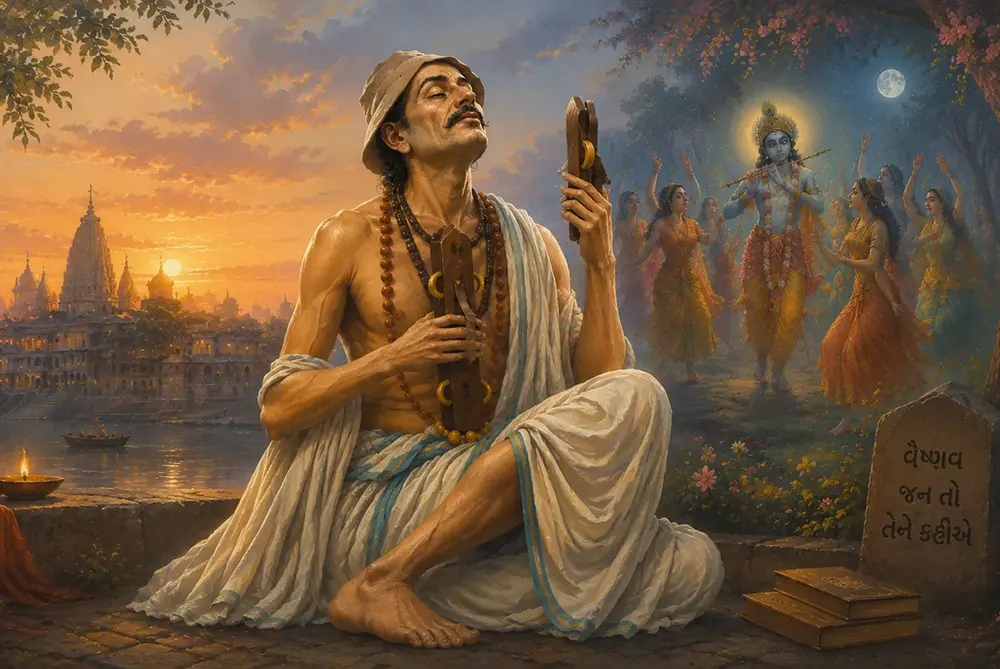
Narsinh Mehta, also known as Narsi Mehta or Narsinh Bhagat, occupies a foundational place in Gujarati devotional literature and is traditionally regarded as Gujarat’s Adi Kavi, its first great poet. He is associated with the Krishna-centred bhakti tradition of medieval Gujarat, and his songs have remained alive through singing and oral performance for centuries.
Much of the traditional biography surrounding Narsinh comes through hagiographical stories. These stories include accounts of his devotion, poverty, social nonconformity and association with people who were excluded by the orthodox social order. Scholars rightly distinguish between what can be historically established and what belongs to devotional memory. Yet the persistence of these stories reveals something important: generations of listeners understood Narsinh’s poetry as a challenge to spiritual pride and social exclusion.
There is also a scholarly caution worth preserving. Vaishnav Jan To is traditionally attributed to Narsinh Mehta, and it has lived in Gujarati tradition under his name for generations. However, the surviving manuscript history of the specific poem is later than Narsinh’s lifetime, so its authorship cannot be established with the same certainty as popular retellings sometimes suggest. That does not diminish the poem’s place in the Narsinh tradition. If anything, it reminds us that devotional literature lived through singers, communities and performance as much as through manuscripts.
What matters most is that the song belongs to the moral and devotional world associated with Narsinh Mehta: a world in which love of God must eventually transform the way a person sees and treats other beings.
Why Gandhi Carried This Bhajan Into History
Centuries after Narsinh Mehta, another Gujarati found something extraordinary in these words.
Mahatma Gandhi did not simply admire Vaishnav Jan To. He incorporated it into his prayer life and public work, helping transform a regional Gujarati bhajan into an internationally recognised song of moral aspiration. Scholarship on Narsinh Mehta specifically identifies the bhajan as an important source of moral inspiration in Gandhi’s public life.
That relationship becomes especially meaningful when we understand what Gandhi saw in the song.
A person cannot claim spiritual superiority while remaining indifferent to another person’s suffering.
A person cannot speak of God while treating another human being as inferior.
A person cannot call themselves religious while allowing pride, hatred and greed to govern their conduct.
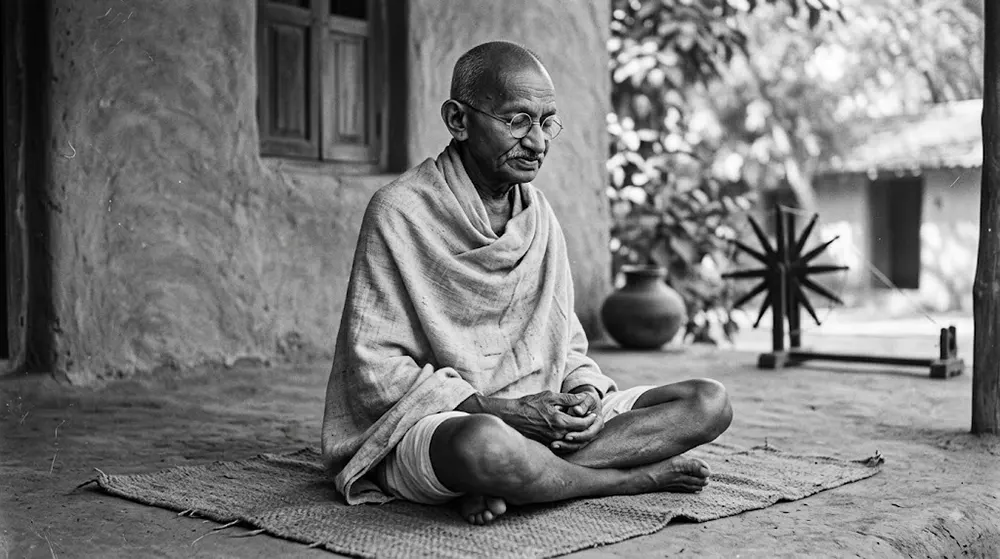
The opening lines of Vaishnav Jan To therefore became more than devotional poetry in Gandhi’s hands. They became an ethical challenge.
The bhajan was sung in the environment of Gandhi’s ashrams and became part of the soundscape surrounding his public life. Its association with the freedom movement, including the Salt March, helped carry its message far beyond the devotional settings in which it had lived before.
Yet Gandhi’s role should not overshadow Narsinh Mehta. Gandhi did not create the soul of the song. He recognised it, lived with it, and carried it into another age.
A Song That Changed Without Losing Its Soul
There is another fascinating part of the story.
The Vaishnav Jan To most people hear today is not necessarily identical in musical character to the older folk tradition from which the song emerged.
The bhajan was historically associated with the folk traditions of Gujarat’s Kathiawar and Saurashtra regions. During the twentieth century, particularly through the musical culture surrounding Gandhi’s Sabarmati Ashram, it entered more formalised arrangements. The familiar rendition associated with raga Khamaj and later classical and popular performances became the version most widely recognised today.
Something beautiful happened in that journey.
The melody changed.
The singers changed.
The audiences changed.
The historical circumstances changed.
But the central question remained:
Can a human being become compassionate enough, humble enough and inwardly disciplined enough to make their own life a form of prayer?
That question has survived every musical arrangement.
The Art of Living Narsinh Mehta Left Us
Perhaps this is why Vaishnav Jan To continues to feel strangely contemporary.
We live in a world that gives us unprecedented ways to communicate, yet we still struggle to speak kindly.
We have more ways to display generosity, yet we still struggle to help without seeking recognition.
We can connect with thousands of people, yet we still struggle to understand the pain of the person standing beside us.
We have more possessions than many generations before us, yet craving remains.
We know more about spirituality than ever before, yet knowledge can still coexist with anger, jealousy, greed and pride.
Narsinh Mehta’s answer is beautifully inconvenient.
Look at your life.
Not your beliefs.
Not your identity.
Not the image you present to the world.
Your life.
Do you understand another person’s pain?
Can you help without becoming proud?
Can you respect someone you disagree with?
Can you control your tongue?
Can you remain truthful when dishonesty is convenient?
Can you love without possessing?
Can you enjoy the world without becoming enslaved by it?
Can you conquer even a little of your greed, lust and anger?
And if someone watched your life without ever hearing your prayers, would they still recognise that you were trying to walk toward God?
Perhaps that is the real art of living described by Vaishnav Jan To.
It is not the art of appearing spiritual.
It is the art of becoming human in the deepest sense of the word.
Narsinh Mehta begins with another person’s suffering and ends with a human being whose very presence becomes a blessing.
Between those two points lies the entire journey.
Compassion.
Humility.
Truth.
Equality.
Self-control.
Detachment.
Devotion.
And finally, a life so transformed that it no longer needs to announce its spirituality.
It simply radiates it.
More than five centuries later, we still sing the words.
Perhaps the greater invitation is to live them.
Vaishnav jan to tene kahiye, je peed paraayi jaane re.
Call that person a true Vaishnav who knows the pain of another.
Perhaps Narsinh Mehta never intended that line merely to define a religious person.
Perhaps he was asking us a much harder question:
What kind of human being will you become?