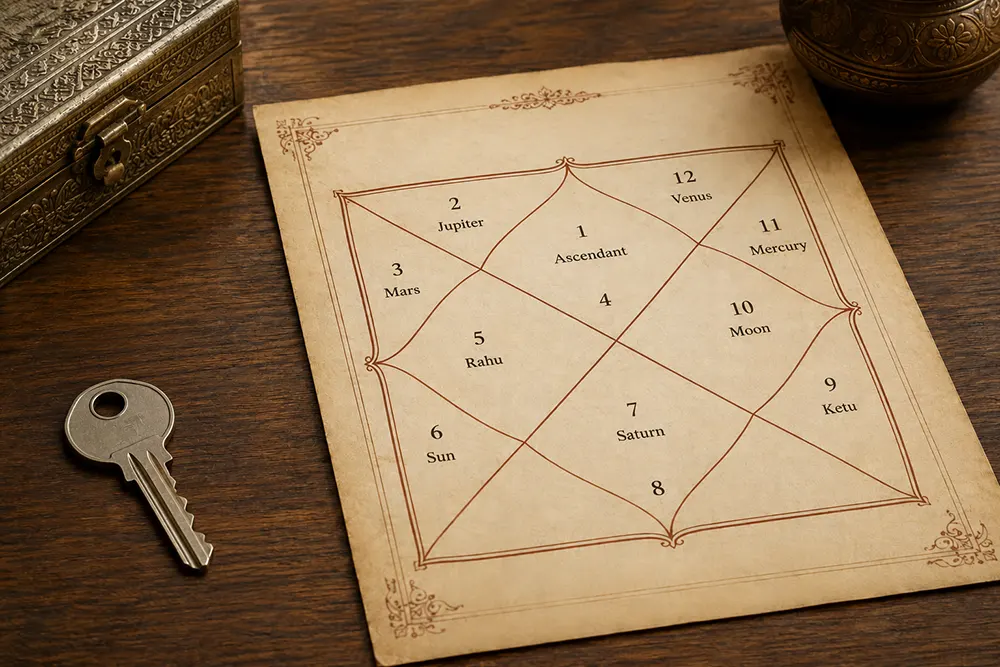
In Vedic Astrology, the Ascendant, also known as the Lagna, is the zodiac sign rising on the eastern horizon at the exact moment of your birth. It marks the beginning of your Kundali and serves as the reference point from which all twelve houses are calculated. While many people are familiar with their Sun Sign or Moon Sign, experienced Vedic astrologers begin almost every Kundali analysis with the Ascendant because it defines the structure of the entire birth chart.
Unlike the Sun Sign, which changes roughly once a month, the Ascendant changes approximately every two hours. As a result, two people born on the same day can have completely different Ascendants, house placements, planetary lordships, yogas, and life themes simply because they were born at different times. This is why an accurate birth time is one of the most important requirements for meaningful astrological analysis.
Use Astro Assured’s Ascendant Calculator below to instantly find your Lagna using your birth date, birth time, and birth place. Along with your Ascendant, you’ll receive a concise report to help you understand its significance in your Kundali.
Your Ascendant Report
Unlock Premium tools and Advanced Astrology with Astro Assured Pro
What is Ascendant (Lagna)?
The Ascendant, or Lagna, is the zodiac sign that was rising on the eastern horizon at the precise time and location of your birth. It becomes the First House of your Kundali, and every other house is counted from it in sequential order. For example, if Virgo is your Ascendant, Virgo becomes the First House, Libra the Second House, Scorpio the Third House, and so on.
This simple concept forms the backbone of Vedic Astrology. Every prediction related to career, marriage, wealth, education, health, children, spirituality, and countless other aspects of life is interpreted through the houses, and the houses themselves are determined by the Ascendant. Without knowing the Lagna, it is impossible to accurately identify house lordships, evaluate yogas, or understand how planets influence different areas of life.
The Ascendant also represents your physical body, appearance, vitality, temperament, natural approach to life, and the way you interact with the world. Since it symbolizes the beginning of life itself, the First House is considered one of the most influential houses in the entire Kundali.
Because the Earth rotates continuously, a new zodiac sign rises on the eastern horizon roughly every two hours. This constant movement is why the Ascendant changes much more rapidly than the Sun or the Moon. Even a small difference in birth time can shift the Ascendant or alter house placements, especially when the birth occurs near the transition between two rising signs.
It is important to understand that the Ascendant is not the same as your Sun Sign or Moon Sign. These are three distinct reference points in astrology, each representing different dimensions of life. The Sun signifies the soul, authority, vitality, and one’s essential purpose. The Moon reflects the mind, emotions, instincts, and psychological tendencies. The Ascendant, however, establishes the framework of the entire Kundali and determines how every planet expresses its results through the twelve houses.
For this reason, Vedic astrologers almost always begin their analysis with the Lagna before moving on to examine planetary placements, yogas, dashas, divisional charts, and transits.
Ascendant Quick Reference
| Ascendant | Ruling Planet | Element | Modality | Purushartha | Yoga Karakas* | Functional Malefics** |
|---|---|---|---|---|---|---|
| Aries | Mars | Fire | Movable | Dharma | Sun, Jupiter | Mercury, Saturn |
| Taurus | Venus | Earth | Fixed | Artha | Saturn | Jupiter, Moon |
| Gemini | Mercury | Air | Dual | Kama | Venus | Mars, Jupiter |
| Cancer | Moon | Water | Movable | Moksha | Mars | Mercury, Venus |
| Leo | Sun | Fire | Fixed | Dharma | Mars | Venus, Saturn |
| Virgo | Mercury | Earth | Dual | Artha | Venus | Moon, Mars |
| Libra | Venus | Air | Movable | Kama | Saturn | Jupiter, Sun |
| Scorpio | Mars | Water | Fixed | Moksha | Moon | Mercury, Venus |
| Sagittarius | Jupiter | Fire | Dual | Dharma | Sun | Venus, Saturn |
| Capricorn | Saturn | Earth | Movable | Artha | Venus | Moon, Jupiter |
| Aquarius | Saturn | Air | Fixed | Kama | Venus | Sun, Moon |
| Pisces | Jupiter | Water | Dual | Moksha | Mars | Mercury, Venus |
* Yoga Karakas listed are the principal and universally accepted Yoga Karaka planets where applicable. Some Ascendants do not have a single classical Yoga Karaka planet.
** Functional malefics depend on planetary lordships and should always be judged in the context of the complete Kundali, including dignity, conjunctions, aspects, strength, and divisional charts.
Ascendant vs Moon Sign vs Sun Sign
One of the most common misconceptions among beginners is that the Ascendant, Moon Sign, and Sun Sign represent the same thing. While all three are important in Vedic Astrology, they describe different aspects of your life and serve different purposes in chart interpretation.
The Ascendant (Lagna) is the foundation of your Kundali. It determines the First House, establishes the sequence of all twelve houses, and defines planetary lordships. Every prediction related to career, marriage, finances, education, health, and spiritual growth ultimately begins with the Ascendant.
The Moon Sign (Chandra Rashi) represents your mind, emotions, instincts, and emotional responses. It reveals how you process experiences, react to situations, and seek emotional comfort. Many predictive techniques, including the Vimshottari Dasha system and Gochar (transit) analysis, give considerable importance to the Moon.
The Sun Sign (Surya Rashi) represents the soul, vitality, confidence, authority, and sense of purpose. While it plays a significant role in Vedic Astrology, it is generally not the primary reference point for reading a Kundali.
A complete astrological analysis considers all three together rather than relying on only one.
| Feature | Ascendant (Lagna) | Moon Sign | Sun Sign |
|---|---|---|---|
| Based On | Rising sign at birth | Position of the Moon | Position of the Sun |
| Changes Every | ~2 hours | ~2.25 days | ~30 days |
| Represents | Self, body, life direction | Mind and emotions | Soul, vitality and authority |
| Determines Houses | ✓ Yes | ✗ No | ✗ No |
| Used for House Lordships | ✓ Yes | ✗ No | ✗ No |
| Important for Dashas | Indirectly | ✓ Very Important | Supportive |
| Forms the Foundation of the Kundali | ✓ Yes | No | No |
Rather than asking which one is “more important,” it is better to understand that each has a unique role. The Ascendant provides the framework of the Kundali, the Moon reflects your inner world, and the Sun signifies your essential nature and vitality.
How Ascendant Affects Every House
The Ascendant is much more than your rising sign; it determines the entire layout of your Kundali.
Since the Ascendant always becomes the First House, changing the Ascendant automatically changes the position of every other house. As a result, the planetary lordships, yogas, strengths, and predictions also change.
For example, if Aries is the Ascendant, Taurus becomes the Second House, Gemini the Third House, Cancer the Fourth House, and so on. However, if Taurus rises instead, Gemini becomes the Second House, Cancer the Third House, Leo the Fourth House, and the entire structure of the Kundali shifts.
This seemingly small change has a profound impact on interpretation because each planet begins ruling different houses.
For instance, Venus rules the Second and Seventh Houses for an Aries Ascendant, making it a maraka planet. For Capricorn Ascendant, however, Venus rules the Fifth and Tenth Houses, making it the Yoga Karaka capable of producing excellent results. The same planet can therefore behave very differently depending on the Ascendant.
The Ascendant influences:
- House placements
- Functional benefic and malefic planets
- House lordships
- Raja Yogas and Dhana Yogas
- Maraka planets
- Badhaka houses
- Strength of planetary combinations
- Interpretation of Mahadashas and Antardashas
- Transit results
- Divisional chart analysis
This is why experienced Vedic astrologers always identify the Ascendant before beginning any serious Kundali analysis. Without the Lagna, the rest of the chart cannot be interpreted correctly.
Role of Ascendant Lord (Lagnesh)
Every Ascendant has a ruling planet known as the Ascendant Lord, or Lagnesh. Since the Ascendant represents you, its ruler becomes one of the most influential planets in your entire Kundali.
The Lagnesh governs your overall vitality, health, confidence, personality, life direction, and ability to express your potential. A strong Ascendant Lord often gives resilience, self-belief, and the capacity to overcome obstacles, while an afflicted or weakened Lagnesh may indicate periods of struggle, reduced vitality, or delays in achieving one’s goals.
The condition of the Lagnesh is judged by several factors, including:
- House placement
- Zodiac sign
- Strength (own sign, exaltation, debilitation, etc.)
- Conjunctions with other planets
- Planetary aspects
- Combustion
- Retrogression
- Placement in divisional charts
- Shadbala and other measures of planetary strength
A Lagnesh placed in a Kendra (1st, 4th, 7th, or 10th House) or Trikona (1st, 5th, or 9th House), especially in its own sign or exaltation, is generally considered favorable. However, no single rule should be applied in isolation. Every Kundali is unique, and the final interpretation depends on the interaction of multiple astrological factors.
Since the Lagnesh represents the native, strengthening it, whether naturally through its dignity or through appropriate remedial measures when required; often has a positive influence on multiple areas of life.
Frequently Asked Questions
What is an Ascendant in Vedic Astrology?
The Ascendant, or Lagna, is the zodiac sign rising on the eastern horizon at the exact moment of your birth. It becomes the First House of your Kundali and forms the basis for interpreting all other houses.
Is Ascendant the same as Lagna?
Yes. In Vedic Astrology, the terms Ascendant and Lagna are used interchangeably and refer to the same concept.
Why does the Ascendant change so quickly?
The Earth rotates continuously, causing a different zodiac sign to rise on the eastern horizon approximately every two hours. This is why your exact birth time is essential for calculating the correct Ascendant.
Why is my birth time important?
Your birth time determines your Ascendant. Even a small difference in time can alter the Ascendant or change house placements, which can significantly affect the interpretation of your Kundali.
Can two people born on the same day have different Ascendants?
Yes. Since the Ascendant changes roughly every two hours, people born on the same date, but at different times or locations, may have completely different Lagnas.
Which is more important: Ascendant, Moon Sign, or Sun Sign?
All three are important, but they serve different purposes. The Ascendant forms the foundation of the Kundali, the Moon Sign reflects the mind and emotions, and the Sun Sign represents vitality, authority, and the soul. A comprehensive reading considers all three together.
What if I don’t know my exact birth time?
Without an accurate birth time, the Ascendant cannot be calculated reliably. In such cases, astrologers may perform birth time rectification using significant life events to estimate the correct birth time before making detailed predictions.
How can I find my Ascendant?
Simply enter your birth date, exact birth time, and birth place into Astro Assured’s Ascendant Calculator. The calculator will instantly determine your Lagna and provide a personalized report to help you understand its significance in your Kundali.