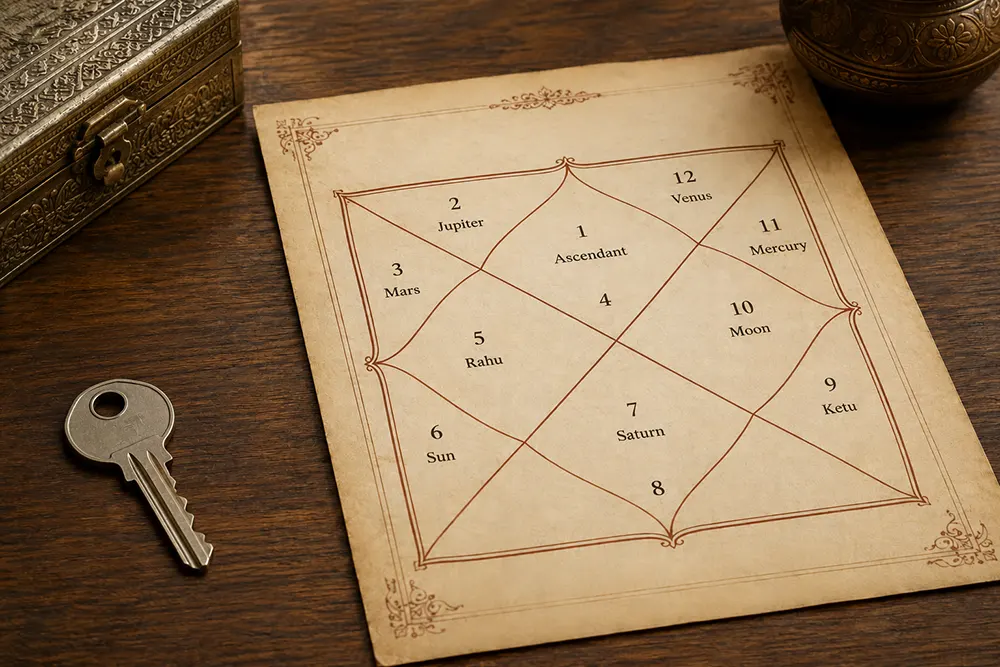
Marriage is one of the most important areas of life explored in Vedic Astrology. While the 7th house remains the primary house of marriage, experienced astrologers often use another powerful indicator called Upapada Lagna (UL) to understand the spouse, the quality of marriage, and how the relationship manifests in the real world.
Upapada Lagna is the Arudha (reflection or manifestation) of the 12th house according to Jaimini Astrology. It is commonly referred to as the “Spouse Point” because it reveals the actual spouse, family life after marriage, the public image of the relationship, and the long-term sustainability of the marriage. Many astrologers find that Upapada Lagna often explains marriage outcomes more accurately than the 7th house alone because it reflects how the marriage ultimately materializes rather than merely the potential for partnership.
The concept originates from classical Jaimini and Parashara traditions. However, there is an important calculation difference. The widely used Jagannatha Hora (JHora) method calculates Upapada Lagna from the 12th house for all ascendants. Another interpretation found in Brihat Parashara Hora Shastra (BPHS) uses the 12th house for odd ascendants and the 2nd house for even ascendants. This means some charts, especially those with even ascendants, can produce different Upapada Lagnas depending on the method used.
Upapada Lagna Calculator
Upapada Lagna Calculator
This content is a preview of the quality and depth available inside Astro Assured Pro. Become a Pro Member to unlock advanced astrology, exclusive tools, and premium research.
How to Read Your Upapada Lagna
Finding your Upapada Lagna is only the first step. A proper interpretation requires examining several connected factors:
- The sign occupied by Upapada Lagna.
- The condition of the Upapada Lagna lord.
- Planets placed in Upapada Lagna.
- The 2nd house from Upapada Lagna.
- The 7th house from Upapada Lagna.
- The 8th house from Upapada Lagna.
- The 12th house from Upapada Lagna.
- The relationship between Upapada Lagna and Darakaraka.
- Confirmation through the Navamsa (D9) chart.
Among these factors, the 2nd house from Upapada Lagna is often considered the most important because it indicates whether the marriage will be sustained and supported over time.
Key Upapada Lagna Factors
Upapada Lagna Sign
The sign occupied by Upapada Lagna describes the overall nature of the spouse and the tone of married life. Fire signs often produce dynamic and passionate relationships. Earth signs emphasize stability and practicality. Air signs focus on communication and intellectual compatibility, while water signs bring emotional depth and sensitivity.
The sign should never be interpreted in isolation. The condition of the sign lord and planetary influences usually have greater predictive value.
Upapada Lagna Lord
The lord of Upapada Lagna is one of the most important marriage indicators in the chart.
A strong Upapada lord generally supports:
- Better spouse quality
- Stable marriage
- Stronger emotional support
- Greater marital satisfaction
A weak, debilitated, combust, or heavily afflicted Upapada lord can indicate:
- Marital challenges
- Delays in marriage
- Emotional distance
- Strain within the relationship
Particular attention should be paid to aspects from Jupiter and Venus, as these often protect and improve marriage-related outcomes.
Planets in Upapada Lagna
The planets occupying Upapada Lagna significantly influence the spouse and marriage.
| Planet | General Influence |
|---|---|
| Sun | Pride, leadership, authority within marriage |
| Moon | Emotional connection and nurturing qualities |
| Mars | Passion, energy, competitiveness, possible conflicts |
| Mercury | Communication, adaptability, intellectual connection |
| Jupiter | Wisdom, protection, growth, support |
| Venus | Harmony, affection, attraction, romance |
| Saturn | Responsibility, maturity, delay, endurance |
| Rahu | Unconventional relationships, obsession, foreign influences |
| Ketu | Spirituality, detachment, karmic lessons |
Benefic influences generally improve marital happiness, while strong malefic influences can create challenges that require conscious effort to overcome.
The 2nd House from Upapada Lagna
Many astrologers consider the 2nd house from Upapada Lagna to be the true sustainer of marriage.
While Upapada Lagna describes the spouse and marriage itself, the 2nd from UL shows whether the relationship can endure and grow after marriage. It represents family continuity, support, stability, and the ability of the marriage to survive challenges.
A strong 2nd house from UL often indicates:
- Lasting marriage
- Family growth
- Mutual support
- Financial and emotional stability
Benefics such as Jupiter and Venus placed here are traditionally considered highly favorable. Their presence often protects the marriage even when other factors show weaknesses.
A heavily afflicted 2nd from UL may indicate:
- Family tensions
- Separation tendencies
- Emotional distance
- Divorce or long-term instability
The lord of the 2nd from UL should also be examined carefully. A strong lord can compensate for weaknesses in the house itself, while an afflicted lord can reduce otherwise positive indications.
The 7th House from Upapada Lagna
The 7th from Upapada Lagna represents the spouse’s perspective within the marriage.
Since Upapada Lagna functions as the spouse’s reference point, the 7th from UL shows how the spouse experiences the relationship. It can reveal expectations, satisfaction, frustrations, and the overall dynamic between partners.
Benefic influences here generally support harmony and cooperation. Malefic influences may indicate distance, responsibilities, misunderstandings, or recurring challenges that must be managed throughout the marriage.
The 8th House from Upapada Lagna
The 8th from Upapada Lagna reveals hidden dimensions of marriage.
This house can indicate:
- Secrets
- Karmic debts
- Transformational experiences
- Sudden events
- Crises that test the relationship
Strong benefic influences help couples grow through challenges. Heavy afflictions can create instability, hidden tensions, or major turning points within the marriage.
The 12th House from Upapada Lagna
The 12th from Upapada Lagna governs intimacy, private life, sacrifice, and emotional giving within marriage.
A strong 12th house often supports:
- Emotional closeness
- Physical intimacy
- Compassion
- Mutual sacrifice
Afflictions can indicate dissatisfaction, emotional withdrawal, imbalance in giving and receiving, or feelings of isolation within the relationship.
Upapada Lagna and Darakaraka
Darakaraka is the Jaimini significator of the spouse and is determined by the planet holding the lowest degree in the chart.
Many astrologers consider the combination of Upapada Lagna and Darakaraka essential for marriage analysis.
Particularly important combinations include:
- Darakaraka placed in Upapada Lagna
- Upapada lord connected to Darakaraka
- Mutual aspects between UL and Darakaraka
- Darakaraka influencing the 2nd from UL
When multiple marriage indicators repeat the same message, predictive confidence increases significantly.
Upapada Lagna in Navamsa (D9)
Navamsa remains one of the most important charts for marriage analysis.
The placement of the Upapada lord in Navamsa often refines predictions regarding spouse quality and marital happiness. Exalted placements, own-sign placements, and Vargottama positions generally strengthen positive results.
If the Rashi chart and Navamsa both support the same conclusion, the indication becomes considerably stronger.
Marriage Timing Through Upapada Lagna
Upapada Lagna is also useful for identifying periods when marriage-related events become active.
The most commonly observed triggers include:
Dasha of the Upapada Lord
Marriage, engagement, relationship milestones, or significant marital developments often occur during the dasha or sub-period of the Upapada lord.
Dasha of Darakaraka
Darakaraka periods frequently activate spouse-related events and important relationship developments.
Jupiter Transits
Jupiter’s transit over Upapada Lagna or its lord is often associated with growth, blessings, and important developments in relationships. Many astrologers consider these periods favorable for marriage.
Saturn Transits
Saturn’s influence can bring delays, responsibilities, tests, or long-term commitments. While challenging at times, Saturn can also help build lasting relationships through maturity and discipline.
Rahu-Ketu Transits
These transits often activate karmic relationship themes, unconventional circumstances, sudden attractions, or periods of detachment and reassessment.
Multiple Marriages and the 8th-from-Upapada Rule
Classical Jaimini tradition extends Upapada principles to subsequent marriages.
The primary Upapada Lagna represents the first significant marriage or spouse. If a second marriage is indicated, astrologers examine the 8th house from the original Upapada Lagna. This becomes the secondary Upapada.
For a third marriage, the 8th house from the secondary Upapada is examined, and the process continues in the same manner.
This technique provides a framework for analyzing multiple significant partnerships within a lifetime.
How Upapada Lagna Is Calculated
Upapada Lagna is calculated using Arudha Pada principles.
The process is straightforward:
- Identify the source house.
- Find the lord of that house.
- Count the number of signs from the source house to its lord.
- Count the same number of signs forward from the lord’s position.
- The resulting sign becomes the preliminary Upapada Lagna.
- Apply Arudha exception rules if required.
An important Arudha principle states that the resulting Arudha cannot remain in the same sign as its source or directly opposite it. If this occurs, the position must be adjusted according to traditional Arudha rules.
These exception rules are responsible for many calculation differences seen between manual calculations and software-generated results.
JHora vs BPHS: Why Different Calculators Give Different Results
One of the most debated topics surrounding Upapada Lagna is the calculation method itself.
JHora Method
Jagannatha Hora calculates Upapada Lagna using the 12th house as the source for every ascendant.
This approach follows the straightforward interpretation that Upapada is the Arudha of the 12th house.
BPHS Method
A commonly cited interpretation of Brihat Parashara Hora Shastra introduces a variation.
| Ascendant Type | Source House |
|---|---|
| Odd Ascendants (Aries, Gemini, Leo, Libra, Sagittarius, Aquarius) | 12th House |
| Even Ascendants (Taurus, Cancer, Virgo, Scorpio, Capricorn, Pisces) | 2nd House |
Under this approach, even ascendants such as Taurus, Cancer, Virgo, Scorpio, Capricorn, and Pisces may produce a completely different Upapada Lagna than the JHora calculation.
Which Method Is Correct?
There is no universal consensus.
Many modern astrologers use only the JHora method. Others follow the BPHS interpretation. Some practitioners calculate both and then compare the results with Darakaraka, Navamsa, marriage events, and real-life observations.
For this reason, Astro Assured provides both calculations whenever they differ. If both methods point toward similar conclusions, confidence in the interpretation increases. If they differ significantly, additional verification through other marriage indicators becomes essential.
Conclusion
Upapada Lagna is one of the most powerful marriage indicators available in Vedic Astrology. It reveals the manifested spouse, the quality of married life, family dynamics after marriage, and the karmic lessons embedded within relationships.
The most important factors to examine are the Upapada Lagna itself, its lord, the 2nd house from UL, Darakaraka, and the Navamsa chart. No single factor should be used in isolation.
Whether you follow the JHora method, the BPHS method, or choose to study both, Upapada Lagna offers valuable insights into how marriage unfolds and what role it plays in your life’s journey. Used alongside the 7th house, Darakaraka, Dashas, and Navamsa, it becomes an indispensable tool for understanding one of the most important relationships in life.