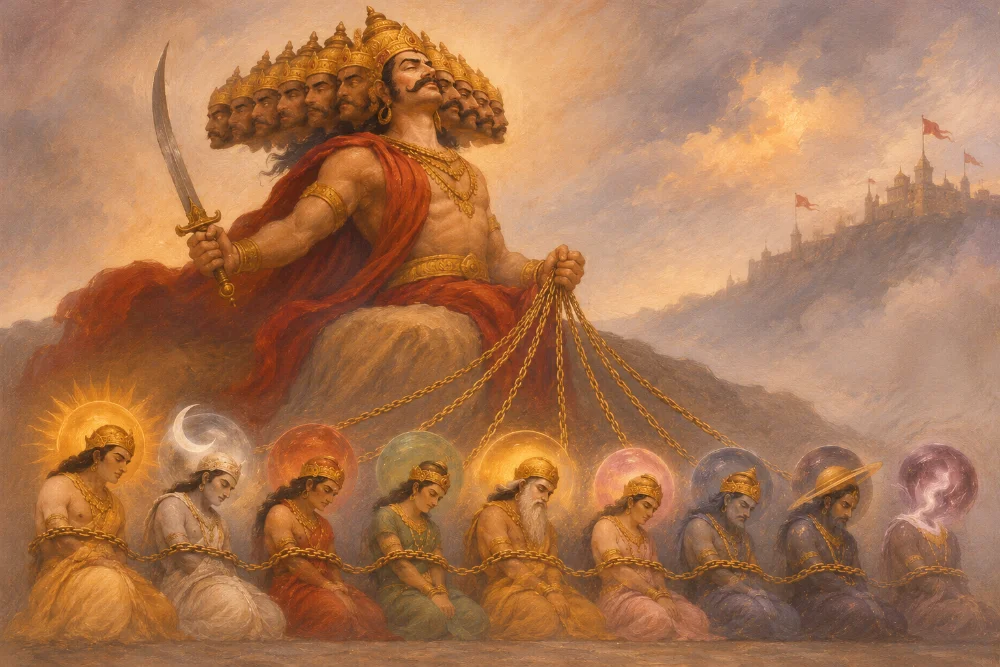

Time occupies a central place in Vedic astrology. A Kundali describes the planetary configuration at the moment of birth, but understanding when its various indications may manifest requires a system of astrological timing. Among the several Dasha systems described in classical Jyotisha, Vimshottari Mahadasha holds a particularly prominent position.
Vimshottari is a Nakshatra-based system that divides a symbolic lifespan of 120 years into nine planetary periods. Each period is governed by one of the nine Grahas: Ketu, Venus, Sun, Moon, Mars, Rahu, Jupiter, Saturn and Mercury. These periods are known as Mahadashas, and each has a prescribed duration.
The system is not merely a calendar that assigns particular years to different planets. It provides a framework for understanding how the planetary configurations of a birth chart become active over time. A planet’s Mahadasha can bring its natural significations, the results of the houses it owns, the matters represented by its placement and the combinations it forms into greater prominence.
To understand Vimshottari Mahadasha, it is therefore necessary to examine its classical foundation, structure, calculation and principles of interpretation.
1. The Classical Foundation of Vimshottari
The principal classical reference for Vimshottari Dasha is the Brihat Parashara Hora Shastra (BPHS), attributed to Maharishi Parashara. Its Dasha chapters describe the planetary periods, their duration, the calculation of the remaining period at birth and the results associated with different planetary periods.
BPHS Chapter 46, commonly titled Vimshottari Dasha, establishes the 120-year cycle and its planetary sequence. Subsequent chapters discuss the results of the Mahadashas and their subordinate periods.
The text identifies Vimshottari as particularly suitable for the present age, traditionally described as Kali Yuga. This establishes its importance within the Parashari system, although classical Jyotisha also preserves other Dasha systems intended for different methods of assessment.
The name Vimshottari is associated with the number 120. Its structure is based on a total of 120 years, distributed among nine planetary rulers in a fixed sequence.
The system begins with Ketu and proceeds through Venus, Sun, Moon, Mars, Rahu, Jupiter, Saturn and Mercury before returning to Ketu. The sequence remains constant, irrespective of the ascendant or the planetary placements in an individual’s Kundali.
2. The Nine Mahadashas and Their Duration
Each of the nine Grahas governs a specific number of years. Together, their periods complete the 120-year Vimshottari cycle.
| Planet | Mahadasha Duration |
|---|---|
| Ketu | 7 years |
| Venus | 20 years |
| Sun | 6 years |
| Moon | 10 years |
| Mars | 7 years |
| Rahu | 18 years |
| Jupiter | 16 years |
| Saturn | 19 years |
| Mercury | 17 years |
| Total | 120 years |
The sequence and duration are fixed. They do not change according to the planet’s dignity, house placement, strength or functional nature in a particular Kundali.
For instance, Venus always governs a 20-year Mahadasha, whether it is exalted, debilitated, placed in a Kendra or associated with malefic planets. What changes is the nature of the results it may deliver.
This distinction is fundamental. The duration of a Mahadasha is a property of the Vimshottari system, while its results depend on the planetary configuration of the individual chart.
3. The Nakshatra Foundation
Vimshottari Mahadasha is determined by the Moon’s position in the Nakshatra division of the zodiac at birth.
The zodiac is divided into 27 Nakshatras, each spanning 13 degrees and 20 minutes. Every Nakshatra is further divided into four Padas, each measuring 3 degrees and 20 minutes.
The nine planetary rulers are assigned to the Nakshatras in groups of three. Each planet governs three Nakshatras, following the same sequence as the Mahadashas.
| Planetary Ruler | Nakshatras |
|---|---|
| Ketu | Ashwini, Magha, Mula |
| Venus | Bharani, Purva Phalguni, Purva Ashadha |
| Sun | Krittika, Uttara Phalguni, Uttara Ashadha |
| Moon | Rohini, Hasta, Shravana |
| Mars | Mrigashira, Chitra, Dhanishtha |
| Rahu | Ardra, Swati, Shatabhisha |
| Jupiter | Punarvasu, Vishakha, Purva Bhadrapada |
| Saturn | Pushya, Anuradha, Uttara Bhadrapada |
| Mercury | Ashlesha, Jyeshtha, Revati |
The Moon’s Nakshatra at birth determines which planetary Mahadasha is operating at the beginning of life.
For example, a person born with the Moon in Rohini begins life in Moon Mahadasha because Rohini is governed by the Moon. A person born with the Moon in Anuradha begins in Saturn Mahadasha.
However, the individual does not necessarily receive the full duration of that Mahadasha. The remaining period is calculated according to how much of the birth Nakshatra is left when the person is born.
This is one of the defining features of Vimshottari.
4. Calculating the Mahadasha Balance at Birth
The Mahadasha balance is determined by the Moon’s exact longitude within its birth Nakshatra.
Each Nakshatra spans 13 degrees and 20 minutes. The portion already traversed by the Moon represents the elapsed part of the Nakshatra, while the remaining portion determines the balance of the planetary period.
The calculation follows this principle:
Remaining Mahadasha = Total Mahadasha Duration x Remaining Nakshatra Arc / Total Nakshatra Arc
Since every Nakshatra measures 13 degrees and 20 minutes, the calculation can be expressed as:
Remaining Mahadasha = Planetary Period x Remaining Nakshatra Fraction
Consider an individual born with the Moon in Ashwini, ruled by Ketu.
Ketu Mahadasha lasts seven years. Suppose the Moon has traversed 25% of Ashwini at birth. The remaining Nakshatra fraction is 75%.
The balance would therefore be:
7 x 75% = 5.25 years.
The individual would begin life with approximately 5 years and 3 months of Ketu Mahadasha remaining, after which Venus Mahadasha would commence.
The calculation is based on the Moon’s precise sidereal longitude. Even a small difference in the birth time or the ayanamsha used can affect the calculated Dasha balance, particularly when the Moon is close to a Nakshatra boundary.
For this reason, accurate birth details and a consistent calculation method are essential.
5. The Structure of Planetary Periods
Vimshottari is organised into several hierarchical levels. The principal period is the Mahadasha, which is subdivided into Antardashas. These are further divided into Pratyantardashas, followed by progressively smaller periods.
The principal levels are:
Mahadasha: The major planetary period, which establishes the broad temporal framework.
Antardasha: The subordinate planetary period operating within a Mahadasha. It introduces the influence of another Graha and helps specify the circumstances through which the major period manifests.
Pratyantardasha: A further subdivision of the Antardasha, providing a more precise timing framework.
Sookshma Dasha: A smaller subdivision used for finer timing.
Prana Dasha: A still smaller subdivision, employed in certain detailed timing methods.
Each level follows the same nine-planet sequence, beginning with the ruler of the period above it.
Understanding Antardasha Calculation
The duration of an Antardasha is proportional to the Mahadasha duration of its ruling planet.
The formula is:
Antardasha Duration = Mahadasha Years x Antardasha Planet Years / 120
For example, during Jupiter Mahadasha, the duration of Venus Antardasha is calculated as:
16 x 20 / 120 = 2.6667 years.
This corresponds to approximately 2 years and 8 months.
The Antardasha sequence begins with the Mahadasha lord itself and then follows the established planetary order.
Thus, Jupiter Mahadasha begins with Jupiter Antardasha, followed by Saturn, Mercury, Ketu, Venus, Sun, Moon, Mars and Rahu.
The same principle applies to the smaller subdivisions.
6. Understanding the Role of a Mahadasha Lord
The most important principle of Vimshottari interpretation is that a planet’s Mahadasha does not produce an identical set of results for everyone.
The planetary ruler must be examined within the context of the individual’s Kundali. Its natural significations are only one part of the assessment.
A planet represents certain matters by its inherent nature. It also governs specific houses through its sign ownership and influences the houses it occupies or aspects. Its associations with other planets can further modify its expression.
Consequently, the same Mahadasha can manifest very differently in two individuals.
Consider Jupiter Mahadasha. Jupiter naturally signifies wisdom, knowledge, teachers, children, Dharma and expansion. However, its functional role depends on the ascendant and the houses it owns.
For one ascendant, Jupiter may govern important Trikona houses and become a significant benefic. For another, it may own houses associated with difficulties or mixed results.
Its placement, dignity, aspects, conjunctions, divisional strength and participation in yogas further determine how its period unfolds.
The planet’s Mahadasha should therefore be judged through the following dimensions:
Natural significations: The inherent matters represented by the planet.
Functional lordship: The houses owned by the planet for the particular ascendant.
House placement: The Bhava occupied by the planet and the areas of life it influences.
Dignity and strength: Its condition in the sign, divisional charts and relevant strength calculations.
Associations and aspects: The influence of other planets through conjunction, aspect and exchange.
Yogas: The auspicious or inauspicious combinations in which the planet participates.
These factors establish the broad potential of a Mahadasha. The Antardasha and relevant transits help determine how that potential becomes activated over time.
7. The Relationship Between Mahadasha and Antardasha
A Mahadasha establishes the broader planetary influence, but its results are not necessarily uniform throughout its entire duration.
The Antardasha lord plays an important role in determining the particular experiences that emerge during a sub-period.
Its relationship with the Mahadasha lord must be examined through natural friendship, functional lordship, house placement, conjunctions, aspects and strength.
A favourable Mahadasha may contain Antardashas that bring challenges, while a difficult Mahadasha may contain sub-periods that produce constructive developments.
For example, a planet that owns the 10th house may activate professional matters during its Antardasha within another planet’s Mahadasha. Whether these developments are favourable depends on the condition of both planets, the 10th house and the overall promise of the Kundali.
It is therefore inaccurate to classify an entire Mahadasha as uniformly favourable or unfavourable without examining its subordinate periods.
Classical texts such as Brihat Parashara Hora Shastra and Phaladeepika discuss the results of these planetary combinations in considerable detail. Their approach reinforces the importance of judging the relationship between the two period lords rather than interpreting each planet independently.
8. The Role of Divisional Charts and Planetary Strength
The Rashi chart, or D1, remains the foundation of Kundali interpretation. However, the condition of a Mahadasha lord should not be determined solely through its placement in the Rashi chart.
Parashari astrology employs sixteen divisional charts, collectively known as Shodashavarga. Each division provides additional insight into particular dimensions of life and planetary strength.
The Navamsa, or D9, is particularly important for examining the deeper condition of planets and matters associated with Dharma and marriage. The Dashamsa, or D10, is relevant to profession and public activity, while other divisions provide additional areas of assessment.
The strength of a planet is also evaluated through Shadbala, a sixfold system comprising positional, directional, temporal, motional, natural and aspectual strength.
Vimshopaka Bala offers another measure by assessing planetary dignity across selected divisional charts.
These methods help establish whether a planet possesses the strength to deliver its indications. However, strength and auspiciousness are not interchangeable. A powerful planet can deliver difficult results if its functional lordship and associations indicate such outcomes.
Similarly, a planet with limited strength may still produce favourable developments in areas supported by the Kundali.
9. The Influence of Planetary Transits
Vimshottari Mahadasha provides the principal framework for planetary timing, while Gochar, or planetary transit, offers an additional layer of temporal interpretation.
The movements of Jupiter, Saturn and the lunar nodes are particularly important in many traditional methods of transit assessment. Their positions are examined in relation to the natal Moon, Lagna, relevant houses and the planets governing the operating periods.
Transits can activate or modify the indications of a Mahadasha and Antardasha. They may coincide with the manifestation of a natal promise or introduce temporary support and obstruction.
However, transits should not be interpreted independently of the birth chart. A favourable transit does not automatically guarantee an event that lacks sufficient natal support.
The Dasha system and Gochar are complementary methods. The former identifies the operating planetary period, while the latter helps refine the timing and circumstances of its manifestation.
10. Is Every Mahadasha Good or Bad?
One of the most common misconceptions about Vimshottari is that certain planetary periods are universally favourable while others are inherently difficult.
No planet’s Mahadasha can be classified in this manner without considering the individual’s Kundali.
The natural nature of a planet, its functional lordship, placement, dignity, strength and associations all contribute to the results of its period.
Even a planet traditionally considered benefic can produce challenging experiences if it is functionally adverse or afflicted. Likewise, a natural malefic may produce significant achievements when it owns favourable houses and is well placed.
Another misconception is that a Mahadasha represents only one dominant theme. In reality, a planet can govern several houses and signify multiple areas of life. Its period may therefore bring developments across different dimensions, sometimes simultaneously.
The interpretation must account for this complexity rather than reduce a planetary period to a handful of keywords.
Conclusion
Vimshottari Mahadasha provides a systematic framework for understanding the timing of planetary results in Vedic astrology. Its 120-year structure, beginning with the planetary ruler of the Moon’s birth Nakshatra, establishes the sequence through which the nine Grahas govern successive periods of life.
Yet the true significance of a Mahadasha lies not in its duration or planetary name, but in the condition of its ruler within the individual’s Kundali.
The same planet can produce markedly different experiences depending on its house ownership, placement, dignity, strength and associations. Its Antardasha relationships and the prevailing transits further determine how its indications unfold.
Vimshottari should therefore be approached as a method of interpreting the temporal activation of a Kundali, not as a fixed sequence of events assigned to nine planets.
To understand any Mahadasha, one must first understand the planet governing it, the houses it influences and the promises contained within the birth chart. Only then can the period be interpreted with the depth and precision that classical Jyotisha demands.
Frequently Asked Questions About Vimshottari Dasha
What is Vimshottari Dasha in Vedic astrology?
Vimshottari Dasha is the primary planetary period system used in Vedic astrology (Jyotish) to time events in a person’s life. Based on a full cycle of 120 years, it divides human life into sequential planetary periods (Mahadashas) ruled by the nine Grahas, showing when specific karmic promises in the birth chart become active.
How is the starting Vimshottari Dasha calculated?
The starting Mahadasha at birth is determined by the exact longitudinal degree of the natal Moon (Chandra) within its Nakshatra (lunar mansion). Each of the 27 Nakshatras is ruled by one of the nine planets, and the balance of the first Dasha depends on how much of that Nakshatra the Moon has yet to traverse at the moment of birth.
What is the sequence and duration of each planetary Mahadasha?
The 120-year cycle follows a fixed planetary order: Ketu (7 years), Venus (20 years), Sun (6 years), Moon (10 years), Mars (7 years), Rahu (18 years), Jupiter (16 years), Saturn (19 years), and Mercury (17 years). Regardless of which planet starts the cycle at birth, every subsequent period proceeds strictly in this sequence.
What are Mahadasha, Antardasha, and Pratyantardasha?
Vimshottari Dasha works in nested layers for precise timing. Mahadasha is the major multi-year planetary period setting the broad life theme. Antardasha (Bhukti) is the sub-period within a Mahadasha lasting months or a few years, while Pratyantardasha is a finer sub-sub-period lasting weeks or months that pinpoints exact event windows.
How do astrologers judge whether a Dasha period will give positive or challenging results?
A planet does not deliver good or bad results solely because it is a natural benefic or malefic. Astrologers examine the Dasha lord’s functional nature for the rising sign (Lagna), its house ownership, placement, dignity (exaltation or debilitation), conjunctions, and planetary aspects (Drishti), alongside current transits (Gochara) to understand the exact nature of the period.
Classical References
- Brihat Parashara Hora Shastra: Chapter 46, Vimshottari Dasha; Chapter 47, Dasha-related timing principles; subsequent chapters on Mahadasha and Antardasha results.
- Phaladeepika by Mantreswara: Chapters 19 and 20, planetary periods and Bhukti results.
- Saravali by Kalyana Varma: Planetary characteristics, house results and astrological combinations.
- Jataka Parijata by Vaidyanatha Dikshita: Planetary strength, combinations and Dasha interpretation.
Note: Chapter and verse numbering may vary between printed editions and recensions of these texts. The references above identify the relevant textual sections rather than implying identical numbering across all editions.