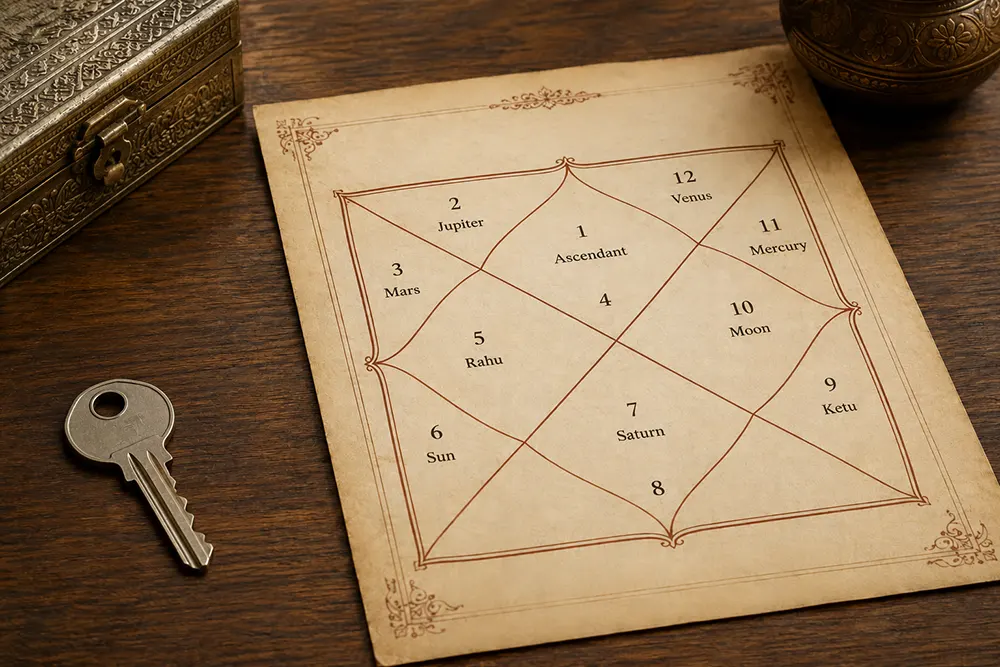
Kundali Milan, traditionally known as Ashtakoota Guna Milan, is one of the most widely used methods of assessing compatibility between two individuals before marriage in Vedic astrology. This Kundali Matching Calculator evaluates compatibility based on the Nakshatras of the bride and groom and calculates their Ashtakoota Guna Milan score out of 36.
The eight Kootas examine different dimensions of compatibility, including temperament, mutual attraction, mental harmony, family life, health and progeny. However, the final Guna score should be understood as an important traditional compatibility indicator rather than a complete judgment of married life. A deeper Vedic marriage analysis also considers the individual Kundalis and relevant planetary factors.
Check Your Marriage Compatibility
Vedic Matchmaking
Ashtakoota Guna Milan
Vedic Matchmaking
Name 1 & Name 2
| Koota (Category) | Prediction | Score |
|---|
Unlock Premium tools and Advanced Astrology with Astro Assured Pro
What is Kundali Milan?
Kundali Milan is the traditional Vedic practice of comparing the birth stars, or Janma Nakshatras, of two individuals to assess their compatibility for marriage. The most commonly used system is Ashtakoota Guna Milan, in which eight different Kootas are evaluated and assigned a combined maximum of 36 Gunas.
The calculation is primarily based on the Moon’s Nakshatra and Rashi. Since the Moon represents the mind, emotions and patterns of response in Vedic astrology, its position forms an important foundation for traditional compatibility assessment.
Each Koota addresses a particular aspect of compatibility. Some examine temperament and mental harmony, while others relate to attraction, health, family life and progeny. The resulting score provides a structured way to understand the basic compatibility between two Nakshatras.
At the same time, Kundali Milan is not limited to the number of Gunas obtained. A particular score can arise from many different combinations of Kootas, and therefore the individual Koota results can be as important as the total score.
The 8 Kootas of Ashtakoota Guna Milan
Ashtakoota Guna Milan consists of eight Kootas with a combined maximum of 36 Gunas.
| Koota | Maximum Gunas | What It Represents |
|---|---|---|
| Varna | 1 | Temperament, values and spiritual compatibility |
| Vashya | 2 | Mutual attraction, influence and interpersonal dynamics |
| Tara | 3 | Birth-star compatibility, fortune and general well-being |
| Yoni | 4 | Physical attraction and sexual compatibility |
| Graha Maitri | 5 | Mental compatibility, friendship and communication |
| Gana | 6 | Temperament, nature and behavioural compatibility |
| Bhakoot | 7 | Emotional harmony, family life and prosperity |
| Nadi | 8 | Health, physiological compatibility and progeny |
| Total | 36 | Overall Ashtakoota compatibility |
The Kootas carry different weights. Nadi, Bhakoot and Gana, for example, contribute considerably more to the final score than Varna. Therefore, two couples obtaining the same total score may have very different compatibility profiles depending on where their Gunas are gained or lost.
Understanding the Ashtakoota Score
The traditional Ashtakoota system produces a score between 0 and 36 Gunas. A higher score generally indicates greater compatibility within the specific factors assessed by Ashtakoota Guna Milan. However, the score should be interpreted along with the individual Kootas and other astrological factors rather than treated as an absolute measure of marital success.
For a practical interpretation, the score can be broadly understood as follows:
| Ashtakoota Score | Compatibility | Brief Prediction |
|---|---|---|
| Less than 18 | Poor | The Nakshatra compatibility is relatively low and deserves careful examination of the individual Kootas and complete Kundalis. |
| 18 to 24 | Average | Basic compatibility is present, although certain areas may require closer consideration. |
| 24 to 30 | Good | The Nakshatras show a generally strong level of compatibility across the Ashtakoota factors. |
| 30 to 36 | Excellent | The Nakshatras show a very high degree of compatibility according to the Ashtakoota system. |
These ranges are broad interpretive categories, not rigid rules that determine whether a marriage should or should not take place. In particular, a lower score does not automatically indicate an unsuitable marriage, just as a high score does not guarantee a harmonious married life.
The distribution of the score matters. A match with 25 Gunas can have a very different astrological profile from another match with the same 25 Gunas. The specific Kootas involved, particularly Nadi and Bhakoot, should therefore be examined alongside the total score.
Other Factors Considered in Vedic Marriage Matching
Ashtakoota Guna Milan provides a traditional starting point, but complete Vedic marriage matching involves considerably more than comparing Nakshatras.
7th House and 7th Lord
The 7th house is the principal house of marriage and partnerships. Its lord, occupants, aspects and overall strength are therefore important when examining marital prospects. The condition of the 7th house in both Kundalis can provide information that cannot be obtained from Guna Milan alone.
Manglik Dosha
Manglik Dosha, or Kuja Dosha, is traditionally assessed from the position and influence of Mars in the Kundali. Its interpretation involves specific rules and exceptions, and the presence of Manglik Dosha should not be evaluated simply by identifying Mars in a particular house without considering the complete chart.
Venus and Jupiter
Venus is an important natural significator of relationships, affection and marital happiness, while Jupiter has important significations relating to marriage, wisdom, family and dharma. Their dignity, house placement, lordship and associations should be considered within the context of each individual Kundali.
Navamsha
The Navamsha (D9) is one of the most important divisional charts used in Vedic astrology for examining marriage and the deeper strength of planets. The condition of the 7th house, 7th lord and relevant planets in the Navamsha can add considerable depth to a marriage analysis.
Dasha and Timing
Planetary Dashas can also be relevant, particularly when assessing the timing of marriage and significant periods in married life. The compatibility of two individuals cannot be fully understood without considering how their respective planetary periods may operate over time.
Nadi Dosha and Bhakoot Dosha
Nadi Dosha and Bhakoot Dosha receive particular attention in Kundali Milan because of the relatively high number of Gunas assigned to these Kootas.
Nadi carries 8 Gunas and is traditionally associated with health, physiological compatibility and progeny. When both individuals have the same Nadi, the Ashtakoota system may assign zero points for Nadi. This is commonly referred to as Nadi Dosha. Traditional Vedic astrology also describes various conditions and exceptions that can modify or cancel its significance, so it should not be interpreted solely from the numerical score.
Bhakoot carries 7 Gunas and is traditionally associated with emotional compatibility, family life, prosperity and the overall flow of the relationship. Certain Rashi combinations can result in what is known as Bhakoot Dosha. As with Nadi, the presence of a Bhakoot Dosha should be examined in the context of the complete Kundalis and relevant cancellation or mitigating factors.
Therefore, neither Nadi Dosha nor Bhakoot Dosha should automatically be treated as an isolated prohibition against marriage. Their significance depends on the broader astrological context.
Kundali Matching for Marriage: What Should You Actually Look At?
A meaningful Vedic marriage analysis should proceed beyond the final number displayed by Guna Milan.
First, examine the overall Ashtakoota score and the individual Kootas to understand the basic Nakshatra compatibility. Then identify whether significant considerations such as Nadi Dosha or Bhakoot Dosha are present and examine their traditional exceptions and mitigating factors.
The analysis can then be expanded to the 7th house, 7th lord, Mars, Venus, Jupiter and Navamsha, followed by relevant planetary Dashas and other chart-specific factors. This broader approach helps distinguish between a simple Guna score and a complete astrological assessment of marriage compatibility.
In other words, Kundali Milan is a starting point, not the entirety of Kundali analysis. The 36-Guna system provides a structured traditional framework, while the complete Kundalis provide the wider astrological context in which that result should be understood.
Conclusion
Kundali Milan offers a traditional and systematic method of examining compatibility between two Nakshatras before marriage. The Ashtakoota Guna Milan system evaluates eight different dimensions and produces a score out of 36, providing a useful first layer of compatibility analysis.
However, marriage is a complex area of Vedic astrology, and the Guna score alone cannot represent every factor present in two Kundalis. Nadi, Bhakoot, Manglik Dosha, the 7th house, planetary strength, Navamsha and Dashas may all add important context to the assessment.
If you want a deeper interpretation of your compatibility beyond the Ashtakoota score, you can connect with our astrologer for a Personalised Kundali Matching consultation.
Frequently Asked Questions
What is Kundali Milan?
Kundali Milan is the traditional Vedic practice of comparing two individuals’ birth stars and other astrological factors to assess compatibility for marriage. The most widely used method is Ashtakoota Guna Milan, which evaluates eight Kootas for a maximum of 36 Gunas.
How many Gunas should match for marriage?
Traditionally, 18 out of 36 Gunas is commonly considered a basic threshold for compatibility. However, the total score should not be interpreted in isolation. The individual Kootas and complete Kundalis can provide important additional information.
Is 24 Gunas a good Kundali match?
A score of 24 Gunas falls within the very good compatibility range used by this calculator. Nevertheless, the specific distribution of the Gunas, Nadi and Bhakoot considerations, and the broader Kundalis should also be examined.
Is 30 Gunas a good match?
Yes, 30 Gunas represents a high level of compatibility within the Ashtakoota system. However, a high Guna score does not by itself provide a complete assessment of marriage compatibility.
What if Kundali Milan is below 18 Gunas?
A score below 18 indicates relatively low compatibility according to the Ashtakoota system. It does not, by itself, establish that a marriage will be unsuccessful. The individual Kootas, Doshas, cancellation factors and complete Kundalis should be examined before reaching a conclusion.
What is Nadi Dosha?
Nadi Dosha is a traditional consideration in Ashtakoota Guna Milan that arises when the Nakshatra-based Nadi relationship of two individuals results in no Nadi points. Nadi is assigned 8 out of the total 36 Gunas and is traditionally associated with health, physiological compatibility and progeny.
What is Bhakoot Dosha?
Bhakoot Dosha is a traditional consideration arising from certain Rashi relationships in Ashtakoota Guna Milan. Bhakoot carries 7 Gunas and is traditionally associated with emotional compatibility, family life and prosperity.
Is Nadi Dosha always harmful?
No single factor in Kundali Matching should automatically be interpreted without context. Traditional Vedic astrology describes various exceptions and cancellation conditions for Nadi Dosha, and the complete Kundalis should be examined before assessing its significance.
Is Guna Milan enough for marriage?
Guna Milan is an important traditional component of Vedic marriage matching, but it is not the complete analysis. The 7th house, 7th lord, Mars, Venus, Jupiter, Navamsha, Dashas and other relevant factors can provide additional insight into marital compatibility.
Does Kundali Matching require Nakshatras?
The Ashtakoota system is fundamentally based on the Janma Nakshatras and Rashis associated with the Moon. This calculator specifically evaluates compatibility using the Nakshatras of the bride and groom.
Can Kundali Matching predict married life?
Kundali Matching can provide a traditional astrological assessment of compatibility, but the Ashtakoota score alone cannot predict every aspect of married life. A complete analysis requires examination of both individual Kundalis and relevant planetary factors.
Do I need the exact birth time for Kundali Matching?
For a Nakshatra-based Ashtakoota calculation, the accuracy of the birth details is important because the Moon’s Nakshatra and Rashi form the basis of the calculation. For a complete Kundali Matching analysis, accurate birth time becomes even more important because houses, Ascendant and divisional charts also need to be assessed.