An eclipse is one of the most fascinating celestial events observed from Earth. While astronomy explains it as the alignment of the Sun, Moon, and Earth, Vedic astrology views it through a deeper symbolic lens. Eclipses are closely associated with Rahu and Ketu, the lunar nodes that represent karmic forces, transformation, and life’s unseen patterns. For centuries, eclipses have been regarded as spiritually significant periods that encourage reflection, self-awareness, and inner growth.
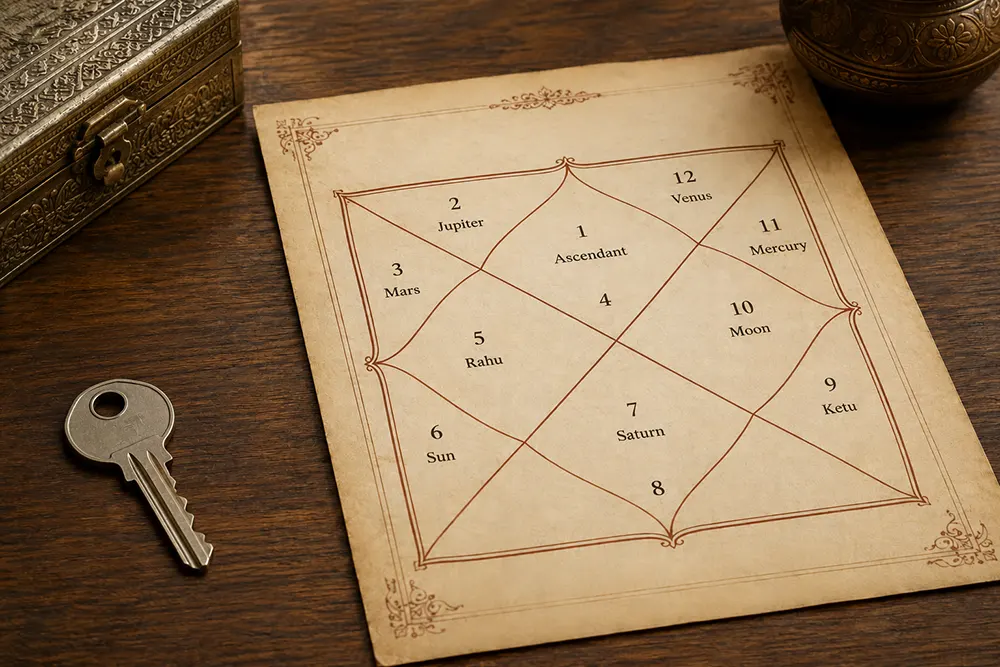
Whether it is a Solar Eclipse or a Lunar Eclipse, every eclipse carries its own astrological significance depending on the zodiac sign, Nakshatra, planetary influences, and your unique Kundali. Rather than affecting everyone in the same way, an eclipse acts like a spotlight, illuminating specific areas of life that may require attention, change, or growth. In this guide, you’ll learn what eclipses mean in Vedic astrology, why they matter, their general effects, traditional practices, and how to find upcoming and past eclipses.
Upcoming Eclipses 2026
What is an Eclipse?
An eclipse occurs when the Sun, Moon, and Earth align in such a way that one celestial body casts its shadow on another. There are two primary types of eclipses.
A Solar Eclipse occurs during a New Moon when the Moon passes between the Earth and the Sun, partially or completely blocking the Sun’s light. A Lunar Eclipse occurs during a Full Moon when the Earth comes between the Sun and the Moon, causing the Earth’s shadow to fall upon the Moon.
From a scientific perspective, eclipses are predictable astronomical events governed by orbital mechanics. Astronomers can accurately calculate their timings centuries in advance.
Vedic astrology accepts this astronomical explanation while adding another layer of symbolic interpretation. Rather than focusing solely on the physical alignment, it studies the astrological meaning of the eclipse, including the zodiac sign, Nakshatra, planetary relationships, and the area of the Kundali being activated. These factors help astrologers understand the themes and life experiences that an eclipse may symbolize.
Solar Eclipse vs Lunar Eclipse
| Feature | Solar Eclipse | Lunar Eclipse |
|---|---|---|
| Moon Phase | New Moon | Full Moon |
| Alignment | Moon between Earth and Sun | Earth between Sun and Moon |
| What Gets Obscured | Sun | Moon |
| Visibility | Visible only from specific regions | Visible from the entire night side of Earth |
| Duration | Usually a few minutes (totality) | Can last several hours |
| Astrological Focus | Identity, purpose, authority, new beginnings | Emotions, relationships, inner transformation |
| Associated Luminary | Sun | Moon |
Rahu and Ketu’s Role in Eclipses
In Vedic astrology, eclipses are inseparably connected with Rahu and Ketu, the north and south lunar nodes. Although they are not physical planets, they are mathematically calculated points where the Moon’s orbit intersects the apparent path of the Sun.
This is precisely why eclipses do not occur during every New Moon or Full Moon. An eclipse can only take place when the Sun and Moon align close to one of these lunar nodes. When this alignment happens, the conditions become favourable for a Solar or Lunar Eclipse.
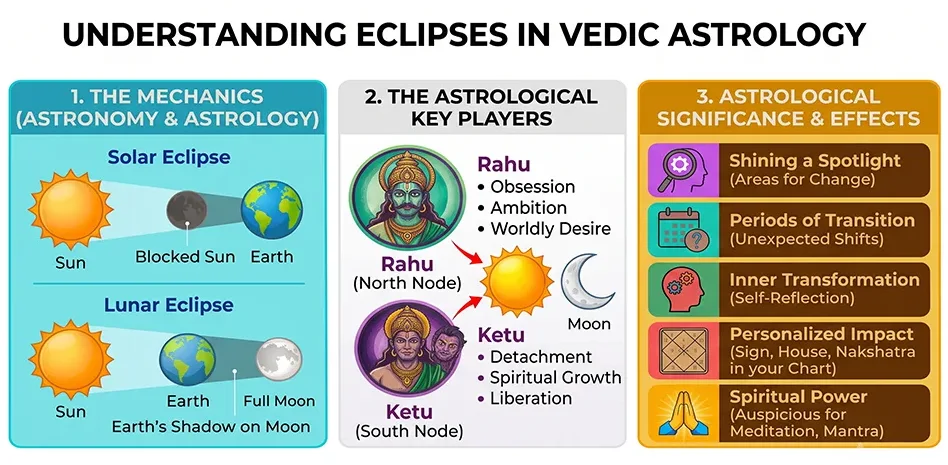
The association of eclipses with Rahu and Ketu also has a rich mythological foundation. According to the story of Samudra Manthan, the demon Swarbhanu disguised himself among the Devas to drink the nectar of immortality. Lord Vishnu, in the form of Mohini, recognized the deception and severed his head with the Sudarshan Chakra. Having already consumed the nectar, both the head and body survived, becoming Rahu and Ketu. It is said that Rahu periodically swallows the Sun or the Moon in revenge, giving rise to eclipses.
Rather than treating this story as a literal explanation, many astrologers view it as a symbolic representation of eclipses. Rahu represents obsession, illusion, ambition, and worldly desires, while Ketu signifies detachment, spiritual awakening, and liberation. During an eclipse, these deeper themes often become more noticeable in individual and collective experiences.
Eclipse at a Glance
| Aspect | Vedic Astrology Interpretation |
|---|---|
| Associated Nodes | Rahu and Ketu |
| Types | Solar Eclipse and Lunar Eclipse |
| Occurs During | New Moon or Full Moon near the lunar nodes |
| Represents | Transformation, karmic lessons, heightened awareness |
| Duration of Influence | Depends on the eclipse and the individual’s Kundali |
| Key Factors | Zodiac sign, Nakshatra, house placement, Dasha, transits |
| Spiritual Practices | Meditation, mantra chanting, prayer, charity |
Why Eclipses Matter in Vedic Astrology
Eclipses are considered significant because they often coincide with periods of transition, heightened awareness, and changing circumstances. They are viewed as moments when hidden matters become visible, long-standing patterns demand attention, or important decisions begin to unfold.
Astrologically, an eclipse gains importance when it activates sensitive areas of a person’s Kundali. The zodiac sign, Nakshatra, house placement, planetary conjunctions, current Dasha, and ongoing transits all influence how its symbolism may manifest. For one individual, an eclipse may coincide with career developments, while another may experience changes in relationships, finances, education, or spiritual pursuits.
Eclipses are also regarded as spiritually powerful periods. Many traditions encourage meditation, mantra chanting, prayer, and self-reflection during this time, believing that the mind becomes more inwardly focused. Whether one follows these traditions from a religious, spiritual, or contemplative perspective, an eclipse often serves as an opportunity to pause, observe, and reconnect with oneself.
It is equally important to avoid fear-based interpretations. An eclipse is not automatically good or bad, nor does it guarantee dramatic life events. Like any astrological factor, it is one piece of a much larger picture. A meaningful interpretation always considers the complete Kundali rather than drawing conclusions from the eclipse alone.
General Effects of an Eclipse
Every eclipse is unique, and its influence depends on multiple astrological factors. However, certain themes are commonly associated with eclipses in Vedic astrology.
Many people experience periods of change or transition around eclipses. Existing situations may reach a turning point, hidden information may surface, or a fresh perspective may emerge regarding an important area of life. Sometimes these developments unfold immediately, while in other cases they gradually reveal themselves over the following weeks or months.
Emotionally, eclipses can encourage introspection. People often find themselves reflecting on relationships, goals, habits, or unresolved issues. This increased awareness may lead to important decisions or inspire personal growth.
Professionally, an eclipse may coincide with changing responsibilities, new opportunities, or the conclusion of an existing phase. In relationships, it can bring greater clarity, stronger commitments, or the realization that certain dynamics need to evolve. Spiritually, eclipses are often associated with deeper contemplation and the willingness to let go of limiting beliefs.
The specific effects depend on where the eclipse falls in your Kundali. Astrologers carefully examine the zodiac sign, Nakshatra, house placement, proximity to natal planets, current Dasha, and planetary transits before forming any interpretation. For this reason, generalized eclipse predictions should always be viewed as broad themes rather than fixed outcomes.
Factors That Determine Eclipse Effects
| Factor | Why It Matters |
|---|---|
| Zodiac Sign | Indicates the area of experience being emphasized |
| Nakshatra | Adds a deeper psychological and karmic layer |
| House Placement | Shows which part of life is activated |
| Conjunctions | Modifies the eclipse’s influence on planets |
| Current Dasha | Determines whether eclipse themes are likely to become prominent |
| Planetary Transits | Can strengthen or soften the overall effects |
Traditional Practices During an Eclipse
Across India and many other cultures influenced by Vedic traditions, eclipses have long been observed with specific spiritual practices. While customs vary between regions, families, and lineages, the underlying intention is usually one of purification, mindfulness, and devotion.
Many people spend the eclipse engaged in mantra chanting, meditation, prayer, or reading sacred texts. Since external activities are often minimized, the period is viewed as favourable for introspection and spiritual discipline.
Some traditions recommend avoiding meals during the eclipse, particularly food prepared before it begins. Others encourage taking a bath after the eclipse, cleaning the home or altar, and making charitable donations. These practices are rooted in traditional beliefs and continue to be followed by many households today.
It is important to recognize that not every tradition follows the same guidelines. Modern practitioners often adapt these customs according to their personal beliefs, health considerations, and family traditions. Rather than viewing them as rigid rules, they may be understood as time-honoured practices intended to cultivate awareness, discipline, and gratitude.
Common Traditional Practices During an Eclipse
| Practice | Traditional Purpose |
|---|---|
| Meditation | Improve focus and inner awareness |
| Mantra Chanting | Spiritual discipline and devotion |
| Prayer | Seek blessings and cultivate mindfulness |
| Fasting | Traditional observance followed in many households |
| Charity | Express gratitude and compassion |
| Bath After Eclipse | Symbolic purification according to tradition |
Frequently Asked Questions
Do eclipses affect everyone?
Eclipses influence everyone collectively as astronomical events, but their astrological significance varies from person to person depending on the complete Kundali.
What is the difference between a Solar and Lunar Eclipse?
A Solar Eclipse occurs during a New Moon when the Moon blocks the Sun, while a Lunar Eclipse occurs during a Full Moon when the Earth’s shadow falls on the Moon.
Why are Rahu and Ketu associated with eclipses?
In Vedic astrology, eclipses occur when the Sun and Moon align near the lunar nodes, known as Rahu and Ketu. Their mythological symbolism further strengthens this association.
Is every New Moon or Full Moon an eclipse?
No. An eclipse only occurs when the Sun and Moon are positioned close enough to Rahu or Ketu for the necessary alignment to take place.
Are eclipses considered inauspicious?
Not necessarily. An eclipse is generally viewed as a period of heightened sensitivity and transformation rather than something inherently auspicious or inauspicious.
Can I meditate during an eclipse?
Yes. Many spiritual traditions consider an eclipse to be a favourable time for meditation, mantra chanting, prayer, and self-reflection.
Why do some people avoid eating during an eclipse?
Avoiding food during an eclipse is a traditional practice followed in many households. The custom has cultural, spiritual, and Ayurvedic roots, although practices differ between traditions.
Does an eclipse affect my Moon sign or Ascendant?
It can, particularly if the eclipse occurs in the same sign or activates important houses or planets in your Kundali. A complete chart analysis is needed for accurate interpretation.
How can I know whether an eclipse is important for me?
The best way is to examine the eclipse in relation to your birth chart. Our Eclipse Finder helps you explore upcoming and past eclipses, while a detailed Kundali analysis provides personalized insights.
Final Thoughts
Eclipses have fascinated humanity for thousands of years, inspiring scientific curiosity, mythological stories, and profound spiritual traditions. In Vedic astrology, they are viewed as meaningful celestial events that invite greater awareness rather than fear. Their significance lies not merely in the astronomical phenomenon itself, but in the symbolic messages they may reveal within the larger framework of an individual’s Kundali.
Whether you are exploring eclipses for spiritual growth, astrological research, or simple curiosity, remember that no eclipse should be interpreted in isolation. The zodiac sign, Nakshatra, planetary positions, Dasha, and the complete Kundali together determine its true significance. By understanding these factors, eclipses become valuable opportunities for reflection, learning, and personal evolution rather than sources of uncertainty.